








It’s amazing how important semantics have become to Republicans engaged in the health care fight. It started in March with a strange fight over the nuanced meaning of the word “everybody.”
More recently, GOP officials have been reduced to insisting that taking hundreds of billions of dollars out of Medicaid shouldn’t ever be described as a “cut.”
All of which brings us to the spirited, ongoing dispute about whether the tens of millions of Americans who’d lose their health coverage as a result of the Republican plan would really be “choosing” to go without. From TPM’s summary:
As Senate Republicans lurch towards repealing the Affordable Care Act, party leaders and the Trump administration are pushing a new line about the projection that their bill would strip 22 million people of their health insurance over the next decade: that many or most of those people would be exercising their freedoms and dropping coverage by choice.
“If you’re not going to force people to buy something they don’t want, then they won’t buy it,” House Speaker Paul Ryan (R-WI) said on Fox News. “So it’s not that people are getting pushed off a plan. It’s that people will choose not to buy something they don’t like or want.”
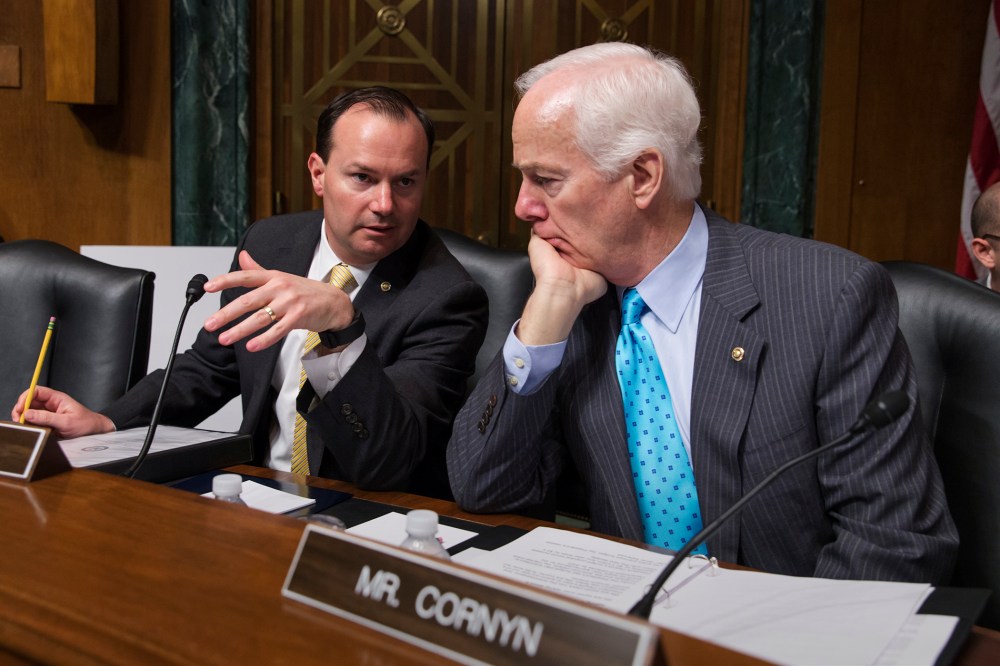
Senate Majority Whip John Cornyn (R-Texas) has been especially enthusiastic about pushing the “choice” argument. The Republican leader doesn’t dispute the Congressional Budget Office’s findings that the GOP bill would leave 22 million Americans uninsured; rather, Cornyn has tried to reframe this as some kind of positive.
Those tens of millions of Americans, as the Texas senator sees it, will simply “choose” not to have health security — because Republicans are promoting “freedom.”
Just so we’re clear, Cornyn and Paul Ryan aren’t kidding. This isn’t some kind of strange attempt at dark humor or a satirical attempt to make Republicans appear cartoonishly cruel.
To appreciate why the “choice” argument is so hard to take seriously, let’s circle back to a piece from March, when the Congressional Budget Office pointed to a hypothetical, 64-year-old American with an annual income of $26,500. Under “Obamacare,” the CBO found, he’d pay $1,700 in premiums. Under the Republican alternative, that out-of-pocket cost would rise to $14,600.
At that point, there’s obviously no way that American would buy insurance. According to GOP rhetorical rules, however, we’re not supposed to say that consumer “lost” his coverage, or had his coverage “taken away.” Instead we’re supposed to say, thanks to Republican-imposed “freedom,” that American would “choose” to go without. Of course, in reality, that consumer may want health security. But if it’s prohibitively expensive, the “choice” has effectively, if not literally, been taken away. To be sure, not every Republican thinks this way. A variety of GOP lawmakers, most notably in the Senate, recoiled in response to the Congressional Budget Office’s score. But this only contributes to the broader incoherence of the Republicans’ health care pitch. As Ezra Klein put it today, in reference to Cornyn, “A sitting US senator celebrating Americans’ freedom to not be able to afford health insurance sounds like a socialist satire of American values. But it also exposes the deepest problem afflicting the GOP’s health care effort: There is no clarity within the Republican Party on what its health bill is meant to achieve. Top Republicans can’t even agree on whether de-insuring tens of millions of people is a moral failing or a bold advance for freedom!”
Steve Benen is a producer for "The Rachel Maddow Show," the editor of MaddowBlog and an MS NOW political contributor. He's also the bestselling author of "Ministry of Truth: Democracy, Reality, and the Republicans' War on the Recent Past." Recommended


