










It’s a phrase most Americans have probably never heard of or even thought about: “Senate organizing resolution.” Ordinarily, it’d be a straightforward agreement among senators about how the chamber will function over the course of the Congress.
But in 2021, there’s nothing ordinary about our political conditions.
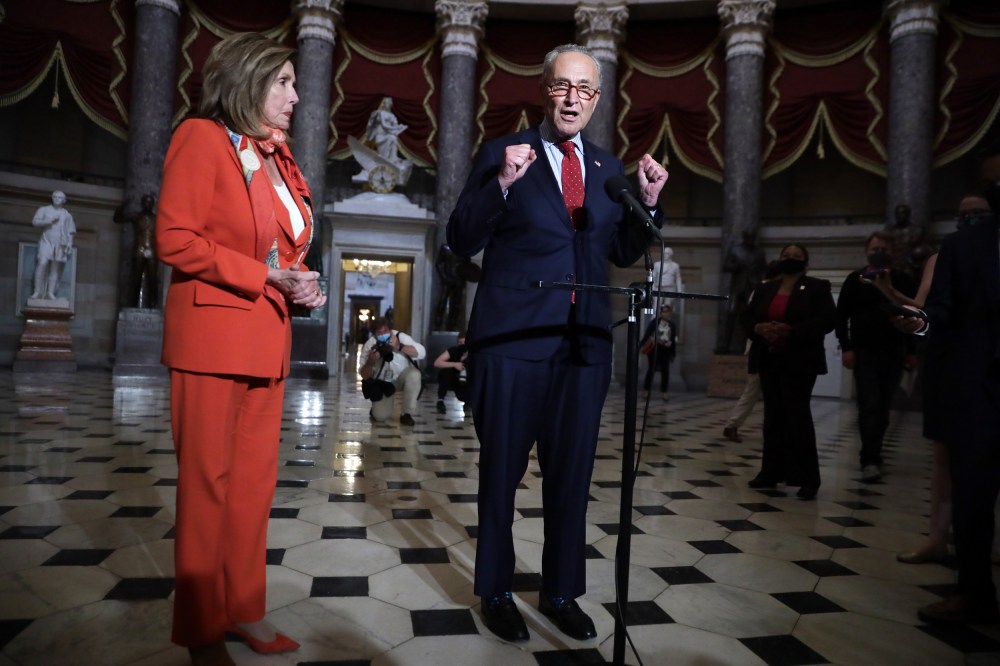
As of a couple of days ago, the Senate is evenly divided — each party now has a 50-member conference — but Democrats enjoy an effective majority because Vice President Kamala Harris tips the scales. It’s why Sen. Chuck Schumer (D-N.Y.) is the new Senate majority leader.
The expectation was that the chamber would function the same way it did 20 years ago, which is the last time there was a 50-50 Senate, but this week, Senate Minority Leader Mitch McConnell (R-Ky.) said the old template is no longer good enough. The top GOP senator is refusing to endorse a power-sharing agreement — threatening to filibuster the organizing resolution — unless Schumer agrees in advance that Democrats will not eliminate legislative filibusters over the next two years.
Or put another way, McConnell is effectively telling Schumer, “If you won’t let me block your agenda with filibusters, I’ll block Democrats from controlling the Senate through a filibuster.”
It serves as a striking reminder: the political world’s spotlight has turned to the future of the Senate’s filibuster rule. What was once considered a relatively fringe idea — returning the Senate to its traditions as a majority-rule institution — has gone mainstream.
Indeed, the New York Times‘ David Brooks, a prominent center-right observer and a pundit who’s earned a reputation for steadfast moderation, wrote about efforts to “break the partisan logjam” in D.C. His new column added:
If this doesn’t work and Republicans go into full obstruction mode, Democrats should absolutely kill the filibuster.
What’s striking about this isn’t the idea; it’s the source. If David Brooks thinks Democrats should “absolutely kill the filibuster” in response to Republican obstructionism, it’s emblematic of a political debate that’s changing quickly.
As recently as 2017, for example, Sen. Sherrod Brown (D-Ohio) signed a bipartisan letter insisting the legislative filibuster must remain intact. A few months ago, the Ohio Democrat declared, “We’ve got to eliminate the filibuster.”
McConnell appears mindful of these prevailing winds, which helps explain his hardball tactics on the organizing resolution.
Of course, with Brooks’ framing in mind, there’s no real question as to whether Republicans will “go into full obstruction mode”; they already have. Literally on Joe Biden’s first full day in the White House, GOP senators said they would, en masse, reject his economic relief package and his immigration reform proposal, and there’s no reason to believe the party will adopt a more constructive posture in the coming months.
The question is, what are Democrats prepared to do about it?
From the White House’s perspective, there are some meaningful steps the new president can take on his own, and we’ve already seen Biden take executive actions to advance his priorities.
But there are significant limits to policymaking without Congress. The Democratic agenda includes a great many worthwhile ideas, which if approved, would be popular and effective. Nearly all of those ideas will die unless they (a) convince 10 Senate Republicans to break ranks and support ambitious progressive proposals; or (b) reform the Senate rules and return it to a majority-rules institution.
To be sure, it’s a complex debate. Sen. Joe Manchin (D-W.Va.), Congress’ most conservative Democrat, has said he’s strongly against changing the existing filibuster, and without his support, reform efforts are over before they start. What’s more, there are other Senate Dems who quietly worry about the long-term consequences of not being able to block radical far-right ideas the next time Republicans control the levers of federal power. There are related nuances concerning GOP structural advantages in the Senate, and the possible expansion of the chamber by adding new states to the union. And while each of these elements matter, there are core truths that are inescapable: The Senate does not and cannot function as an effective legislative body under its current rules. Without a functioning Senate, federal policymaking has turned sclerotic in recent decades, and the problem will persist indefinitely without reforms. Voters have put Democrats in charge of the White House, Senate, and House for the first time in a decade, and as Ezra Klein explained well yesterday, if the party fails to produce impressive results, power will shift quickly to the radicalized Republican Party. The electorate cares little about legislative procedures, and voters will be unmoved by a 2022 campaign message that amounts to, “We would have done great things, but we instead prioritized antiquated Senate rules that Republicans keep abusing.” Almost exactly five months ago, Chuck Schumer told Roll Call, looking ahead to the 2020 elections, “We have a moral imperative to the people of America to get a whole lot done if we get the majority, which, God willing, we will, and keep it in the House, and Biden becomes president, and nothing is off the table.” The Democratic leader added at the time, “We will do what it takes to get this done. I’m hopeful, maybe if [Donald] Trump goes and McConnell is no longer leader, some Republicans might work with us. But we’re going to have to get it done, whether they work with us or not,” he added. Watch this space.
Steve Benen is a producer for "The Rachel Maddow Show," the editor of MaddowBlog and an MS NOW political contributor. He's also the bestselling author of "Ministry of Truth: Democracy, Reality, and the Republicans' War on the Recent Past."
Latest Post
Recommended


