








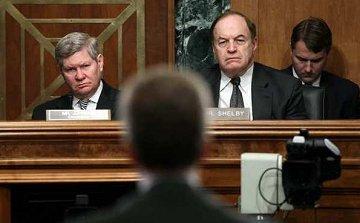
The Senate Banking Committee, led by Chairman Richard Shelby (R) of Alabama, held a hearing yesterday on the JPMorgan Chase’s admittedly “stupid” trading bets that lost the company at least $2 billion in a very short amount of time. Was the hearing intended to further embarrass the banking giant? Demand answers for what happened? Hardly.
Shelby, generally known as the banking industry’s best and most well-funded buddy, held the hearing to berate federal regulators.
As Dana Milbank explained, Shelby pestered Gary Gensler, head of the Commodity Futures Trading Commission, on when, exactly, his agency learned about JPMorgan’s mismanagement. When Gensler explained he learned of the bets through media reports, just like everyone else, Shelby pounced.
“Press reports!” Shelby echoed, with mock surprise. He smiled. “Were you in the dark?”
Gensler tried to explain that his agency does not yet have authority to regulate the bank, but Shelby interrupted. “So you really didn’t know what was going on … until you read the press reports like the rest of us?” he asked again.
“That’s what I’ve said,” Gensler repeated.
But Shelby wanted him to keep saying it. “You didn’t know there was a problem there until you read the press reports?”
JPMorgan Chase has given Shelby tens of thousands of dollars in recent years, and it got its money’s worth yesterday. As Milbank added, “The trading scandal at JPMorgan highlighted the urgent need for tougher regulation of Wall Street, but Shelby’s harangue was part of a larger effort to use the scandal as justification to repeal regulations.”
Exactly. Shelby shrieked in glee during his show-trial hearing yesterday, arguing that the Commodity Futures Trading Commission struggled in its oversight role during JPMorgan’s mismanagement, which in Shelby’s mind, means the Commodity Futures Trading Commission should have a weaker oversight role.
I’ve been trying to come up with a metaphor Shelby might understand. Let’s try this: imagine there’s a fire department that’s having trouble learning about and putting out fires.
In our hypothetical, this fire department has employed capable people, but they lack the tools and resources to quickly identify where fires break out, and get to the scene in a hurry.
If we follow the logic Shelby relied on yesterday, the appropriate response to this hypothetical is to give the fire department less power and fewer resources. After all, they’re struggling to complete their assigned tasks, so the department is clearly not to be trusted. The notion of improving the fire department’s tools and resources, allowing its capable staff to do its job well, never enters the picture. We’re seeing this dynamic play out with Wall Street. Milbank went on to say: It’s true that Dodd-Frank, the legislation responding to the 2008 economic collapse, hasn’t worked — because it hasn’t been put in place. At the heart of the proposed reforms is the “Volcker rule,” named for a former Federal Reserve chairman, which attempts to separate banks’ gambling from their government-backed deposits. This mimics the situation before the Depression-era Glass-Steagall law was repealed in 1999. Banking lobbyists managed to weaken the Volcker rule in 2010 by securing exemptions. Even the watered-down version has been slowed by a barrage of objections from executives — none louder than Dimon. And regulators ¬haven’t had the funds to keep up with the workload. The result is that key parts of the law haven’t been implemented. Now industry-friendly lawmakers are using the scandal to discredit never-implemented regulations. Milbank assumed JPMorgan will win the argument on Capitol Hill, not because it’s right, but because it’s invested $20 million on lobbying and campaign contributions in the past three years.
The place for in-depth analysis, commentary and informed perspectives. Recommended


