








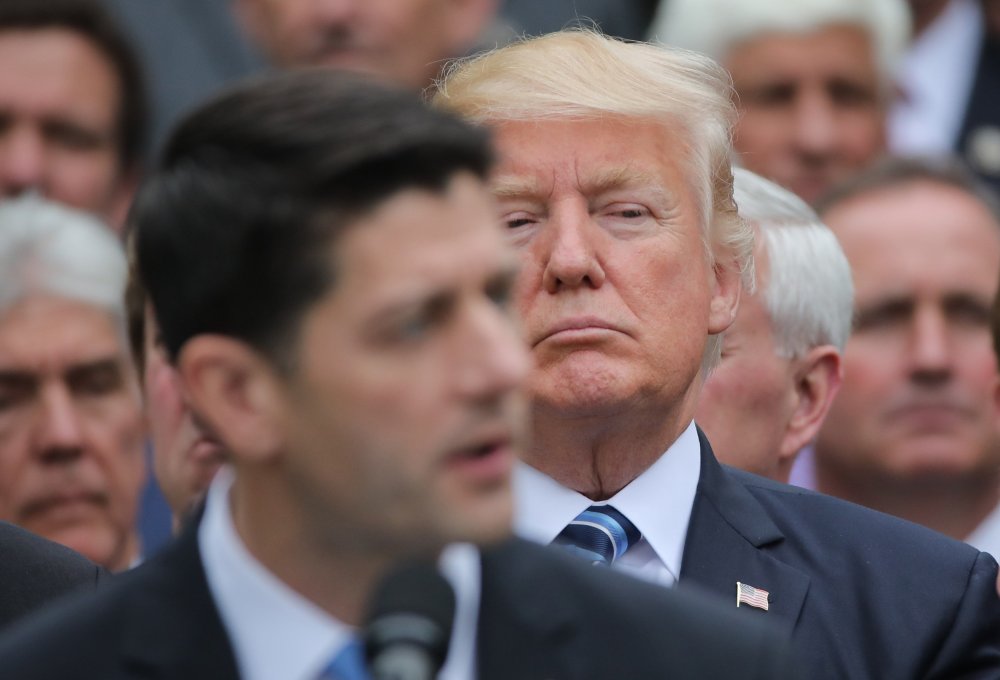
At a town-hall forum on CNN last night, House Speaker Paul Ryan (R-Wis.) was willing to say Donald Trump was “wrong” when the president failed to fully condemn racist activists in Charlottesville. But a voter at the event pressed the Republican leader on going a step further.
“Speaker Ryan, as the leader of the congressional Republicans, I’d like to ask you what concrete steps that you will take to hold the president accountable when his words and executive actions either implicitly or explicitly condone, if not champion, racism and xenophobia,” the Wisconsin voter said. “For example, will you support the resolution for censure?”
This generated quick applause, though Ryan wouldn’t budge.
“I will not support that. I think that would be — that would be so counterproductive. If we descend this issue into some partisan hack-fest, into some bickering against each other, and demean it down to some political food fight, what good does that do to unify this country? … So I think that would be the absolutely worst thing we should do.”
It’s a curious argument. For members of Congress to tolerate presidential defense of racists is, according to the Speaker of the House, apparently preferable to formal criticism.
What Ryan may not appreciate is the degree to which the nature of his opposition is a self-fulfilling prophecy.
Censuring Trump could be a bipartisan exercise. Indeed, it almost certainly should be. Last week, Steve Schmidt, a longtime GOP strategist and former aide to John McCain, told Rachel on the show that congressional Republican leaders “have to censure him, or they risk sliding into a moral abyss with him.”
Jennifer Rubin, a conservative Washington Post writer, echoed the sentiment, arguing, “Any Republican not willing to sign on [to the censure resolution] should be voted out. Period. It’s the only litmus test that matters.”
And yet, as of this morning, the censure resolution has 78 co-sponsors — and zero Republicans. (Update: The list of co-sponsors is now up to 112 House members.)
Ryan’s argument is that the resolution would lead to partisan “bickering” and a “political food fight.” But it doesn’t have to be this way. If the Speaker were to announce today that the president’s defense of racists cannot stand, and he’s therefore calling on GOP lawmakers to put principle over party and endorse the censure resolution, there wouldn’t necessarily be a “food fight.” We’d instead see the top Republican and the top Democrat in the House stand unified against bigotry, endorsing a formal declaration that in the United States in 2017, Trump’s rhetoric is not only unacceptable; it’s also worthy of a congressional rebuke. But that’s the one approach Ryan has ruled out. Instead, the Speaker is creating the political conditions he’s condemning: by rejecting the resolution out of hand and turning this into another political dispute, Ryan has introduced partisanship into a process that didn’t need it. There’s nothing inherently partisan about the measure; it only becomes a congressional “food fight” if the House Speaker makes the first volley. Nevertheless, the censure resolution exists, and though Congress’ summer break won’t end for a couple of weeks, members can sign on as co-sponsors at any time. In light of Ryan’s opposition, a floor vote is extremely unlikely, but don’t be surprised if House Democrats file a resolution of inquiry — the same tactic they used to force committee votes on the release of Trump’s tax returns.
Steve Benen is a producer for "The Rachel Maddow Show," the editor of MaddowBlog and an MS NOW political contributor. He's also the bestselling author of "Ministry of Truth: Democracy, Reality, and the Republicans' War on the Recent Past." Recommended


