








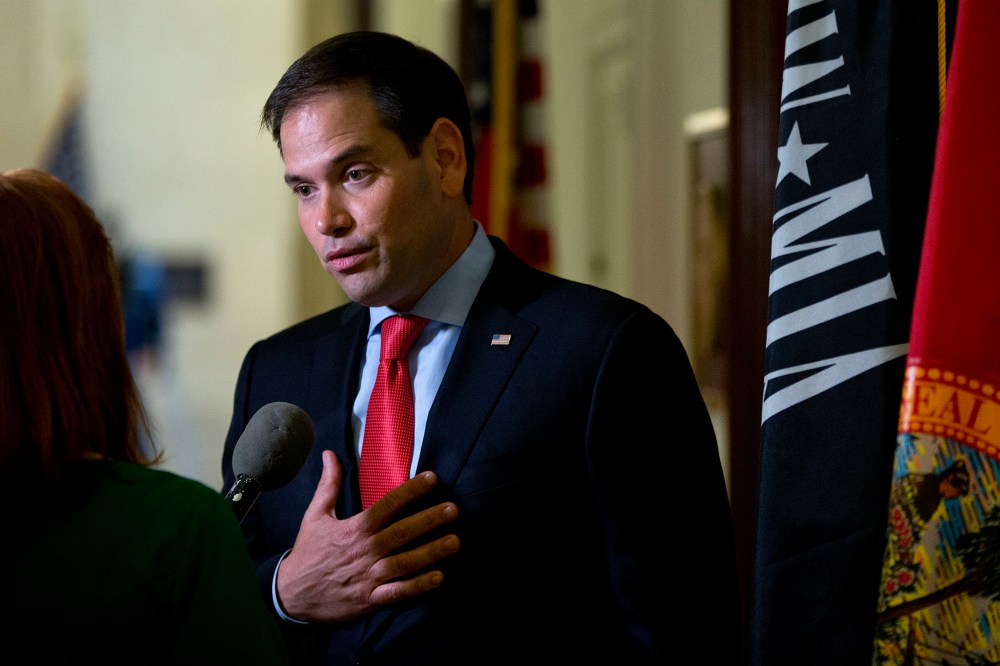
Two weeks ago, Sen. Marco Rubio (R-Fla.) recommended an important change to the Republican tax plan: by reducing the corporate tax rate to about 21%, instead of 20%, the legislation could expand the child tax credit. GOP leaders refused, saying the 20% corporate rate was necessary and non-negotiable.
This week, however, those same Republican leaders effectively extended their middle finger at the Florida senator, deciding they could live with a 21% corporate tax rate so long as the additional resources were directed at another tax break for the wealthiest Americans.

As NBC News reported, Rubio responded the way a senator is supposed to respond — by walking away from the bill.
Just days before an expected vote, the sweeping Republican tax bill’s fate was up in the air Thursday, with few details confirmed and key senators withholding support unless changes were made.
Sen. Marco Rubio, R-Fla., announced he would oppose the bill unless it expanded a child tax credit to millions of lower income families by making a larger portion refundable against payroll taxes.
“I want to support tax reform and it’s important for the country, but I think this needs to be part of it,” Rubio told reporters.
The legislative arithmetic is straightforward: there are currently 52 Republican senators, which means the party can lose no more than two of its own members or the regressive and unpopular tax plan dies. Sen. Bob Corker (R-Tenn.) already voted against the bill once, and it sounded yesterday like he isn’t changing his mind.
If Rubio joins him — a big “if,” to be sure — that would shrink the number of GOP votes for the still-unreleased plan to 50, which would be enough for passage, but would leave Republican leaders with no margin for error.
It’s against this backdrop that Sen. Mike Lee (R-Utah), who partnered with Rubio on the idea of an expanded child tax credit, said he’s also unsure about how he’ll vote. Sens. Susan Collins (R-Maine) and Jeff Flake (R-Ariz.), meanwhile, haven’t yet committed to supporting the proposal, and two more GOP senators — Arizona’s John McCain and Mississippi’s Thad Cochran — are dealing with some health concerns.
This is, in other words, a fairly volatile dynamic, especially for a vote that’s expected on the Senate floor in four days.
So, what happens now? Among other things, there’s uncertainty as to how and whether Senate Republicans address Rubio’s concerns. Common sense suggests GOP leaders should simply give him what he wants — it’s a modest ask, which would make the legislation more popular with the pubic — but as things stand, there’s no reason to assume that they will.
Maybe Republican leaders are assuming they can pass the bill without Rubio; maybe they’re assuming the Floridian is bluffing and won’t follow through on his threat. Either way, the change he’s seeking may not come to fruition. Another thing to consider is what would happen if GOP leaders caved and met Rubio’s demands. As the party no doubt understands, that would raise the possibility of other senators saying, “Wait, if Rubio is getting the change he wants, maybe I should threaten to vote against the bill in order to get what I want, too.” Once the barn door is open, the results can be unpredictable, which suggests the party will try to keep it closed. Finally, even if we assume that Rubio isn’t just grandstanding — a risky assumption — there’s still the matter of the third Republican “no” vote. Susan Collins seems like the obvious choice, but for reasons that I still struggle to understand, the Maine senator seems to think that this ridiculous legislation has merit. Rumor has it the text of the bill will be unveiled today, with the debate in the Senate getting underway on Monday. From there, GOP leaders hope to clear the upper chamber on Tuesday, sending it to the Republican-led House for a vote before the end of next week. Buckle up.
Steve Benen is a producer for "The Rachel Maddow Show," the editor of MaddowBlog and an MS NOW political contributor. He's also the bestselling author of "Ministry of Truth: Democracy, Reality, and the Republicans' War on the Recent Past." Recommended


