








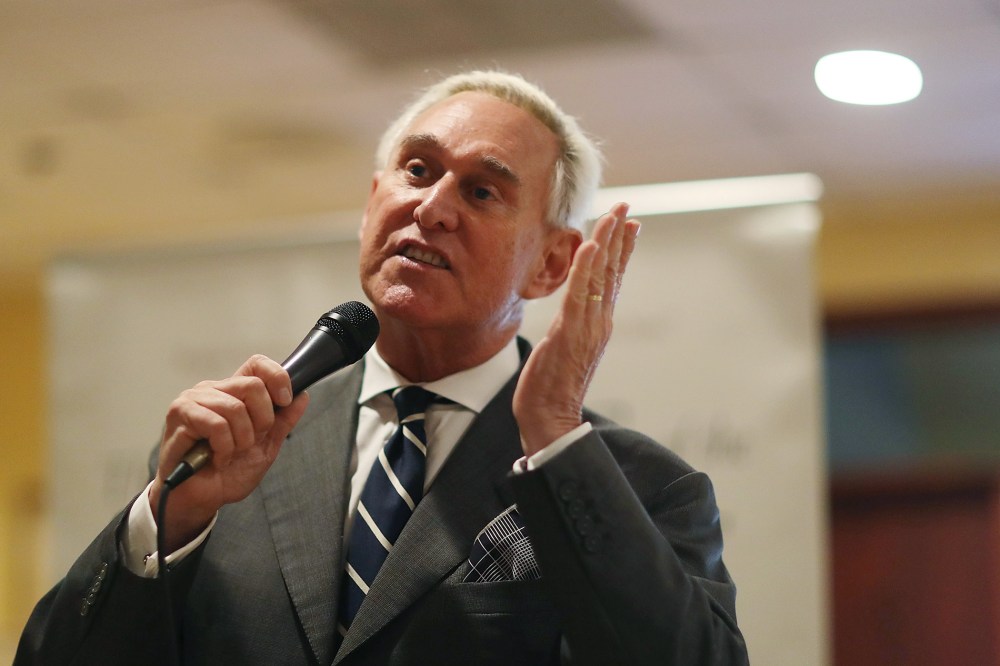
When Republican operative and Donald Trump adviser Roger Stone was arrested by the FBI, Americans saw much of the drama unfold on camera. That’s because CNN had a camera crew at Stone’s home and was able to capture the arrest.
The accused felon believes federal law enforcement and the cable news network conspired in order to … well, they just conspired. Politico reported yesterday:
Roger Stone urged a federal judge Wednesday to make special counsel Robert Mueller’s office explain why it shouldn’t be held in contempt for violating the seal on the longtime Donald Trump aide’s indictment by allegedly leaking it to the press.
Stone has repeatedly criticized the dramatic arrest at his home in January, which was caught on film by a CNN camera crew staking out his South Florida house. Stone claims CNN was tipped off about the arrest to film the raid, violating court orders.
To bolster the allegations, Stone’s attorneys presented the court with evidence that, as Rachel noted on the show last night, really didn’t make any sense. That’s because we already know how and why CNN was able to get the footage, and it wasn’t because of a behind-the-scenes conspiracy.
But what makes this story of particular interest to me isn’t Roger Stone concocting a strange narrative that presents him as some kind of victim. The operative has come up with all kinds of odd claims over the years, so this CNN yarn is par for the course.
What I find remarkable, however, is how many Republicans leaders, unable to resist the appeal of a conspiracy theory involving American journalists and the special counsel investigation they love to hate, have bought into the nonsense.
Vox, for example, had this report last week about acting Attorney General Matthew Whitaker and the line of questioning he received from Rep. Doug Collins (R-Ga.), the panel’s ranking member.
Asked by Collins if he is “familiar from public reports or otherwise” that “a CNN reporter was camped out outside of Stone’s house when the FBI arrested him,” Whitaker said he was, and that he finds it “deeply concerning.”
Collins followed up by asking if somebody at DOJ “share[d] a draft indictment with CNN prior to Stone’s arrest.” Whitaker didn’t rule it out, and went on to say, “I share your concern with the possibility that a media outlet was tipped off to Mr. Stone’s either indictment or arrest before it was made, that information was available to the public.”
I have no idea whether Whitaker lent credence to the conspiracy theory because he was genuinely confused or because he saw political value in fueling the nonsensical fire.
Either way, in the congressional exchange, we saw the top Republican on the House Judiciary Committee and the nation’s top law-enforcement official treat the conspiracy theory as if it had merit.
Alas, it doesn’t end there. Donald Trump recently sat down with the Daily Caller, a far-right website, which touched on the same subject: THE DAILY CALLER: Speaking of the FBI, sir, were you comfortable with the way and the force that was used against the raid in Roger Stone’s house? Do you think that was appropriate for your FBI to be doing that in a white collar case? TRUMP: I thought it was very unusual. You know, I’ve stayed out of that whole situation so that — because there was no collusion whatsoever. There was no nothing done wrong and frankly, I could have waded in very early, I could have ended it very easily if I wanted to but just let it run its course. But I will say, like, I’m speaking for a lot of people that were very disappointed to see that go down that way, to see it happen where it was on camera, on top of it. That was a very, very disappointing scene — THE DAILY CALLER: You thought it was unusual that CNN was there? TRUMP: You have 29 people and you have armored vehicles and you had all of the other and, you know, many people know Roger, and Roger is not a person that they would have to worry about from that standpoint. I thought it was sad to see it. It followed a presidential tweet on Jan. 25, in which Trump asked rhetorically, in reference to Stone’s arrest, “Who alerted CNN to be there?” Conspiracy theories are not new. Conspiracy theories being touted by fringe partisan operatives are not new. But there’s nothing normal about discredited conspiracy theories being amplified by a president, an attorney general, and one of the leaders of the House Judiciary Committee.
Steve Benen is a producer for "The Rachel Maddow Show," the editor of MaddowBlog and an MS NOW political contributor. He's also the bestselling author of "Ministry of Truth: Democracy, Reality, and the Republicans' War on the Recent Past." Recommended


