








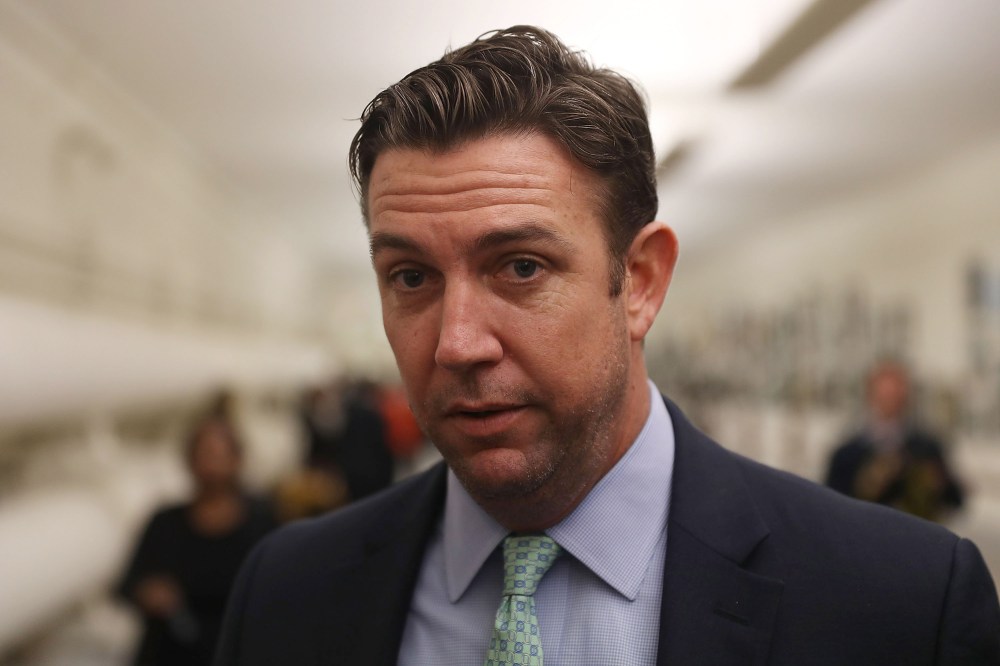
The first Republican member of Congress to endorse Donald Trump was Rep. Chris Collins (R-N.Y.), who was recently arrested for alleged insider trading. The second Republican member of Congress to endorse Trump was Rep. Duncan Hunter Jr. (R-Calif.), who was indicted yesterday afternoon.
U.S. Rep. Duncan Hunter and his wife, Margaret E. Hunter, were hit Tuesday with federal charges that they “converted and stole” more than a quarter million dollars in campaign funds, according to a 47-page grand jury indictment.
The San Diego County couple used the cash to take trips to Italy, Hawaii, London and elsewhere, and even used the funds to cover school tuition, dental work and theater tickets, the federal grand jury in the U.S. District Court for the Southern District of California said in an indictment unsealed Tuesday.
According to the indictment, the Hunters started misusing campaign funds when their own personal finances hit a rough patch. “By virtue of those delinquencies as well as notifications of outstanding debts and overdue payments from their children’s school, their family dentist, and other creditors — the Hunters knew that many of their desired purchases could only be made using campaign funds,” the indictment states.
This may not seem like the most provocative of political misdeeds, but let’s not forget that the last member of Congress to face accusations like these was Illinois Democrat Jesse Jackson Jr., and he went to jail for flagrant misuse of campaign funds for personal use.
So, what happens now? A few things, actually.
While the California Republican moves forward with his legal defense, he’ll be stripped of his congressional committee assignments. (House Speaker Paul Ryan imposed the same punishment on Chris Collins after his indictment.)
At least as of right now, Hunter will, however, also move forward with his re-election plans in California’s 50th district — where it would be difficult to remove the congressman’s name from the ballot, even if he decided to step aside. Indeed, a spokesperson for California Secretary of State’s office told Roll Call, “At this point there does not exist a process in elections code for him to have his name removed from the ballot.”
This is one of the most GOP-friendly districts in California — Trump, for example, won in this district by 15 points — and Hunter has generally been seen as a heavy favorite against his Democratic challenger, Ammar Campa-Najjar. The electoral conditions, however, have suddenly changed. As for the bigger picture, if GOP insiders were worried about the “culture of corruption” charge before yesterday’s developments, those concerns are more acute now. Postscript: In case anyone’s curious, when it comes to Trump’s congressional supporters from 2016, Collins was first, and he’s under indictment. Hunter was second, and he’s under indictment. Who was third? Focusing specifically on House GOP lawmakers, two members jumped on the Trump Train on Feb. 29, 2016: Reps. Tom Marino (R-Pa.) and Scott DesJarlais (R-Tenn.). As it turns out, Marino’s nomination to serve as Trump’s drug czar was later derailed by controversy, and much of DesJarlais’ political career has been marred by personal scandals.
Steve Benen is a producer for "The Rachel Maddow Show," the editor of MaddowBlog and an MS NOW political contributor. He's also the bestselling author of "Ministry of Truth: Democracy, Reality, and the Republicans' War on the Recent Past." Recommended


