








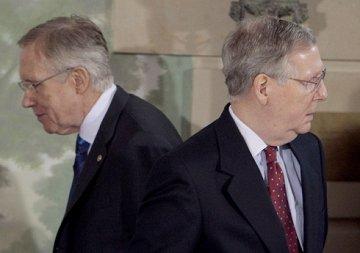
For three-and-a-half hours last night, nearly every member of the Senate met behind closed doors in the Old Senate Chamber to discuss a political crisis of sorts: whether the minority would continue to block President Obama’s executive-branch nominees and what the majority intended to do about it.
The meeting itself was rather odd. Senators already have a forum in which they can hold a debate — it’s called the Senate. But their usual chamber has cameras and public seating, and last night, for whatever reason, members wanted to debate in private for a candid conversation.
By all accounts, it was a constructive conversation, but there was no resolution. As I type, there are some back-channel talks underway, but barring a breakthrough, the Senate Democratic leadership intended to move forward with its “nuclear option” plans.
Senator Harry Reid of Nevada took a defiant and uncompromising stand on Monday before a showdown on the future of the filibuster, saying that Republicans must stop blocking executive branch nominations or he will try to change rules to “save the Senate from becoming obsolete.”
The problem with characterizing Reid as “defiant and uncompromising” is that it suggests he’s somehow the aggressor in this political drama. He is not. It’s Senate Republicans, who’ve engaged in unprecedented obstructionist tactics, unseen in all of American history, who have instigated this standoff. It’s the GOP minority’s defiance and uncompromising posture that got the chamber in this mess in the first place.
Senate Minority Leader Mitch McConnell (R-Ky.) was willing to put an offer on the table.
After the meeting, Mr. McConnell offered Democrats up-or-down votes on all seven contested nominations in exchange for a promise to drop the rule-change threat. Mr. Reid demanded a pledge not to filibuster future nominations. Both sides balked, according to aides familiar with the exchange. At this point, any kind of concession is unusual, but it’s hard to see McConnell’s offer as a serious resolution. Senate Dems, in this scenario, would get up-or-down votes on seven executive-branch nominees, at which point Senate Republicans would be able to go back to filibustering as many executive-branch nominees as they saw fit, with the assurance that Democrats would simply accept the obstructionism. Richard Cordray’s nomination to lead the Consumer Financial Protection Bureau is set to reach the floor in just two hours. As best as I can tell, Reid isn’t bluffing and he has the votes he needs to execute the nuclear option and force a majority-rule vote — if, that is, Republicans try to block Cordray. Last night, there were some rumors that the GOP would hold off and instead focus their opposition on NLRB nominees instead. There’s still a possibility for an 11th-hour agreement, but it’s unclear what in the world such a deal might look like. If a compromise is close, however, don’t be too surprised if 10 a.m. eastern comes and goes while talks continue. I’ll keep you posted.
The place for in-depth analysis, commentary and informed perspectives. Recommended


