








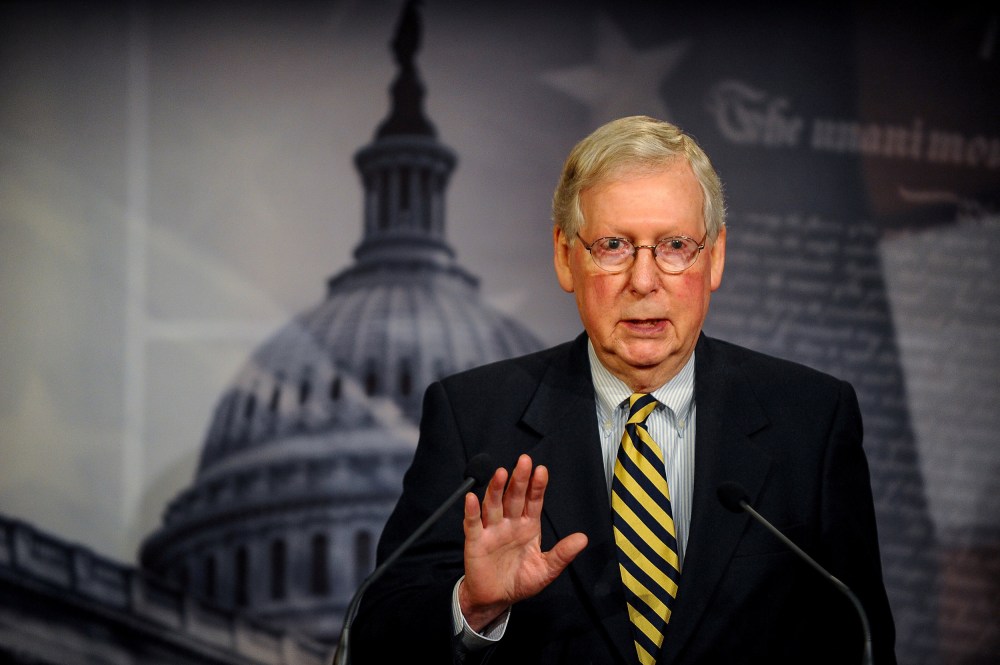

Just two weeks after CARES Act benefits expired over the summer, and public anxieties grew, Senate Majority Leader Mitch McConnell (R-Ky.) insisted that policymakers “get back to the table” and reach an agreement on a new economic-aid package. Using his best passive voice, the GOP leader added, “The stalemate needs to be ended.”
The Kentucky Republican, who’s up for re-election this year, had no intention of participating in the negotiations, but he nevertheless said, “It’s time to sit down and get a deal done.”
That was in mid-August. Two months later, the on-again, off-again talks between the White House and congressional Democratic leaders are showing unexpected signs of progress. But even if House Speaker Nancy Pelosi (D-Calif.) and Treasury Secretary Steven Mnuchin were somehow able to bridge their differences, there’s still McConnell’s Senate to consider.
And yesterday, as NBC News reported, the GOP Senate leader made clear that he does not want a pre-election agreement.
Senate Majority Leader Mitch McConnell told his fellow Republican members in a closed-door meeting Tuesday that he is “encouraging” the White House to wait until after the Nov. 3 election to reach an agreement on a Covid-19 relief package with House Speaker Nancy Pelosi, according to three sources familiar with the conversation.
The Kentuckian told reporters after the closed-door meeting that if a bipartisan deal comes together, the Senate would “consider” the agreement “at some point.” It was hardly a firm commitment.
The comments also seemed to contradict Donald Trump’s optimism from hours earlier: the president told Fox News yesterday morning that he expects McConnell to support whatever package the White House endorses. “Not every Republican agrees with me,” Trump said, “but they will.” He added, “They’ll be on board if something comes.”
Senate Republicans appear to disagree. Senate Majority Whip John Thune (R-S.D.) conceded yesterday that it would “be hard” to find just 13 members of his party who would support an aid package, even if it received the president’s blessing.
Some GOP senators are staunchly opposed to aiding “blue states.” Others are convinced the Republican base is against increased government spending. Others still are loath to take up an issue that divides Republican lawmakers — and positions them at odds with their own party’s president — so close to Election Day.
What’s more, the New York Times reported, “Above all, Republicans fretted that a vote on such a package could interfere with their hasty timetable for confirming Judge Amy Coney Barrett to the Supreme Court by early next week.” It’s quite a message to send to struggling voters: Republicans may get around to economic aid “at some point,” but the real priority is stacking the Supreme Court with another far-right justice. All the while, much of the party appears to be laying the groundwork to oppose measures to boost the economy in the event of a Joe Biden victory. On a nearly daily basis, Trump tells the public that the House Speaker is to blame for the delays. Indeed, he told Fox News yesterday morning, “Nancy Pelosi doesn’t want to approve anything.” In reality, Pelosi has already passed two ambitious aid packages, and she’s spent weeks negotiating with the president’s own team on a possible third. Whether Trump understands events unfolding around him or not, the main hurdle standing in the way of a pre-election economic deal is Mitch McConnell.
Steve Benen is a producer for "The Rachel Maddow Show," the editor of MaddowBlog and an MS NOW political contributor. He's also the bestselling author of "Ministry of Truth: Democracy, Reality, and the Republicans' War on the Recent Past."
Latest Post
Recommended


