The Rachel Maddow Show WEEKNIGHTS 9PM ETMorning Joe WEEKDAYS 6AM ETDeadline: White House with Nicolle Wallace Weekdays 4PM ETThe Beat with Ari Melber Weeknights 6PM ETThe Weeknight Weeknights 7PM ETAll in with Chris Hayes TUESDAY-FRIDAY 8PM ETThe Briefing with Jen Psaki TUESDAYS – FRIDAYS 9PM ETThe Last Word with Lawrence O’Donnel Weeknights 10PM ETThe 11th Hour with Stephanie Ruhle Weeknights 11PM ET
The Tea, Spilled by Morning Joe: ‘They called me “Daddy”’
In today’s newsletter, Joe discusses President Trump and Stephen Miller’s obsession with “American decline,” the atmosphere at this year’s World Economic Forum conference in Davos and more.
Recommended News The Tea, Spilled by Morning Joe: NYE Edition, Part 2 Joe Scarborough Morning Joe The Tea, Spilled by Morning Joe: ‘Being president of this country is entirely about character’ Joe ScarboroughIllustration: Natalie Sanders, photo: Kevin Dietsch/Getty Images
This is the Jan. 21, 2026, edition of “The Tea, Spilled by Morning Joe” newsletter. Subscribe hereto get it delivered straight to your inbox every Monday through Friday.
Donald Trump dreams of an America as powerful as when William McKinley was in the White House.
The United States was among the great powers at the turn of the 20th century, but it was in a fierce competition with Great Britain, Germany, and other nations for the role of the world’s preeminent power.
The British Empire ruled a quarter of the globe.
Germany’s military machine was so powerful that it destroyed large swaths of the world over the 20th century’s first 45 years.
Trump and Stephen Miller now attack the U.S. as weakened by post-war alliances, harkening back to an imagined glorious past.
This is nothing new. Every generation produces a collection of doomsayers declaring the country’s decline.
In the 1970s, leaders like Henry Kissinger thought the Soviet Union would eclipse America’s technological prowess.
The Soviet empire collapsed in 1989, at about the same time as Silicon Valley’s dizzying rise began.
After the Berlin Wall fell, declinists like Trump focused on Japan, warning that the country would soon crush America economically because the Japanese bought Pebble Beach and Rockefeller Center.
Japan promptly entered its “Lost Decade.”
American critics spent the first 20 years of this century predicting how a rising China would pass the U.S. as the world’s preeminent power.
Instead, China’s birth rate is at its lowest level since Mao’s revolution in 1949 — all because of its weakening economy.
Now it is Trump and Miller who trash America’s greatness, while declaring only they can save us from decline.
Please.
Despite our many failures over the first quarter of this century, America has been stronger militarily, economically, technologically, and culturally during that time than at any point in its almost 250-year history.
Using Paul Kennedy’s measure in “The Rise and Fall of the Great Powers”— a nation’s strength relative to the rest of the world — America’s power has been unmatched for the past 25 years.
Economically, the U.S. economy generates about $30 trillion a year.
Russia’s economy doesn’t even produce one-tenth of America’s gross domestic product.
California alone ranks as the fourth-largest economy in the world.
Texas is the eighth-biggest global economy.
U.S. soft power is even more profound.
Our cultural reach — in music, film, media, education — extends farther than ever.
Technologically, America is light-years ahead of its closest competitor, thanks in large part to immigrants and their children who came to America and built Silicon Valley.
If people like Miller really want an America that looks like the 1950s — more white and more segregated — they should just admit that race is the driver of this political charade.
But if they want to talk about real power — military, economic, technological, cultural — the facts are clear and they are wrong.
By every objective measure, the U.S. is stronger relative to the rest of the world than at any moment in modern history.
That strength endures because of the international order we created 80 years ago, out of the rubble of World War II. Our NATO-led order still makes the U.S. the most powerful nation on the face of the earth.
America is great.
But the real question is when we will again elect leaders who want to make us good.
— President Donald Trump, ridiculing European leaders earlier today in Davos, Switzerland
On Jan. 19, 1989, President Ronald Reagan delivered his last speech as commander-in-chief and reminded Americans that the United States could remain a shining city on a hill.
REAGAN: I think it’s fitting to leave one final thought, an observation about a country which I love. It was stated best in a letter I received not long ago. A man wrote me and said: “You can go to live in France, but you cannot become a Frenchman. You can go to live in Germany or Turkey or Japan, but you cannot become a German, a Turk, or a Japanese. But anyone, from any corner of the earth, can come to live in America and become an American.”
[…]
This, I believe, is one of the most important sources of America’s greatness. We lead the world because, unique among nations, we draw our people — our strength — from every country and every corner of the world.
And by doing so we continuously renew and enrich our nation.
While other countries cling to the stale past, here in America we breathe life into dreams.
We create the future, and the world follows us into tomorrow.
Thanks to each wave of new arrivals to this land of opportunity, we’re a nation forever young, forever bursting with energy and new ideas, and always on the cutting edge, always leading the world to the next frontier.
As global leaders gather in Davos, questions about America’s reliability as a NATO ally are front and center.
Katty Kay — co-host of “The Rest is Politics” podcast and a correspondent for BBC Studios — joined us to discuss growing anxiety in Europe about Trump, NATO, and the future of the transatlantic alliance.
JS: Katty Kay, European leaders fear Donald Trump is abandoning their allies. That concern isn’t new — Angela Merkel said as much during Trump’s first term. We heard similar warnings yesterday, from Canada’s [prime minister,] Mark Carney. What do you expect to unfold today in Davos?
KK: The U.S. backing away from Europe actually predates Trump. Barack Obama also urged Europeans to take more responsibility for their own defense. Trump’s done it more forcefully, and he took credit last night for pushing NATO allies toward 5% of GDP on defense.
That message has sunk in: Europe knows it must do more.
JS: What’s the mood like on the ground?
KK: Here in Davos, there’s a sense of anticipation — and unease — about what Trump will do next. He thrives on that uncertainty, running global politics like a reality show. He claims this is tough negotiating. He will ask for 100% and maybe settle for 60%. But Trump’s approach is fracturing alliances. The next time the U.S. turns to Europe for help, especially in confronting China, Europeans may be reluctant.
Trump’s approach makes them question American reliability.
JS: How has the tone in Davos shifted?
KK: Davos is no longer about reversing climate change or economic equality, as it was a few years ago. The topics now revolve around [artificial intelligence] and geopolitical muscle. That focus greatly reflects Trump’s influence on world leaders. Even American business leaders are being cautious, avoiding topics he dislikes.
America’s president has made global leaders, both political and corporate, more fearful to act on their agendas. Donald Trump may see this as strength, but most here suggest this tough approach may hurt America’s long-term interests.
JS: We’re also getting a preview of Trump’s tone from Treasury Secretary Scott Bessent, who has mocked European leaders in Davos. With that kind of petulance, and Mark Carney’s declaration of a ruptured alliance, what options do Europe’s leaders have moving forward?
KK: I was at an event last night with a head of state, an intelligence chief, and a U.S. senator. They were all wrestling with that question.
Europe does have leverage. It’s America’s biggest trading partner, and while tariffs would hurt both sides, Europe could target supply chains. This is especially true with minerals, tech components, and pharmaceuticals. They could also tighten regulations on U.S. tech firms.
JS: How are European leaders weighing their next moves?
KK: European leaders are debating how to respond and whether to extend a hand of friendship or keep a baseball bat behind their back.
They’re waiting to measure Trump’s tone here in Davos, and to see what American actions follow. But make no mistake: Domestic pressure means they can’t ignore challenges to European sovereignty. They’ll have to respond, one way or another.
This conversation has been condensed and edited for brevity and clarity.
Brooklyn Beckham, son of soccer legend David Beckham and fashion designer Victoria Beckham, set the online world on fire earlier this week after sharing a series of stories on Instagram that accused his parents of being “inauthentic” and trying to ruin his relationship with his wife, Nicola Peltz.
The rift between the eldest Beckham son and his parents, which has been making waves for the better part of a week, has seen Brooklyn cut off his parents and refuse to reconcile. In his stories, Brooklyn alleged that his parents pressured him into “signing away the rights to his name” and that his mother “canceled” making Peltz’s wedding dress at the last minute. He also accused Victoria of “dancing very inappropriately on me” after “hijacking” his first dance with Peltz at the pair’s wedding in 2022.
The Beckham parents gave no comment until yesterday, when David, in an interview with CNBC, said “children are allowed to make mistakes” and mused about the “power of social media” without addressing any of the accusations Brooklyn has leveled.
ONE MORE SHOT
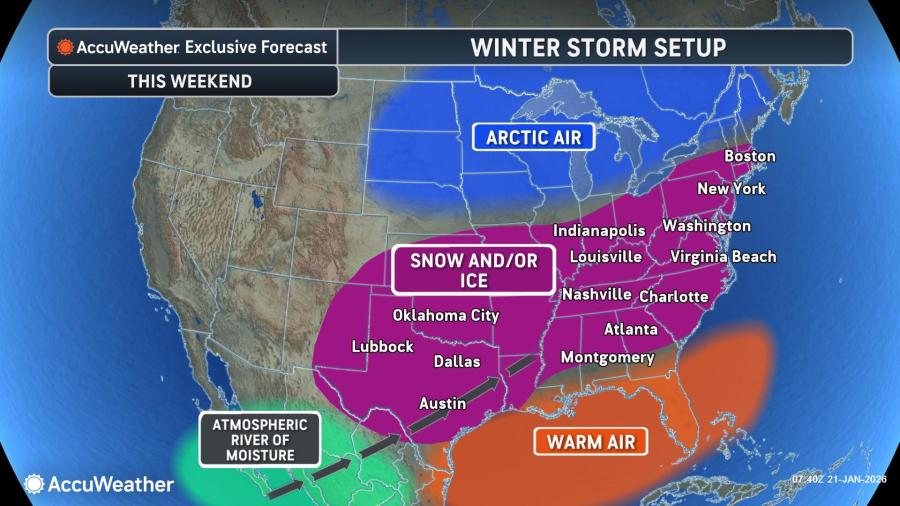
ACCUWEATHER
Millions of Americans are bracing for a major winter storm taking aim at the South, Midwest, and Northeast starting Friday and going through Monday. The storm, named Fern by the Weather Channel, is slated to bring potentially damaging snow, ice, and sleet to more than 180 million residents. Stay safe and warm out there, folks!
SPILL IT!
Tomorrow, actor and comedian Sean Hayes will join us to discuss his new off-Broadway show, “The Unknown.”
Have a question? Ask here, and we may feature your question on the show.
Former Rep. Joe Scarborough, R-Fla., is co-host of MS NOW's "Morning Joe" alongside Mika Brzezinski — a show that Time magazine calls "revolutionary." In addition to his career in television, Joe is a two-time New York Times best-selling author. His most recent book is "The Right Path: From Ike to Reagan, How Republicans Once Mastered Politics — and Can Again."