









It wasn’t long after January’s deadly insurrectionist attack on the U.S. Capitol when an obvious idea took hold: policymakers needed an independent commission, along the lines of the 9/11 Commission, to determine what happened and why.
As we’ve discussed, in theory, this seemed like a no-brainer. Even now, months after the assault, there’s no shortage of questions in need of answers and an independent panel could both fill in the gaps and make policy recommendations to prevent related violence in the future. National polling showed fairly strong support for the idea.
But in practice, putting the pieces together has proven nearly impossible.
Part of the problem has been with the proposed makeup of the panel. House Speaker Nancy Pelosi (D-Calif.) originally pitched an 11-member panel, with the White House appointing three members, while each of the four congressional leaders would appoint two.
Republicans balked — it would’ve given Democrats a sizable advantage — and so Pelosi drafted a new proposal this week in which the commission’s membership would be split evenly between the parties.
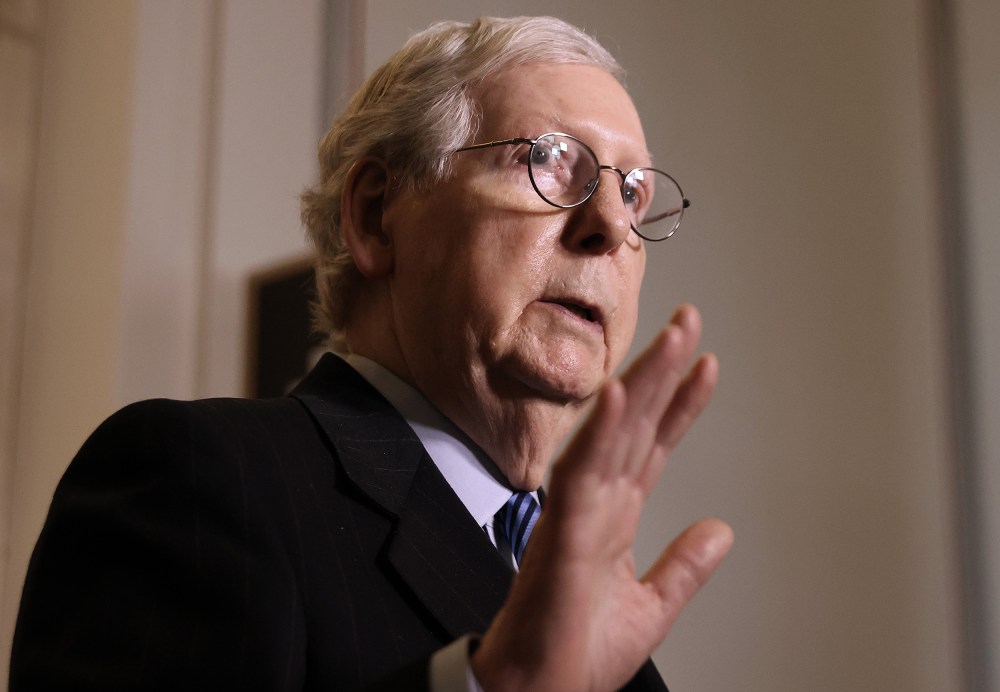
And while that would appear to resolve a key sticking point, Senate Minority Leader Mitch McConnell (R-Ky.) told reporters yesterday that he’s still focused on another concern.
“Number one, the commission needs to be balanced,” McConnell said. “And number two, the scope of it needs to deal with a little bit broader than just January the 6th. We’ve also had a number of violent disturbances around the country last year, and I think we ought to look at this broader scope, and with a totally balanced, 9/11-style commission. If [Pelosi] were willing to put that forward, I think it would enjoy broad bipartisan support.”
Or put another way, according to the Republicans’ Senate leader, the commission designed to scrutinize the Jan. 6 attack on the Capitol should not focus entirely on the Jan. 6 attack on the Capitol.
In case this isn’t obvious, McConnell’s approach falls outside the historical norm. When Congress created the 9/11 Commission, no one in positions of authority asked, “But what about other terrorist attacks?” When Congress created a Watergate commission, no one argued, “Should the panel investigate other politicians’ scandals, too?” When Congress created a commission to examine the JFK assassination, few thought to ask, “Why focus on just one murder?”
But McConnell has adopted this position anyway, and we know why: a careful examination of the insurrectionist riot in January would shine a spotlight on right-wing violence, incited by Republicans. The Senate minority leader wants the focus to be “a little bit broader,” so as to include instances of left-wing violence that had nothing to do with the attack on the Capitol.
Let’s not forget the obvious fact that McConnell knows better. The day before Inauguration Day, the Kentuckian took to the chamber floor, acknowledged that the rioters had been “fed lies,” and blamed Trump for having “provoked” the mob. A few weeks later, McConnell added, “There is no question — none — that President Trump is practically and morally responsible for provoking the events of [Jan. 6]. No question about it. The people who stormed this building believed they were acting on the wishes and instructions of their president. And their having that belief was a foreseeable consequence of the growing crescendo of false statements, conspiracy theories, and reckless hyperbole which the defeated president kept shouting into the largest megaphone on planet Earth.” The Senate GOP leader went on to say, “Sadly, many politicians sometimes make overheated comments or use metaphors that unhinged listeners might take literally. This was different. This was an intensifying crescendo of conspiracy theories, orchestrated by an outgoing president who seemed determined to either overturn the voters’ decision or else torch our institutions on the way out.” That was in February. Two months later, McConnell has decided there were “a number of violent disturbances around the country last year,” and the attack on the nation’s seat of government was merely one incident among many. Postscript: If the proposed commission never comes together, House Democrats plan to move forward with a multi-committee investigation, which has already issued document requests to several relevant departments and agencies.
Steve Benen is a producer for "The Rachel Maddow Show," the editor of MaddowBlog and an MS NOW political contributor. He's also the bestselling author of "Ministry of Truth: Democracy, Reality, and the Republicans' War on the Recent Past."
Latest Post
Recommended


