








As things stand, they’re actually doing this.
Senate GOP leaders have set a timeline to vote next week on legislation to repeal large chunks of the Affordable Care Act, even though they don’t yet appear to have secured enough support to pass it. […]
GOP aides and others familiar with the negotiations said they anticipate the Senate bill’s text will be released later this week. The CBO is expected to release its estimate of the Senate bill’s impact on the federal budget and insurance coverage early next week, and a vote could potentially be held next Thursday, before lawmakers scatter.
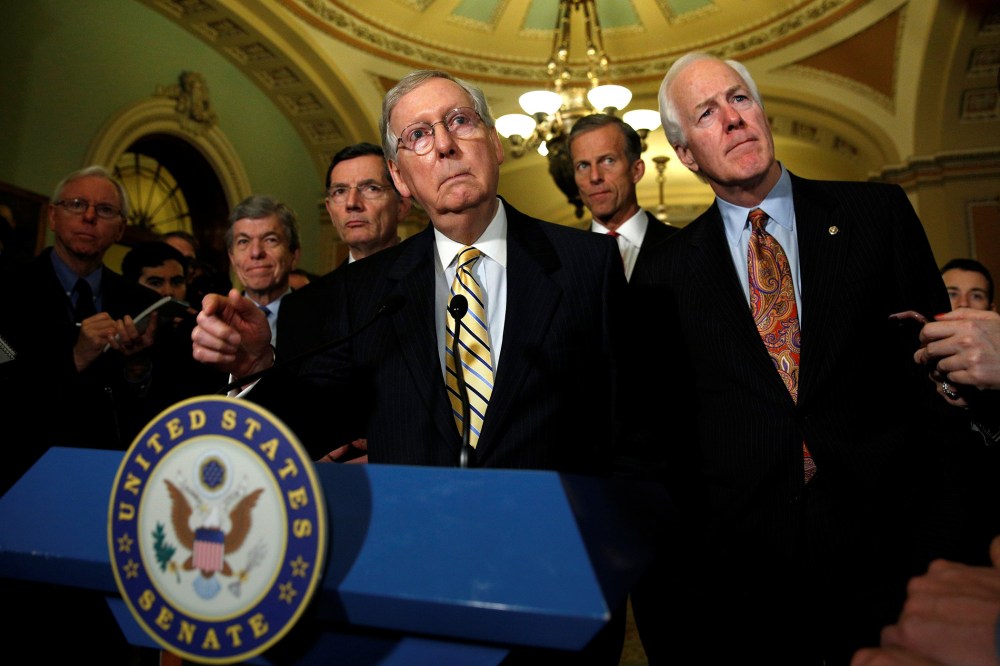
As the Wall Street Journal report makes clear, the Republicans’ legislation — the life-or-death bill that will be voted on next week — does not yet exist. What’s more, Senate Majority Leader Mitch McConnell (R-Ky.) has not yet secured the 51 votes he’ll need to advance the measure.
But he and the GOP leadership are moving forward anyway. Politico had a related piece noting that McConnell and his cohorts are going through with this, “potentially leaving rank-and-file lawmakers with no more than a week to review legislation that would affect millions of Americans and one-sixth of the U.S. economy.”
“Review” is itself a generous term under the circumstances. It might be better to say “speed-read.”
Senate Democrats, meanwhile, will likely have even less time with the proposal, since Senate Republicans don’t intend to unveil their secret bill until after it’s presented to the Congressional Budget Office. It creates the very real possibility that nearly half of the nation’s elected senators, representing more than half of the American people, will only have a day or two to scrutinize legislation that would overhaul the nation’s health care system.
McConnell swore he’d never try to govern this way. His assurances, we now know, were a lie.
As the truly scandalous process moves forward, it’s worth pausing to appreciate the fact that McConnell isn’t breaking any laws or rules by turning the U.S. Senate into some kind of banana republic. Rather, he and his Republican cohorts are rejecting American norms and traditions in ways without modern precedent.
In generations past, congressional leaders from both parties could’ve tried gambits like these, but they didn’t — not because the structure of the institutions didn’t allow it, but because there was an unstated respect for how leaders in the United States conducted matters of state. Legislating this way was something Americans simply did not do.
In other words, the ability to govern this way isn’t new; the willingness to govern this way is new.
It’s a bit like the idea of senators filibustering every piece of legislation of any consequence. Members had that ability for generations, but didn’t exercise it because such antics fell so far outside American norms. To even consider the establishment of mandatory supermajorities on practically every vote, for much of the nation’s history, would’ve been considered ridiculous. Then McConnell & Co. came along and decided to reject those norms and create a new standard. Now they’re doing it again, embracing the idea that major legislation can be written behind closed doors; the secret bill can bypass committees and hearings; and it can be brought to the floor for a vote without any meaningful deliberations or debate. I’m reminded of something the Washington Post’s Dana Milbank wrote in April about McConnell: “No man has done more in recent years to undermine the functioning of U.S. government. His has been the epitome of unprincipled leadership, the triumph of tactics in service of short-term power…. McConnell is no idiot. He is a clever man who does what works for him in the moment, consequences be damned.” As we discussed at the time, this isn’t about issues or ideology, per se. My point isn’t that McConnell is on the right, and I’m on the left, so I’m opposed to his vision and preferred policies. Rather, we’re talking about politics on an institutional level. We can evaluate the Kentucky Republican’s views on given issues on a case-by-case basis, but what makes McConnell so destructive is how he’s pursued his priorities, not just the priorities themselves. I don’t blame McConnell for considering partisan advantage important; I blame him for prioritizing partisan advantage above literally every other consideration, including the health and sustainability of our political system. I’m not bothered by his victories; I’m bothered by what those victories have cost. McConnell’s legacy will include a systemic breakdown in American governance. By all appearances, that suits the Senate Majority Leader just fine, which is precisely the problem.
Steve Benen is a producer for "The Rachel Maddow Show," the editor of MaddowBlog and an MS NOW political contributor. He's also the bestselling author of "Ministry of Truth: Democracy, Reality, and the Republicans' War on the Recent Past." Recommended


