









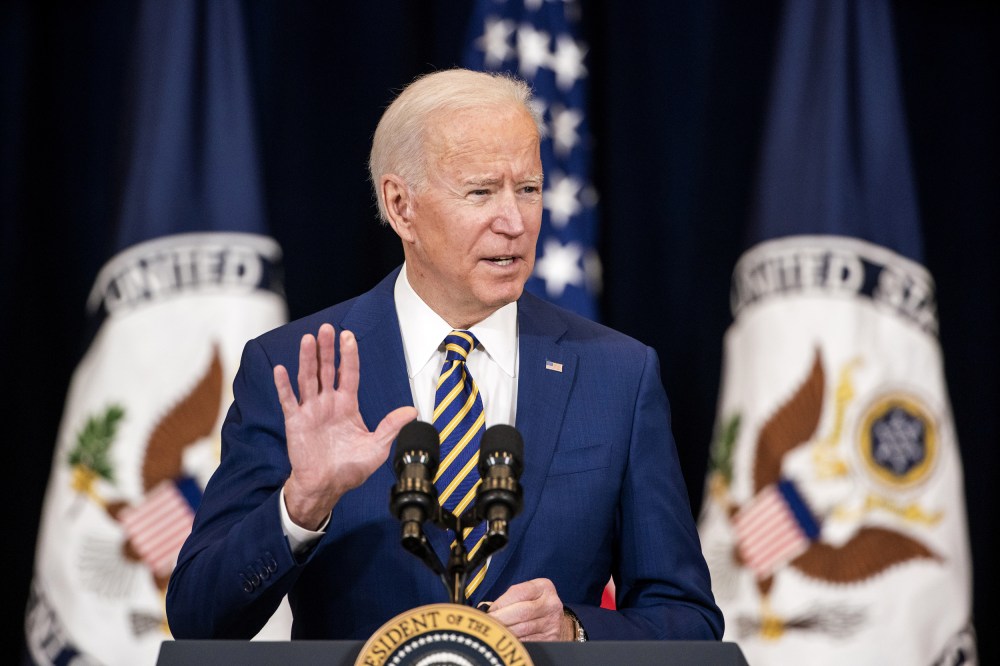

President Joe Biden sat down with CBS News’ Norah O’Donnell for his first network television interview since taking office, and while the two covered a fair amount of ground, there was one part of the discussion that seemed to generate the most chatter.
President Joe Biden said that former President Donald Trump should not receive intelligence briefings even though they typically have been given to other former presidents. Biden told CBS News in an interview that Trump was “unfit to be president” and his “erratic behavior” is why he should not have access to the nation’s classified information.
O’Donnell noted to the new president, referring to his immediate predecessor, “You’ve called him an ‘existential threat.’ You’ve called him ‘dangerous.’ You’ve called him ‘reckless.’” Biden didn’t back off.
“Yeah, I have,” he replied. “And I believe it.”
The president added, “I just think that there is no need for him to have the intelligence briefings. What value is giving him an intelligence briefing? What impact does he have at all, other than the fact he might slip and say something?”
As notable as the comments were, the White House wasted little time in clarifying that Biden has not made a unilateral decision about cutting off his predecessor’s access to government secrets.
“The President was expressing his concern about former President Trump receiving access to sensitive intelligence, but he also has deep trust in his own intelligence team to make a determination about how to provide intelligence information if at any point former President Trump requests a briefing,” White House press secretary Jen Psaki said in an emailed statement.
In other words, if Donald Trump requested or was scheduled to receive an intelligence briefing, it would be up to U.S. intelligence officials to determine how — or whether — to proceed. Biden apparently has an opinion about the matter, but according to the White House, he doesn’t intend to intervene directly.
If the issue sounds at all familiar, it’s not your imagination. Circling back to our coverage from the final days of the former president’s term, Trump, like his predecessors, will theoretically continue to have access to intelligence briefings and sensitive secrets, even as a private citizen.
But given Trump’s unique situations, a variety of voices have stepped forward in recent weeks to argue in support of cutting off the Republican’s access. House Intelligence Committee Chairman Adam Schiff (D-Calif.), for example, told CBS News last month, “There is no circumstance in which this president should get another intelligence briefing… I don’t think he can be trusted with it now, and in the future he certainly can’t be trusted.”
Sen. Angus King (I-Maine), a member of the Senate Intelligence Committee, said on CNN around the same time that “there’s a grave danger” of Trump “inadvertently or willfully revealing classified information.” The Maine independent added, “There is no upside, there is no reason that he needs to have this information.”
Sue Gordon, a career CIA official who served as the principal deputy director of national intelligence for the first three years of the Trump era, wrote a Washington Post op-ed on the subject, imploring Biden to keep Trump deliberately in the dark.
It’s a difficult position with which to disagree, and not just because Trump has demonstrated an unnerving habit of blurting out sensitive national security information for no apparent reason. Shortly after Biden was declared the winner of the 2020 presidential election, the Washington Post reported that Trump “checks the boxes of a classic counterintelligence risk.” The article explained, “He is deeply in debt and angry at the U.S. government, particularly what he describes as the “deep state” conspiracy that he says tried to stop him from winning the White House in 2016 and what he falsely claims is an illegal effort to rob him of reelection.” Former CIA officer David Priess, who wrote a book on presidential intelligence briefings, noted, “Anyone who is disgruntled, dissatisfied or aggrieved is a risk of disclosing classified information, whether as a current or former officeholder. Trump certainly fits that profile.” What’s more, Sue Gordon added in her op-ed, “In addition, Trump has significant business entanglements that involve foreign entities. Many of these current business relationships are in parts of the world that are vulnerable to intelligence services from other nation-states. And it is not clear that he understands the tradecraft to which he has been exposed, the reasons the knowledge he has acquired must be protected from disclosure, or the intentions and capabilities of adversaries and competitors who will use any means to advance their interests at the expense of ours.” She went on to describe the Republican’s security profile as “daunting.” In theory, the reason former presidents continue to have access to sensitive intelligence is because their successors might seek advice on matters of national security. Based on Biden’s comments to CBS News, it seems safe to say Trump shouldn’t expect any outreach from the current president.
Steve Benen is a producer for "The Rachel Maddow Show," the editor of MaddowBlog and an MS NOW political contributor. He's also the bestselling author of "Ministry of Truth: Democracy, Reality, and the Republicans' War on the Recent Past."
Latest Post
Recommended


