








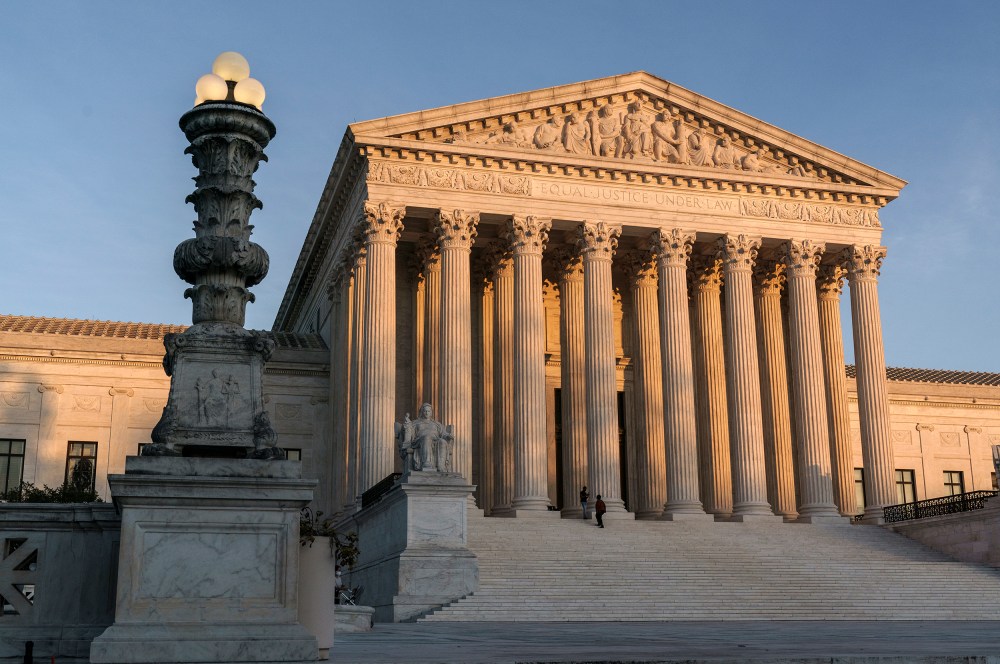

Just before midnight, the day before Thanksgiving, a newly Trumpified Supreme Court issued its first big ruling: in a 5-4 decision, the justices blocked New York’s pandemic restrictions on religious institutions. In the hopes of stopping the spread of COVID-19, the state had created occupancy limits, which the conservative Supreme Court said violated religious liberty.
As we discussed soon after, courts have traditionally recognized the importance of state and local officials, working with public-health authorities, creating temporary measures to address life-threatening emergencies. In this case, however, five Republican-appointed justices — not one of whom has a background in epidemiology or pandemic responses — decided to prioritize their opinions about religion above all.
In a striking dissent, Justice Sonia Sotomayor wrote, “Justices of this Court play a deadly game in second-guessing the expert judgment of health officials about the environments in which a contagious virus, now infecting a million Americans each week, spreads most easily.”
Justice Neil Gorsuch, Trump’s first choice for the high court, marveled in a concurring opinion that New York’s policy imposed looser restrictions on outlets such as liquor stores and bicycle repair shops than on houses of worship. It fell to Sotomayor to explain details that should be obvious: “Unlike religious services … bike repair shops and liquor stores generally do not feature customers gathering inside to sing and speak together for an hour or more at a time.”
My fanciful hope was that Sotomayor’s stinging dissent was so brutal, the far-right jurists would have no choice but to rethink their approach. As we were reminded late on Friday, the conservatives appear undeterred.
A splintered Supreme Court on late Friday night partly lifted restrictions on religious services in California that had been prompted by the coronavirus pandemic. The court ruled in cases brought by South Bay United Pentecostal Church in Chula Vista and Harvest Rock Church in Pasadena. The churches said restrictions imposed by Gov. Gavin Newsom, a Democrat, violated the Constitution’s protection of the free exercise of religion.
The ruling in South Bay United Pentecostal Church v. Newsom is online here (pfd). Because the justices were split four different ways — there was disagreement about which specific restrictions were and were not permissible — the breakdown gets a little complicated, but the bottom line was straightforward: in the hopes of keeping the public safe, in-person worship services were prohibited across most of California.
In the name of “religious liberty,” six justices said state public health officials couldn’t do this, regardless of the pandemic or scientific judgments.
And that didn’t sit well with the three remaining center-left jurists on the high court. Slate‘s Mark Joseph Stern explained:
Justice Elena Kagan’s extraordinary dissent accused her conservative colleagues of endangering lives by overruling public health officials and potentially facilitating the spread of COVID-19. But the court’s new conservative majority ignored her warning — and, in the process, gave itself new powers to strike down alleged burdens on religious freedom. The Supreme Court effectively tossed out decades of case law in a late-night emergency order, unsettling precedent that states have relied upon to craft COVID restrictions. As Kagan sharply noted, Friday’s order “injects uncertainty into an area where uncertainty has human costs.” Kagan was uncharacteristically blunt in writing the dissent, reminding her conservative colleagues of truths they ought to know. “Justices of this Court are not scientists,” Kagan began. “Nor do we know much about public health policy. Yet today the Court displaces the judgments of experts about how to respond to a raging pandemic…. That mandate defies our caselaw, exceeds our judicial role, and risks worsening the pandemic.” Kagan added, “To state the obvious, judges do not know what scientists and public health experts do. So it is alarming that the Court second-guesses the judgments of expert officials, and displaces their conclusions with its own. In the worst public health crisis in a century, this foray into armchair epidemiology cannot end well.” Kagan, joined by Justices Stephen Breyer and Sonia Sotomayor, concluded: “I fervently hope that the Court’s intervention will not worsen the Nation’s COVID crisis. But if this decision causes suffering, we will not pay. Our marble halls are now closed to the public, and our life tenure forever insulates us from responsibility for our errors. That would seem good reason to avoid disrupting a State’s pandemic response. But the Court forges ahead regardless, insisting that science-based policy yield to judicial edict.” Vox’s Ian Millhiser added, “Kagan has historically avoided using harsh language, and she’s been quite open about her desire to broker compromises with her conservative colleagues that prevent radical changes to the law. That Kagan is now using such bleak terms to criticize her colleagues suggests that she may no longer believe such compromises are possible, now that the Court has a 6-3 Republican majority.”
Steve Benen is a producer for "The Rachel Maddow Show," the editor of MaddowBlog and an MS NOW political contributor. He's also the bestselling author of "Ministry of Truth: Democracy, Reality, and the Republicans' War on the Recent Past."
Latest Post
Recommended


