









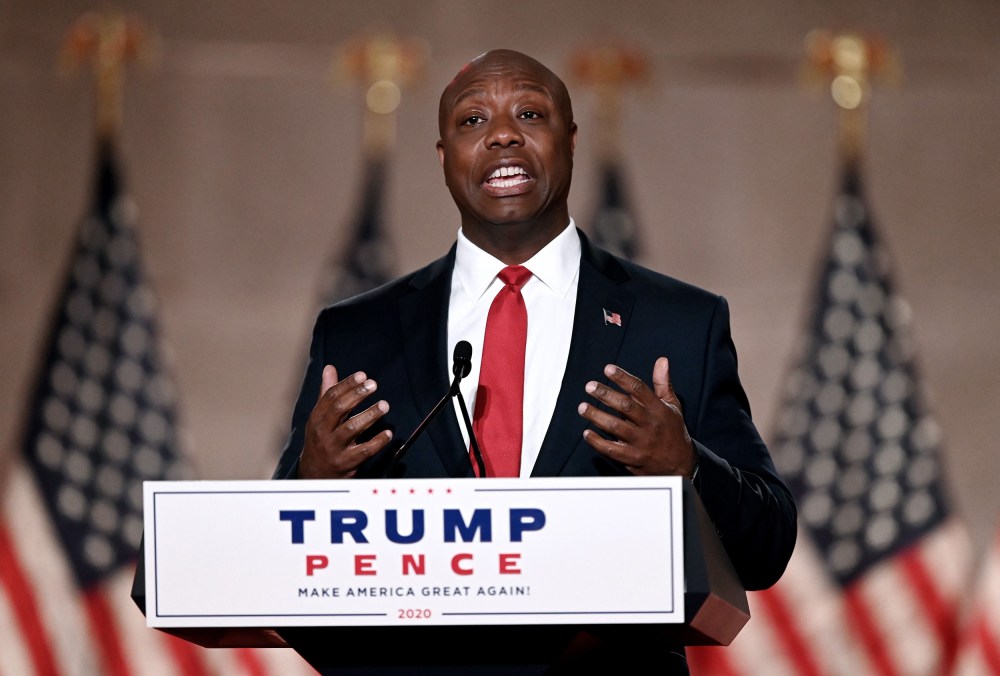

Sen. Tim Scott (R-S.C.) effectively headlined the first night of the Republican National Convention with a speech that included one of the evening’s most important claims.
“Ladies and gentlemen, people don’t always see [Joe Biden’s] failures, because they think we’re having a policy debate on two sides of an issue. That is not what is happening. Our side is working on policy — while Joe Biden’s radical Democrats are trying to permanently transform what it means to be an American.”
Part of this rang true: Americans may assume Democrats and Republicans are in the midst of a policy debate, but as the South Carolina Republican noted, that’s “not what is happening.”
It was the rest of his assessment that was problematic.
Indeed, the timing of Scott’s assertion that Republicans are “working on policy” could’ve been better: it was a day earlier when his party, which has been producing platforms every four years since 1856, decided it wouldn’t bother to debate, write, or release a GOP platform in 2020.
Republicans instead announced it would simply “reassert the party’s strong support for President Donald Trump and his administration,” in lieu of crafting an actual governing vision. As the Washington Post‘s Catherine Rampell put it yesterday, “No promises, no policy stances, nothing. Just a bootlicking, blank-check pledge to support anything Trump decides to do, no matter how erratic or lawless, and a (re)confirmation that the party is nothing more than a cult of personality.”
It coincided with the president’s re-election campaign releasing a purported “agenda” for the president’s second term, which was really just a series of hollow catch phrases and slogans masquerading as substantive goals.
So much for “our side is working on policy.”
This is of special interest to me because, as regular readers probably know, I recently wrote a book about how the modern Republican Party has become a post-policy party, indifferent to governing and the substance of solving problems — and this week’s convention developments offer fresh evidence to bolster the book’s thesis.
But what I find especially heartening is the degree to which the larger point continues to come into sharper focus for the political world. Yesterday, for example, Tim Alberta had a fascinating piece in Politico exploring the GOP having “given up” on substantive ideas.
The article quoted Brendan Buck, a longtime senior congressional aide and party veteran, saying, “Owning the libs and pissing off the media. That’s what we believe in now. There’s really not much more to it.”
In The Atlantic, Annie Lowrey had a related piece, describing today’s Republican Party as “the party of no content,” which has grown “remarkably quiet on how they would govern.” She added that GOP leaders have “moved into a queasy post-policy space.” The party’s “aperture has narrowed to just a few issues; its desire to try to pass major, proactive legislation has withered.” The same day, Sen. Josh Hawley (R-Mo.), apparently eager to help drive the point home, wrote an op-ed for Fox News arguing that Donald Trump is “upsetting the status quo” in favor of “working people.” As proof, the Missouri Republican pointed to … nothing in particular. New York‘s Eric Levitz lamented, “The populist case for Trump is now 100 percent policy free.” That’s true, and it’s an indictment with broad applicability. In fact, it’s the common thread that ties together practically all of the problems plaguing the president and his party: they’re failing on the coronavirus response because of their indifference toward policy and governing. They’ve failed to negotiate a new economic-aid package largely for the same reason. Tim Scott may declare with confidence that his side of the political divide is “working on policy,” but it leads to a series of awkward follow-up questions. What policies are Republicans working on? Who’s engaged in the efforts? Why are they hiding so effectively? Where are the fruits of the GOP’s governing labor? The fact that the answers to these questions is so elusive says a great deal about the veracity of the senator’s boast.
Steve Benen is a producer for "The Rachel Maddow Show," the editor of MaddowBlog and an MS NOW political contributor. He's also the bestselling author of "Ministry of Truth: Democracy, Reality, and the Republicans' War on the Recent Past."
Latest Post
Recommended


