








With the Senate’s vote on Obamacare subsidies just more than a week away, it’s no surprise Democrats don’t have a bipartisan deal to extend the tax credits — Republicans have made it clear they’re unlikely to ever agree to one.
What is surprising, however, is that Democrats haven’t settled on what they’ll put forward for a vote.
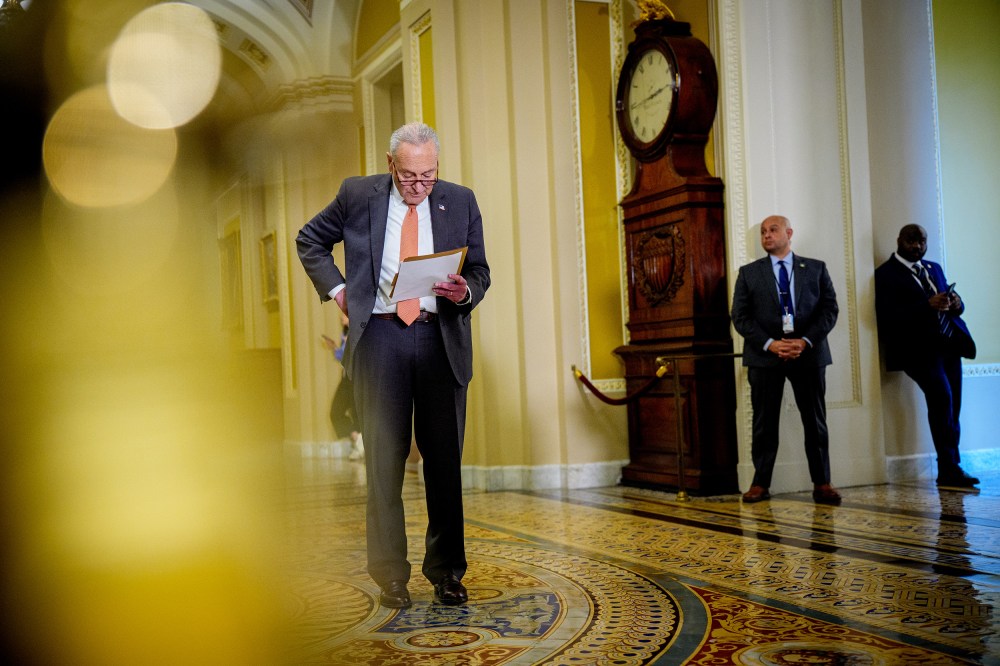
“Stay tuned,” Senate Minority Leader Chuck Schumer, D-N.Y., told reporters Tuesday, saying only that Democrats will be “focused like a laser on lowering people’s costs.”
As part of the bipartisan deal to end the record-breaking government shutdown last month, Republicans agreed to allow Democrats a vote of a health care bill of their choosing by mid-December.

Democrats made combating rising health care costs a central tenet of their shutdown demands — pushing both to extend expiring enhanced Affordable Care Act subsidies and to roll back the cuts to Medicaid included in the GOP’s reconciliation bill that was signed into law over the summer.
But as it stands now, there’s a decent chance they end the year with neither of those goals met.
Coming out of their weekly lunch Tuesday, many Senate Democrats were tight-lipped about what they’ll put up for a vote — with some hinting that next week could end up as a messaging exercise with show votes that, legislatively, accomplish nothing.
“Most of us want a multi-year clean extension,” said Sen. Chris Murphy, D-Conn. “But that wouldn’t get 13 Republican votes.”
“The caucus will have a unified position,” Sen. Tim Kaine, D-Va., told MS NOW, declining to get ahead of the rest of the Democratic coalition.
And Sen. Andy Kim, D-N.J., told MS NOW that Democrats planned “to build the broadest consensus we can amongst all Democrats.”
That last point — building a consensus among “all Democrats” — could prove to be difficult. Before the shutdown, there was internal debate about whether Democrats should focus just on extending the subsidies, or whether their demands should include reversing those Medicaid cuts.
Ultimately, in order to get everyone on board, Democratic leadership included rolling back the Medicaid cuts. But that made it easier for Republicans to cast the Democratic demands as unreasonable.
This time around, with Republicans mostly united on not extending the subsidies, Democrats face similar questions: Should they focus on unifying their own caucus? Or should they focus on dividing the Republicans?

If their goal is maximum political fallout, Democrats could offer a clean and temporary extension — the sort of proposal that some Republicans would actually support. But if this is all a political exercise anyway, they could alternatively just put forward their preferred policy.
“If we can’t get Republican votes, then we’ve just got to come to a conclusion about, you know, what’s the best thing to put on the floor,” Murphy said. “I don’t think we can help Republicans hide from accountability.”
Sen. Peter Welch, D-Vt., told MS NOW that while he’s “basically” in favor of a universal health care program, “we’re not going to get that in the next week.”
“Theress something really particularly urgent about the tax cuts, because they expire,” he added.
As the vote approaches, bipartisan conversations about a potential path forward on health care have almost petered out.
Asked Tuesday about how close they are to an agreement, Sen. Jeanne Shaheen, D-N.H., had a simple answer: “I think we’re not.”
Abortion access continues to be a point of contention — specifically, the Hyde Amendment, which bans federal funds from being used for abortions except in cases involving rape, incest or when the life of the mother is at risk.
Sen. Angus King, I-Maine — who worked with Shaheen to end the shutdown last month — said a Republican push for Hyde Amendment protections in the subsidies has left talks “at a standstill.” And the chances of breaking that impasse? “Doesn’t look very promising,” according to King.
King said he is confident other eligibility requirements GOP lawmakers are pushing — income level caps, for example — could be negotiated, but the push to install Hyde Amendment language is “not negotiable, apparently.”

Republicans have demanded that any extension of the enhanced tax credits includes Hyde Amendment language, describing that element as a deal-breaker for negotiations. Democrats say such an addition would be unnecessary since Obamacare already includes Hyde Amendment language.
There’s a decent possibility that next week plays out as follows: Each party offers their own health care proposal and they both fail in the Senate on party-line votes. Much like Democrats, though, Senate Republicans have yet to coalesce around a counteroffer. “Not that I’ve heard,” Sen. Josh Hawley, R-Mo., said of a GOP proposal. “We have a lot of work to do.” Sen. Bill Cassidy, R-La., is one of those who is offering a proposal, which he is pitching as fulfilling something President Donald Trump has pushed for: sending money directly to Americans rather than insurance companies. Cassidy’s proposal calls for replacing the premium tax credits with prepaid health savings accounts, or HSAs. Asked by MS NOW on Tuesday about how many GOP votes he could deliver for his plan, Cassidy was noncommittal. “Haven’t done a whip count yet,” he said. “But I continue to speak.” Retiring Republican Sen. Thom Tillis of North Carolina said that while Cassidy has “great ideas,” Tillis said Cassidy’s plan is “complex.” “There’s views on either side of the aisle, and I don’t even know if it’d be well received by the House,” Tillis continued. Tillis is warning his party that they need to do something to avert skyrocketing Obamacare premiums or they will “absolutely” pay a political price in competitive elections such as North Carolina’s Senate race next year. “The Democrat strategists have got to be thinking about all the sympathetic stories that theyrre going to march out, beginning in the first quarter of next year, if we don’t get it done,” Tillis said. Sen. Elizabeth Warren, D-Mass., argued this is why the White House floated what amounted to a health care plan trial balloon last week, suggesting lawmakers extend the enhanced subsidies for two years. GOP lawmakers ultimately shot down the idea. Trump “recognizes the Republicans have a real problem,” Warren told MS NOW. “They’ve got an affordability problem, and health care is at the top of that list.” But as Senate progress stalls, the House is looking to jump into the health care conversation. Rep. Brian Fitzpatrick, R-Pa., the co-chair of the bipartisan Problem Solvers Caucus, said he is aiming to roll out his bipartisan plan for the subsidies before the end of this week. He even floated filing a discharge petition for the matter as a break-glass-in-case-of-emergency option. Meanwhile, House GOP leaders still won’t promise a vote on the tax credits, putting the fate of the subsidies — which expire in less than a month — in jeopardy. “We haven’t committed to anything,” House Majority Leader Steve Scalise, R-La., said Tuesday.
Kevin Frey is a congressional reporter for MS NOW.
Mychael Schnell is a reporter for MS NOW. Recommended



