








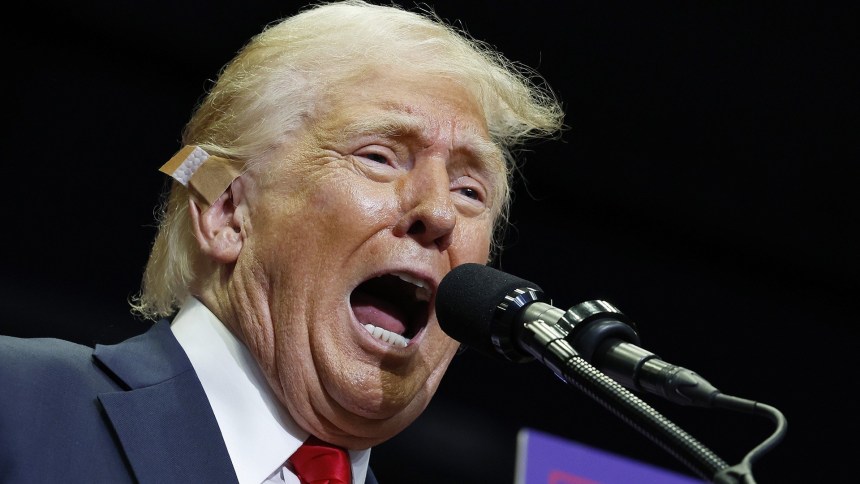

As many major news outlets continue to digest President Joe Biden’s withdrawal from the 2024 race and the Democratic Party’s swift rallying around Vice President Kamala Harris as its standard bearer, you would be forgiven if you had turned your attention away from the person who commanded last week’s news cycle: Donald Trump.
But almost 24 hours to the minute after Biden announced he was leaving the race, Trump took to Truth Social on Monday with what could be a significant post of his own, suggesting it’s his “time to sue” an unspecified “them for illegally breaking into, and raiding, Mar-a-Lago” in the wake of federal District Judge Aileen Cannon’s dismissal of the classified documents case.
Yet, that case — which concerns Trump’s alleged possession of classified and other national security related documents at Mar-a-Lago and both his and his two co-defendants’ alleged obstruction of the federal investigation of the same — was not thrown out because of any finding that the August 2022 search of Mar-a-Lago was legally defective. Instead, Cannon dismissed the case for a wholly unrelated reason: She ruled that the appointment of special counsel Jack Smith and the funding of his office violate two distinct clauses of Article II of the U.S. Constitution.
Nonetheless, the former president-turned-GOP-presidential-nominee is now not only insisting that the Mar-a-Lago search and seizure of evidence broke the law, but also that he intends to sue prosecutors and/or the FBI for violating his rights. And his post therefore begets two questions: One, is Trump serious about a civil lawsuit against federal prosecutors? And two, assuming he is, would that suit have any chance of succeeding?
It’s at best unclear whether Trump could establish the elements of malicious prosecution under Florida law.
Let’s start with whether Trump truly intends to sue. A spokesperson for the Trump campaign did not immediately respond to a request for comment, but if past is prologue, the answer is likely yes. Recall that the nation was first introduced to Cannon not as a result of the indictment against Trump, which was randomly assigned to her, but through the civil case Trump himself filed two weeks after the Mar-a-Lago search and used to secure the appointment of a special master to review the evidence collected “to preserve the sanctity of executive communications and other privileges.”
The second and more significant question then is what such a lawsuit would look like. Let’s assume Trump is going to sue and that what he’s after is a damages award that would hurt and embarrass the government. Whom would Trump sue and what claims might he advance?
Ordinarily, under Supreme Court precedent, the federal government and its agencies are immune from damages unless they waive sovereign immunity. Yet a federal statute — the Federal Tort Claims Act — does exactly that. It specifically allows lawsuits for torts such as false arrest, abuse of process or malicious prosecution where those claims are rooted in the acts of federal investigative or law enforcement officers, a category broadly defined to include “any officer of the United States who is empowered by law to execute searches, to seize evidence, or to make arrests for violations of Federal law.” That doesn’t, of course, mean Trump is filing any such suit in the immediate future, especially as the special counsel’s office has indicated its intent to appeal Cannon’s dismissal of the case. Nor does it mean any lawsuit Trump files will necessarily be one for malicious prosecution. In part, that’s because it’s at best unclear whether Trump could establish the elements of malicious prosecution under Florida law, which would govern in this case. Under a 1994 Florida Supreme Court ruling, claims of malicious prosecution in the state require proof not only that the plaintiff — here, hypothetically Trump — obtained a dismissal in his favor, but also that the case was dismissed because of his innocence. Plus, that plaintiff must also show, among other factors, proof that prosecutors lacked probable cause and acted with malice. Here, by contrast, the case was dismissed on procedural, not substantive grounds, and there are no conclusive judicial findings from the litigation before Cannon that the Mar-a-Lago search was inappropriate or legally defective. On the contrary, late last month, Cannon found Trump failed to make even a preliminary showing that the affidavit submitted by the Justice Department to obtain the Mar-a-Lago search warrant contained any material false statements or omissions, a showing required to obtain any further hearing about the warrant’s propriety. So should we take Trump at his word that he intends to sue? Sure. But can we expect Trump to launch this newest legal effort soon, much less successfully? That’s both more dubious and murkier.
Lisa Rubin is MS NOW's senior legal reporter and a former litigator.
Latest Post
Recommended


