









During his 2016 campaign, when Donald Trump would warn his followers about nefarious enemies, he generally focused his attention outside the United States. The Republican attacked Mexicans, U.S. trading partners, and a mysterious “global power structure” that Trump said controlled the media, the finance industry, the government, major corporations, and the political process as part of a vast conspiracy that only he and a select few were aware of.
Four years later, as the president seeks a second term, he’s once again letting his followers know about pernicious forces he’s eager to defeat, but this time, as Trump made clear over the holiday weekend, the enemies are far closer to home.
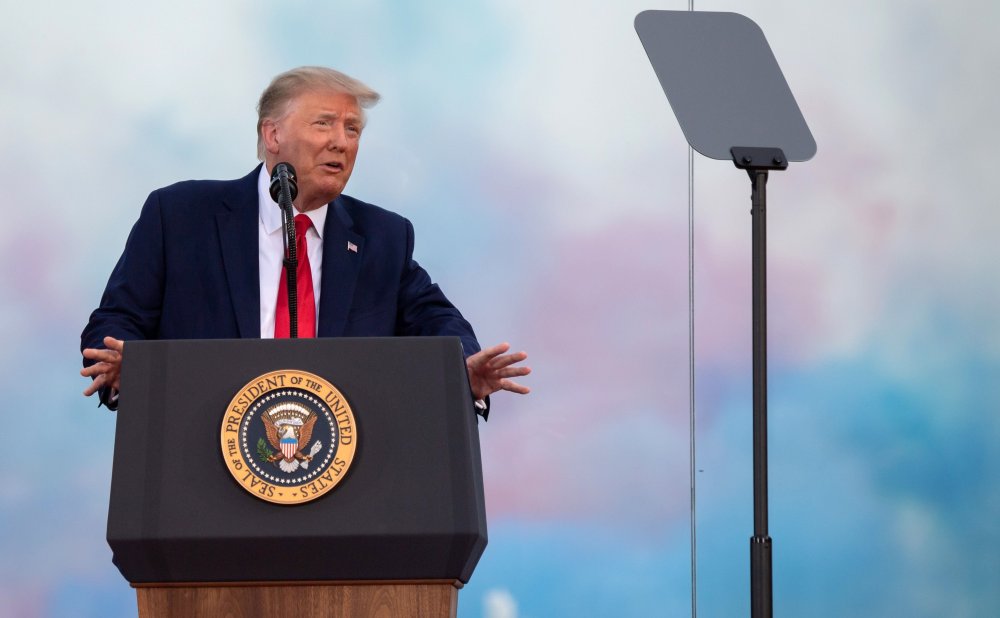
President Donald Trump on Friday celebrated Independence Day by defiantly holding a rally at Mount Rushmore amid the pandemic, using the monument to decry protestors who have toppled Confederate, patriarchal and colonial monuments from coast to coast. As much of the nation has turned against its unequal system of justice and its bitter history of racism in the wake of George Floyd’s death, Trump used the occasion to glorify American history’s heroes and excoriate demonstrators who have ripped statues from their pedestals.
A couple of weeks ago, with multiple polls showing the incumbent president trailing Joe Biden by double digits, Senate Majority Whip John Thune (R-S.D.) — the #2 GOP leader in the chamber — conceded that Trump needed a course correction.
“Right now, obviously, Trump has a problem with the middle of the electorate, with independents, and they’re the people who are undecided in national elections,” Thune told reporters. “I think he can win those back, but it’ll probably require not only a message that deals with substance and policy but, I think, a message that conveys, perhaps, a different tone.”
On the heels of that advice, Trump went to Thune’s home state and rolled out a very specific — and equally ugly — kind of message. In front of Mt. Rushmore, the president carefully played on national divisions, hoping to pit Americans against one another in order to advance his ambitions.
As the New York Times put it, Trump used the 4th of July weekend “to mount a full-on culture war against a straw-man version of the left that he portrayed as inciting mayhem and moving the country toward totalitarianism.”
That assessment wasn’t hyperbolic in the slightest. “Our nation is witnessing a merciless campaign to wipe out our history, defame our heroes, erase our values and indoctrinate our children,” the president declared. “Angry mobs are trying to tear down statues of our founders, deface our most sacred memorials and unleash a wave of violent crime in our cities.”
Far from trying to unify the country or honor American traditions, Trump told his followers, “In our schools, our newsrooms, even our corporate boardrooms, there is a new far-left fascism that demands absolute allegiance. If you do not speak its language, perform its rituals, recite its mantras, and follow its commandments, then you will be censored, banished, blacklisted, persecuted, and punished…. Make no mistake: this left-wing cultural revolution is designed to overthrow the American Revolution.”
As part of the same tirade, Trump added, “One of their political weapons is ‘Cancel Culture’ — driving people from their jobs, shaming dissenters, and demanding total submission from anyone who disagrees. This is the very definition of totalitarianism.”
Happy Independence Day, one and all. What used to be a non-partisan day of celebration has become the latest arrow in Trump’s quiver.
The broader political context was far from subtle: against a backdrop of a public-health crisis he has no idea how to address, the president largely ignored the deadly pandemic ravaging his own country and instead sought to exploit national divisions to boost his struggling candidacy.
Trump has few accomplishments to run on; he has no agenda for a second term; and he hasn’t quite figured out how best to smear his opponent. But Trump is all too aware of the nation’s dividing lines — which in his mind, can and should serve as the basis for his campaign.
A day later, celebrating the 4th at the White House, the president kept his us-vs-them offensive going, declaring, “We are now in the process of defeating the radical left, the Marxists, the anarchists, the agitators, the looters, and people who, in many instances, have absolutely no clue what they are doing…. Their goal is demolition. Our goal is not to destroy the greatest structure on Earth, what we have built: The United States of America.” Note the framing: “their goal” vs. “our goal.” The “us” isn’t Americans at large; it’s citizens who look and think like Donald Trump. Behind in the polls and fearing defeat, the American president has finally found the 2020 message he’s been looking for: Trump has decided to run against Americans he doesn’t like. The Washington Post‘s David Nakamura had a terrific analysis on this, explaining over the weekend, “As he has so often during his tenure, the president made clear that he will do little to try to heal or unify the country ahead of the November presidential election but rather aims to drive a deeper wedge into the country’s fractures. “For Trump, that has meant defining a new foil. If his 2016 campaign to put ‘America first’ was focused on building a wall to keep out immigrants and shedding alliances with nations he believed were exploiting the United States, the president is now aiming his rhetorical blasts at groups of liberal Americans who, he believes, constitute a direct threat to the standing of his conservative base.” Election Day is 17 weeks from tomorrow. Trump’s eagerness to tear the country apart, confident that he’ll be left with the bigger chunk, is all but certain to intensify. And what about John Thune’s recent recommendation that the president expand his appeal “with the middle of the electorate”? Perhaps with “a different tone”? This report from the weekend stood out for me: “On Friday night at Mount Rushmore, Sen. John Thune (R-S.D.), a member of the party’s leadership, and other top Republicans were seen applauding as Trump spoke.”
Steve Benen is a producer for "The Rachel Maddow Show," the editor of MaddowBlog and an MS NOW political contributor. He's also the bestselling author of "Ministry of Truth: Democracy, Reality, and the Republicans' War on the Recent Past."
Latest Post
Recommended


