









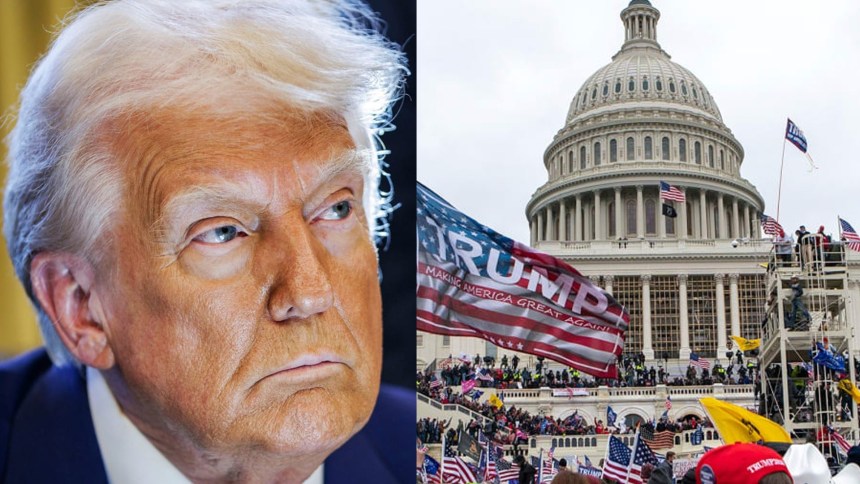

Almost immediately after Donald Trump pardoned Jan. 6 criminals, including convicted felons who violently clashed with police, congressional Republicans were asked for their reactions. They mostly tried to adopt a forward-thinking posture.
Senate Majority Leader John Thune, for example, said in response to questions about the pardons, “We’re looking at the future, not the past.” Republican Sen. Kevin Cramer of North Dakota, similarly added, “I’m ready to move forward.”
This was a badly flawed reaction for a variety of reasons, but House Speaker Mike Johnson echoed his party’s preferred talking point anyway. “The president’s made a decision, we move forward,” the Louisiana Republican told reporters on the third day of the new Trump era. Johnson added, “We’re not looking backwards, we’re looking forward.”
As it happens, that wasn’t altogether true. GOP officials didn’t want to look back at Trump’s pardons from January 2025, but they most certainly want to look back at the insurrectionist violence from January 2021. NBC News reported:
House Republicans are moving to create a new select subcommittee to ‘continue Congress’ investigation’ of the Jan. 6, 2021, attack on the Capitol, chaired by Barry Loudermilk, R-Ga. The House will have to vote on the resolution to establish the subcommittee, which would fall under the Judiciary Committee.
The House speaker — the one who said, “We’re not looking backwards, we’re looking forward” after Trump put violent criminals back on American streets — boasted this week that his party should further investigate Jan. 6 because “there is clearly more work to be done.”
In reality, it’s not nearly as “clear” as the GOP leader wants the public to believe.
In case anyone needs a refresher, it was just a few years ago, as the Republican majority in the House got to work, when the party decided it was time for a new, GOP-friendly investigation into the Jan. 6 attack. The endeavor would be led by Loudermilk, who faced some uncomfortable questions about a controversial Capitol tour the day before the riot.
After launching his own Jan. 6 probe, the Georgia Republican’s first step was simple: He exonerated himself.
In the months that followed, Loudermilk said he intended to determine “what really happened” on Jan. 6, indifferent to the fact that we already learned what really happened.
More than a year after launching the partisan probe, Loudermilk and his GOP colleagues released a report on their findings, which was effectively meaningless and broke no new ground. The document appeared to be designed to undermine the bipartisan House Jan. 6 committee from the previous Congress, but it failed, and even most Republicans blew it off as irrelevant.
Loudermilk and his cohorts set out to discredit earlier findings and expose shocking new details that would alter the public’s understanding of the assault on the Capitol, but the partisan bombshell was a dud. In the months that followed, Loudermilk continued to engage in half-hearted efforts — he even asked the Justice Department to launch a criminal investigation into former House GOP Conference Chair Liz Cheney for foolish reasons that collapsed under scrutiny — but by any fair measure, the entire endeavor was a failure. Congressional Democrats barely bothered to push back against Loudermilk’s “investigation” for the most insulting of reasons: They saw it as too boring and pitiful to warrant a full-throated response. It’s against this backdrop that the House Republican leaders settled on a brilliant idea: Johnson wants the same congressman who failed in his Jan. 6 investigation in the last Congress to keep going with another Jan. 6 investigation in the current Congress — all while telling the public that GOP lawmakers are “looking forward” and leaving Jan. 6 in the rearview mirror. He said this week that Republicans “are proud” to be “exposing false narratives” from the Jan. 6 committee in the 117th Congress. MAGA activists who are expecting blockbuster revelations should probably start lowering their expectations now. This post updates our related earlier coverage.
Steve Benen is a producer for "The Rachel Maddow Show," the editor of MaddowBlog and an MS NOW political contributor. He's also the bestselling author of "Ministry of Truth: Democracy, Reality, and the Republicans' War on the Recent Past."
Latest Post
Recommended


