









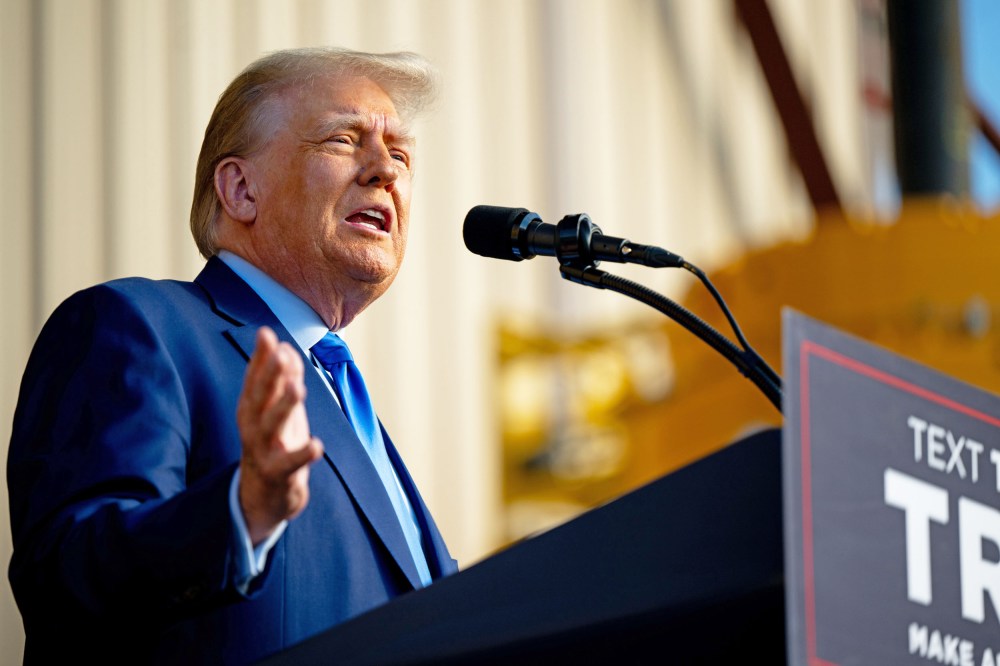

Donald Trump didn’t make a lot of news at his latest campaign rally in Houston, though the former president did boast about something he expects to be able to do if given a second term:
“We’re going to pay off debt — the $35 trillion in debt. We’re going to pay it off. We’re going to get it done fast, too.”
He didn’t appear to be kidding.
Trump says if he is elected he will get the national debt “paid off fast.” pic.twitter.com/AEOf76JyEt
— Ron Filipkowski (@RonFilipkowski) November 2, 2023
If the campaign promise sounds at all familiar, it’s not your imagination. In fact, let’s take a quick stroll down memory lane.
As regular readers may recall, in February 2016, the future president appeared on Fox News and assured viewers that, if he were president, he could start paying off the national debt “so easily.” The Republican argued at the time that it would simply be a matter of looking at the country as “a profit-making corporation” instead of “a losing corporation.”
A month later, Trump declared at a debate that he could cut trillions of dollars in spending by eliminating “waste, fraud, and abuse.” Asked for a specific example, he said, “We’re cutting Common Core.” (Common Core is an education curriculum. It costs the federal government almost nothing.)
A month after that, in April 2016, Trump declared that he was confident that he could “get rid of” the entire multi-trillion-dollar debt “fairly quickly.” Pressed to be more specific, the future president replied, “Well, I would say over a period of eight years.”
By July 2016, he boasted that once his economic agenda was in place, “we’ll start paying off that debt like water.”
As The Washington Post’s Catherine Rampell explained before the Covid-19 crisis, “Federal deficits have widened immensely under Trump’s leadership. This is striking not only because he promised fiscal responsibility — at one time even pledging to eliminate the national debt within eight years — but also because it’s a historical anomaly. Deficits usually narrow when the economy is good and we’re not engaged in a major war. … Trump’s own policies are to blame for this aberration.”
Once the pandemic began, deficits grew even larger. By the time the Republican left office, Trump had added nearly $7.8 trillion to the national debt in just one term, and most of that total was racked up before the Covid crisis.
All of his assurances about eliminating the national debt “fairly quickly” were exposed as ridiculous. Indeed, Trump abandoned his fiscal concerns not long after reaching the White House. By early 2020, the then-president asked audiences rhetorically, “Who the hell cares about the budget?” And yet, here we are, once again seeing the same Republican making the same promises. Trump not only expects to balance the budget — a fanciful goal for one term — he wants voters to believe he’ll quickly be able to pay off tens of trillions of dollars in debt. Obviously, that’s bonkers. But less obvious is the subtext: The former president apparently expects voters to fall for the same trick twice. Indeed, this helps undergird much of his pitch for the 2024 cycle. In his first presidential campaign, Trump told voters he’d “make every dream you ever dreamed for your country come true.” Ahead of Election Day 2016, the Republican added that he’d “fulfill every single wish” Americans had for his presidency. Now, with his record of failure hardly gone from our collective memories, he’s doing it again, offering another round of grandiose promises he’ll never be able to keep, and hoping the electorate won’t pay too much attention to the details. This post updates our related earlier coverage.
Steve Benen is a producer for "The Rachel Maddow Show," the editor of MaddowBlog and an MS NOW political contributor. He's also the bestselling author of "Ministry of Truth: Democracy, Reality, and the Republicans' War on the Recent Past."
Latest Post
Recommended


