











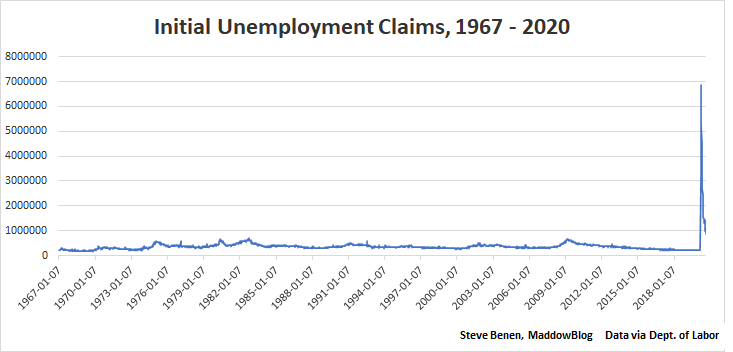
When it comes to weekly unemployment filings, our whole understanding of “normal” flew out the window six months ago. During the Great Recession, for example, when jobless claims topped 600,000, it was considered a catastrophe.
But in 2020, as the coronavirus pandemic started taking a brutal toll on the U.S. economy, Americans confronted an entirely new set of standards — to the point that it seemed like relatively good news two weeks ago when initial jobless claims fell below 1 million for the first time since March.
The new report from the Labor Department pointed in a similar direction today.
In the week ending August 29, the advance figure for seasonally adjusted initial claims was 881,000, a decrease of 130,000 from the previous week’s revised level. The previous week’s level was revised up by 5,000 from 1,006,000 to 1,011,000. The 4-week moving average was 991,750, a decrease of 77,500 from the previous week’s revised average.
Before March, a report like this would’ve been seen as a disaster, but when the number of Americans filing for unemployment benefits tops 1 million 21 times in 23 weeks, this starts to resemble progress.
The cumulative effects continue to matter: these 881,000 Americans who’ve just filed for jobless benefits are in addition to the totals from the last several weeks. In other words, we’ve seen more than 59 million initial unemployment claims filed since mid-March — a total unlike anything the country has seen in modern times.
A reader recently asked me a good question about this statistic: if 59 million Americans have sought jobless benefits, why do most reports indicate that roughly 29 million Americans are out of work? The answer is, many of those who were forced from the workforce after the crisis began in earnest were laid off temporarily, and have since either returned to their old jobs or found new ones. That said, the fact that there are roughly 29 million Americans still looking for a job is a brutal total by any fair standard. All of this reinforces the fact that this is a terrible time to have halted the $600-per-week federal supplement, which expired at the end of July. Nevertheless, the lifeline is gone, unable to overcome Republican opposition. (The $300-per-week stopgap measure recently touted by the Trump White House isn’t yet broadly reaching American households.) I put together the above chart, and at the request of some readers, it shows weekly unemployment filings since 1967, when the federal government started keeping track. (I’ve also made the line a little skinnier to help show the recent drop from last month’s spike.) The image may make it appear as if the last half-century has been relatively stable, but that’s really not the case: there were significant peaks and valleys throughout this period. But those fluctuations now seem minor by comparison.
Steve Benen is a producer for "The Rachel Maddow Show," the editor of MaddowBlog and an MS NOW political contributor. He's also the bestselling author of "Ministry of Truth: Democracy, Reality, and the Republicans' War on the Recent Past."
Latest Post
Recommended


