








Did you catch Mitt Romney’s victory speech in Illinois last night? Echoing the themes — and at times, the literal phrasing — of his economic speech at the University of Chicago on Monday, the former governor spoke at length about his vague appreciation for “freedom.”
Romney did not, however, do what he spent 2011 doing: he didn’t accuse President Obama of making the economy “worse.”
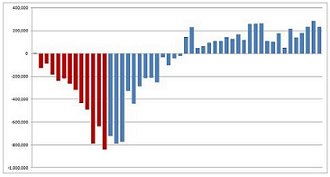
This is not an accident. I first started reporting in January about the subtle — and at times, not-so-subtle — shift in Romney’s rhetoric about the economy, as the candidate and his campaign began to come to terms with the fact that the recovery is picking up steam. Romney had a choice: stick to a line no one would believe, or adapt to improving circumstances. He chose the latter, and now acknowledges practically every day that the economy is getting better on Obama’s watch, while trying to deny the president credit for the progress.
The L.A. Times had a good report on this yesterday, noting that Romney effectively had no choice.
[A]fter months of steady job growth, improved consumer confidence and big gains on Wall Street, the economy seems in less dire need of fixing, and Romney has been forced to alter his message or risk seeming out of touch.
“I believe the economy’s coming back,” Romney said at a breakfast stop Monday in Springfield, where the former Massachusetts governor campaigned ahead of Tuesday’s Illinois primary.
But he gave absolutely no credit to President Obama — “the economy always comes back after recession” — and insisted the administration’s policies had made matters worse and the recovery slower than it should have been.
Greg Sargent added, “This yet another sign that the Romney campaign is betting heavily on the possibility that the American people won’t remember or factor in just how awful a crisis Obama inherited upon taking office.”
Quite right. At this point, the old Reagan line — “Are you better off now than you were four years ago?” — is the one question Romney and the Republican Party doesn’t want Americans to ask, because it’s so transparently obvious that national conditions have improved considerably.
This is not to say that conditions are good, necessarily, only that they’re better. When FDR sought re-election in 1936, the unemployment rate was 17%, but he won re-election in a historic landslide — not because a 17% unemployment rate was satisfactory, but because Americans realized Roosevelt inherited a crisis and helped get the country back on track. It was about the direction, not the condition — like now, the economy went from losing jobs to gaining jobs, from contraction to growth. It makes Romney’s challenge very difficult. His pitch is, in effect, “Sure, Obama inherited a global crash, took steps to turn the economy around, and I’ll concede that things are now better. But vote against him anyway because I perceive us lacking … economic ‘freedom.’” This is the single most important aspect of the 2012 presidential election, and Mitt Romney appears to have found himself without an argument.
The place for in-depth analysis, commentary and informed perspectives. Recommended


