








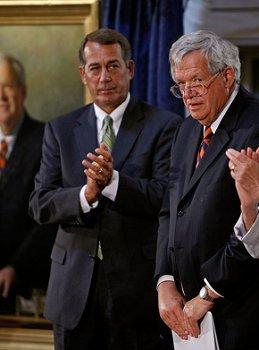
With legislation related to gun safety and immigration reform slowly inching forward in the Senate, House Speaker John Boehner’s (R-Ohio) strategy of letting everything fail in the upper chamber is likely to face some meaningful tests in the coming months. Are House Republicans prepared to try governing for a change?
Probably not. In fact, many rank-and-file GOP House members are already hoping the so-called “Hastert Rule” will prevent any meaningful legislation from becoming law in this Congress. James Carter passed along this item of interest on the bill to prevent gun violence.
U.S. Reps. Paul Broun of Georgia and Steve Stockman of Texas have collected the signatures of more than three dozen Republicans on a letter warning congressional leadership from green lighting legislation providing for universal background checks without majority support from the House GOP caucus.
“We are writing to express our strong opposition to legislation requiring private background checks for firearms purchasers,” the pair, joined by 45 other Republicans, wrote. “Under the precedents and traditions of the House, we would ask that no gun legislation be brought to the floor of the House unless it has the support of a majority of our caucus.”
Other far-right House lawmakers are expressing a similar sentiment on looming immigration legislation — it doesn’t matter if a majority of the House wants reform; what matters is whether a majority of House Republicans want reform.
Of course, the “precedents and traditions of the House” is an amorphous phrase that doesn’t appear to mean much, though in this case, conservatives are referring to something called the “Hastert Rule,” which as regular readers know, is a subject we’ve been following closely.
To briefly recap for those just joining us, under the “Hastert Rule,” a Republican Speaker of the House is only supposed to bring bills to the floor that most of his own caucus supports (measures that enjoy a “majority of the majority”). The idea is, Republicans shouldn’t even consider bills if they’re dependent on Democratic votes to pass — the real power belongs in the hands of the House GOP’s far-right rank and file. Boehner stuck to the non-binding, informal “rule” in the last Congress, but the right is starting to panic a bit because it’s unclear if the Speaker will continue to do so in this Congress.
Conservative concerns are often rooted in paranoia, but in this case, their fears are well grounded.
Consider what Boehner said yesterday.
“Listen,” House Speaker John Boehner said Thursday, “it was never a rule to begin with.”
Recommended


Boehner was talking about the so-called “Hastert rule,” which says, roughly, that the speaker of the House shall not consider any legislation that does not command support from a majority of his own party. The result is that lots of legislation that could get a majority in the House never comes to a vote because it couldn’t get a majority of the House Republican Conference.
But Boehner is right: There is no such thing as the Hastert rule. That’s how Speaker of the House Dennis Hastert ran things when he was in charge — though he, too, broke the rule on occasion. But there’s no reason things have to be run that way.
Indeed, as I’ve been reporting for months, the House isn’t even running this way now. In the first three months of this Congress, Boehner ignored the so-called “rule” three times, and just this week, Sarah Binder noticed the Speaker quietly blowing it off for a fourth time.
Yesterday, Boehner sought to remind everyone that the “rule” isn’t really a rule at all, which only reinforces the impression that the Speaker is not inclined to let this guideline dictate his actions.
This may seem like inside baseball, and obscure legislative procedures may seem dull, but this matters. As we’ve discussed, if Boehner, in the name of getting stuff done, is open to bringing important bills to the floor, and passing legislation even when most of his own members disapprove — relying on a combination of Democratic and Republican votes — the next two years may prove to be constructive. More to the point, it means gun safety and immigration reform may even pass.
If, however, the Speaker backs down in the face of right-wing complaints, such as those raised yesterday, this Congress, like the last, will fail miserably to even vote on meaningful legislation.
The place for in-depth analysis, commentary and informed perspectives.
