








In the 1994 midterms, Republicans posted huge gains and took control of Congress. Time magazine published a cover image of a powerful, triumphant elephant crushing a donkey, under a headline that called it a “GOP stampede.”
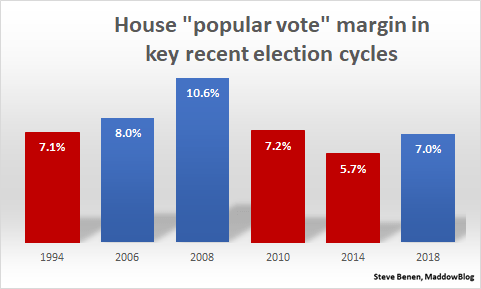
Republicans had reason to crow at the time: by a 7.1% margin, American voters had backed GOP candidates over Democratic candidates.
Nearly a quarter of a century later, Democrats apparently won the House “popular vote” by 7%.
I realize Republicans, benefiting from a Senate map that was almost comically titled in their favor, are thrilled to see their majority grow in the upper chamber. I can also appreciate why many Democrats were disappointed to see some heartbreaking losses in key contests, especially in Florida.
But the scope of the House Democratic victories was rather extraordinary. I put together the above chart based on the findings from Princeton’s Sam Wang, who highlighted the popular-vote gap in House races in several recent cycles.
House Republicans, for example, had excellent years in 1994 and 2010, but House Democrats kept pace with these tallies.
Some observers will no doubt ask in response, “Then why didn’t Democrats win even more seats?” The answer is a familiar one: between Republican gerrymandering and concentration of Democratic votes in urban areas, the party faced an enormous challenge even trying to take back the House of Representatives.
But they did anyway.
I’m inclined to skip the debate over whether or not this counts as a “wave.” The term has no specific definition in political science, and the fact that there’s a debate at all reinforces the fact that it’s a subjective matter. What strikes me as the more salient point is that Republicans had all kinds of advantages, including a strong economy and gerrymandered maps, but the GOP got slammed in House races anyway. As Vox’s Matt Yglesias explained this morning, “After the 2010 midterms, Republicans held the House and the majority of the population lived under GOP governors but they only had 47 senate seats after some disappointing losses. I don’t think people saw that as an ambiguous outcome.” Update: As additional votes have come in, the “popular vote” has shifted. I’ve updated the chart and text to reflect the revised tallies.
Steve Benen is a producer for "The Rachel Maddow Show," the editor of MaddowBlog and an MS NOW political contributor. He's also the bestselling author of "Ministry of Truth: Democracy, Reality, and the Republicans' War on the Recent Past." Recommended


