








One of the oddities of the escalating tensions between the U.S. and Syria is the noticeable lack of ultimatums. At no point has the Obama administration said, “Unless Syria does x, the United States will have no choice but to pursue y.” There are no deadlines the Assad government has been expected to meet; there are no promises Syria has been asked to keep. The question that has dominated the last few weeks is whether the U.S. will use force, not what Syria might do to prevent such action.
This landscape changed slightly this morning in unexpected ways.
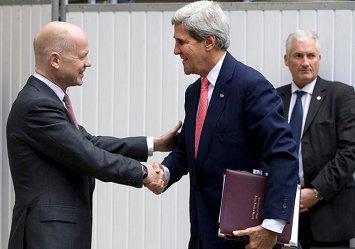
In London, Secretary of State John Kerry was asked if there’s anything Assad could do to avoid a military strike. “Sure,” Kerry said. Assad “could turn over every single bit of his chemical weapons to the international community in the next week.”
The comments did not go unnoticed.
Russia proposed on Monday that Syria hand over its chemical weapons to international control in an attempt to avert a U.S. military attack.
Sergei Lavrov, the Russian foreign minister, told reporters that he had conveyed the idea to Syria at talks in Moscow and expected “a quick and, I hope, a positive answer.” Syria publicly welcomed the idea, but a senior White House official told NBC News that it was no more than a delay tactic.
Well, sure, but as delay tactics go, this one’s really interesting.
This is still an unfolding story, but for those hoping to see a diplomatic resolution to the ongoing crisis, it offers an intriguing opportunity. Russia is, of course, Syria’s close ally, and if Russia sees Kerry’s comments this morning as a possible area of agreement, it tells us something important.
First, it suggests Russia still sees the possibility of a U.S. military strike as likely, congressional skepticism notwithstanding. Second, Russia knows full well that Syria has chemical-weapons stockpiles that Syria won’t formally acknowledge. And third, despite President Obama’s difficulties with Congress, there are still efforts underway to find a political solution.
If the consensus around the world was that a weak U.S. president was flailing, Russia would have no incentive to act at all — it could have simply ignored Kerry’s comments and wait for Republicans to shut down the White House’s foreign policy.
Preliminary reports suggest the Obama administration was unmoved, but this morning’s developments are clearly an unexpected break.
[T]he shift in tone between Mr. Lavrov’s two appearances was striking. Mr. Lavrov said he made the proposal to put Syria’s weapons under international control directly to Mr. Moallem, who remained in Moscow, but it was not immediately clear how the Syrian government might respond. Mr. Lavrov went into more detail than Mr. Kerry’s suggestion — which Mr. Kerry’s own spokeswoman described as a rhetorical exercise rather than a proposal. Mr. Lavrov said Russia was proposing that Syria join the international Convention on Chemical Weapons, which bars the manufacture, stockpiling and use of poison gas. Preliminary reports suggest Syria is amenable to the idea, and U.N. Secretary General Ban Ki Moon endorsed the policy at a news conference this morning. Occasionally, developments like these offer false hope — Russia and Syria may have important caveats in mind that would render the offer little more than a shell game. We’ve heard plenty of insincere offers before. But there’s a real opportunity here that the administration would be reckless to ignore.
Steve Benen is a producer for "The Rachel Maddow Show," the editor of MaddowBlog and an MS NOW political contributor. He's also the bestselling author of "Ministry of Truth: Democracy, Reality, and the Republicans' War on the Recent Past." Recommended


