








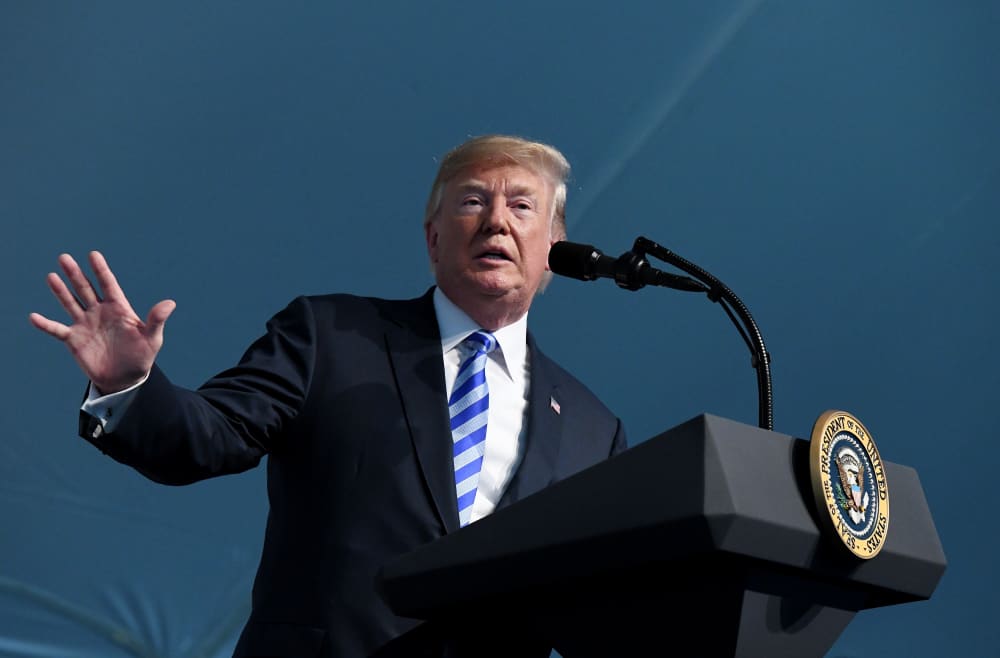
Most of Donald Trump’s remarks at a campaign rally in Minnesota last night were predictable — the president shared his usual grievances — but towards the end of his speech, the Republican shared a thought I haven’t heard him make before.
“You ever notice they always call the other side ‘the elite.’ The elite! Why are they elite? I have a much better apartment than they do. I’m smarter than they are. I’m richer than they are. I became president and they didn’t.”
For a quite a while, prominent voices in Trump World considered “the elite” to be their rivals, and perhaps even their enemies. Shortly after the 2016 election, for example, Kellyanne Conway, Trump’s third campaign manager, insisted that her boss’ success represented a rejection of the “elites.” In fact, she said her own Republican Party was “veering dangerously close to being the party of the elites” until Trump campaign came along.
Soon after, in the Time cover story naming Trump “Person of the Year,” Conway argued, “You cannot underestimate the role of the backlash against political correctness — the us vs. the elite.”
In this sense, the “elite” doesn’t describe wealth or status; it describes attitude. The “elite” care about niceties such as science, diversity, and the rule of law. Trump and his acolytes thumb their nose at the “elite” and their pointless principles.
It’s why, we’re told, a billionaire television personality, who lives in a gold penthouse, who cuts taxes on the rich, and who fights to protect Wall Street, can be a “populist,” while his critics are the “elite.”
Except as of last night, Trump isn’t satisfied with this dynamic — because he wants to be the elite, too.
I’ve never heard a politician complain before about not being labeled part of the elite, but Trump thinks he’s earned the title, thanks largely to the quality of his apartment, his self-proclaimed intellect, and the size of his bank account. Since launching his political career three years ago, Trump has laughably presented himself as a “man of the people,” but now he wants more. The president also sees himself as more elite than the elite, and he expects to be appreciated as such. The New Republic had a good item along these lines, arguing, “Unpacking Trump’s statement, it turns out he’s not, as populist heroes traditionally have been, the avatar or even the tribune of the common man. Rather, Trump is the true elite, a caste of one, the ubermensch who is smart, rich and able to become president. His followers, meanwhile, are ‘the deplorables’ who are, pointedly, not elite in Trump’s manner but have their own form of greatness and smartness which is displayed in their willingness to subsume themselves (‘the most loyal people on earth’) to Trump. This is not the creed of populism but rather of the strong man with an army of loyal followers.” Go ahead and call Trump an “elitist.” Evidently, he considers it a compliment.
Steve Benen is a producer for "The Rachel Maddow Show," the editor of MaddowBlog and an MS NOW political contributor. He's also the bestselling author of "Ministry of Truth: Democracy, Reality, and the Republicans' War on the Recent Past." Recommended


