








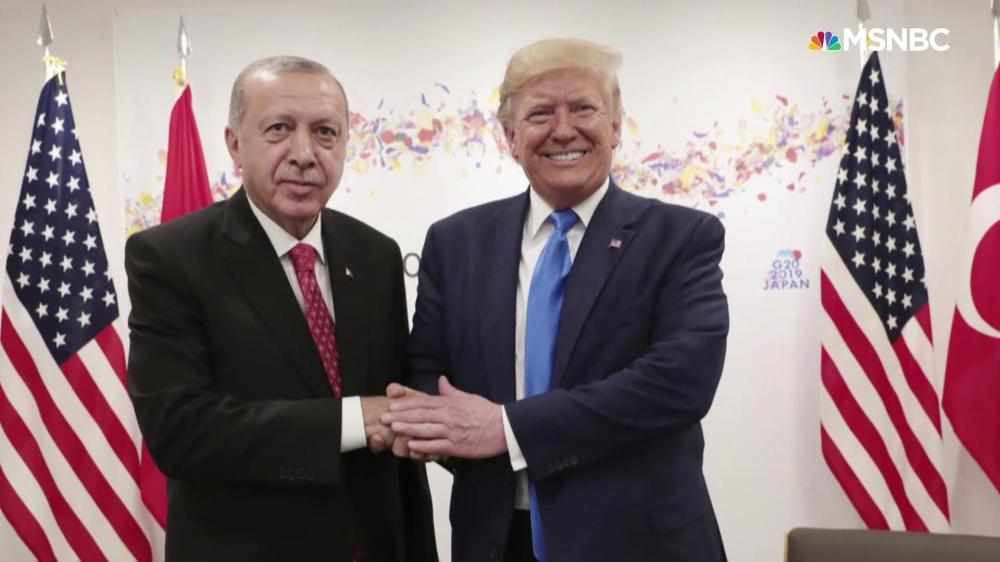
As of this minute, it’s not altogether clear what Donald Trump’s policy toward Turkey is or when it’s likely to change. On the one hand, the Republican impulsively overhauled a key element of his foreign policy in the Middle East because Turkish President Recep Tayyip Erdogan recommended it; on the other hand, Trump has threatened to “totally destroy and obliterate” Turkey’s economy.
On the one hand, Turkey is vowing to ignore the United States’ threats, signaling possible tensions between the countries; on the other hand, Trump will welcome Erdogan to the White House next month. All of this is unfolding, of course, while Trump both abandons and vows to never to abandon Kurdish forces
While the American president struggles to settle on a position, a question hangs over head: what role, if any, do Trump’s conflicts of interest have in this mess? A Washington Post analysis noted yesterday that the Republican acknowledged in December 2015 that his Trump Towers project in Istanbul create “a little conflict of interest” for him when it comes to Turkey.
The easy answer, the answer that might have been offered by any prior president, was that Trump would divest of his investments in Turkey before taking office. Instead, Trump offered another murky response, including an assertion that “we should have been able to win easily but we haven’t used the right military thought process.”
Nor did he divest, of course. Trump Towers Istanbul is still part of the Trump Organization and still generates revenue for Trump himself.
After the 2016 election, Trump chose Michael Flynn to serve as his White House national security adviser, despite Flynn’s work as a foreign agent of Turkey during the campaign. (The convicted felon is currently awaiting sentencing.)
A Democratic source reminded this morning that after Inauguration Day, Turkish officials started booking events at Trump-owned properties. One three-day conference at Trump’s D.C. hotel was organized, in part, by a group run by Ekim Alptekin, a Turkish businessman close to Turkish President Erdogan who hired Flynn a year earlier. As recently as April 2019, Turkey’s deputy minister of foreign affairs was a featured guest at the Annual Conference on U.S.-Turkey Relations, which was also held at Trump’s D.C. hotel. All of which brings us back to the aforementioned Washington Post analysis: “How can the public be fully confident that Trump is separating his business-based relationship with Erdogan from his presidential one? …. Questions exist about this decision for the obvious reason that it reverses U.S. pledges to our allies in the region. But they exist, too, because Trump has repeatedly made other decisions centered on Turkey which would lead any reasonable observer to wonder what’s going on.” Had the Republican divested from his private-sector enterprise, separating his financial interests from his governmental responsibilities, these concerns would be largely nonexistent. Trump, however, chose a very different course.
Steve Benen is a producer for "The Rachel Maddow Show," the editor of MaddowBlog and an MS NOW political contributor. He's also the bestselling author of "Ministry of Truth: Democracy, Reality, and the Republicans' War on the Recent Past." Recommended


