








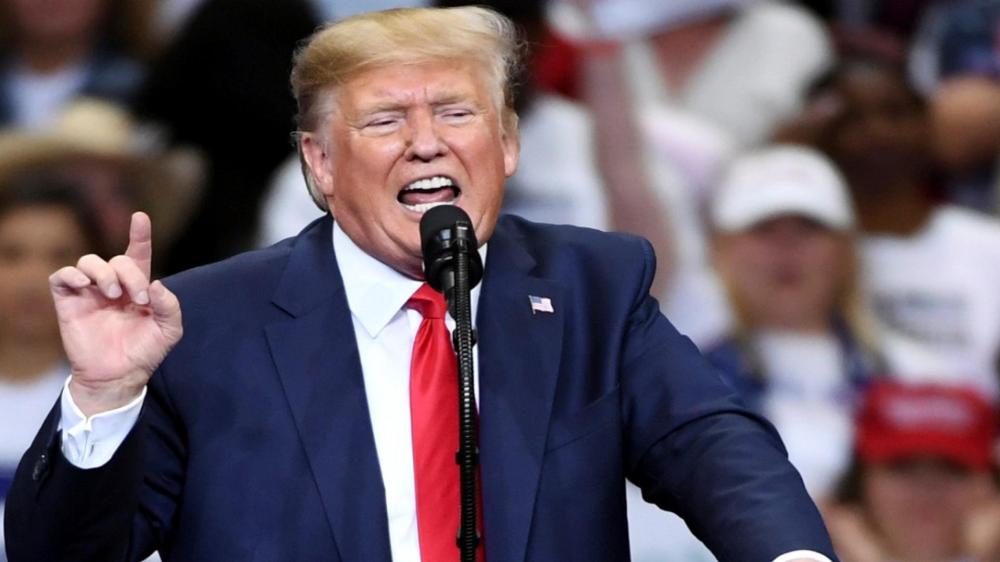
Donald Trump spoke at a far-right event last weekend and denounced the Democratic accusations at the heart of the presidential impeachment inquiry. In fact, the Republican described his perception of the Democrats’ tactics.
“[T]hey’re of the opinion, you know, just keep saying it, saying it, saying it, and maybe someday they’ll believe it,” Trump said.
It was a curious failure of self-awareness for the president. He was, after all, describing one of his most commonly used tactics and attributing it to his critics. And therein lies the rub: as the walls close in on Trump, projection remains his go-to move.
A few days later, the president hosted a White House meeting with congressional leaders, which was derailed by what some participants described as Trump’s “meltdown.” After House Speaker Nancy Pelosi said Americans should “pray for his health,” the Republican responded in his patented I’m-rubber-you’re-glue sort of way, published a tweet accusing Pelosi of being mentally ill, and added, “Pray for her, she is a very sick person!”
Since he heard the Speaker accuse him of a “meltdown,” Trump also accused Pelosi of having had a “meltdown.”
All of which led to the Republican’s campaign rally last night in Texas, held just a few hours after acting White House Chief of Staff Mick Mulvaney acknowledged the White House’s quid-pro-quo scheme with Ukraine. Trump responded by accusing Joe Biden of trying to execute a quid-pro-quo scheme in Ukraine.
Trump said that the former vice president was in charge of Ukraine policy for the Obama administration and sought the firing of the then-Ukrainian prosecutor general while his son, Hunter “was paid massive sums of money [to] buy a Ukrainian energy company.”
“Now that’s what you call quid pro quo,” Trump said.
No, in reality, it’s not. Biden, with bipartisan and international backing, urged Ukraine to dismiss an inept prosecutor who wasn’t investigating the Ukrainian company in question. It bears literally no resemblance to a quid pro quo.
But the fact that the president is pushing the fraudulent line anyway brings a simple truth into focus: Trump genuinely seems to believe he can “no puppet” his way through his impeachment crisis.
I hope you caught Rachel’s segment last week on Trump’s dependence on the rhetorical ploy: “What we have already started living through here is an effort … to turn the behavior for which the president has now been caught, not just into some amorphous and unnecessarily complicated thing that doesn’t really have any inherent meaning, but also to try to make his sins our sins. To try to absolve himself of his own crimes by putting what he did and — what he and his sort of henchmen in Ukraine have been doing — to try to put those crimes on everybody else’s rap sheet.”
It’s become a staple of Trump’s presidency. As regular readers know, the Republican has a playbook for defending himself, and projection is the first page.
A couple of months ago, for example, Trump faced condemnations after using racist rhetoric against four Democratic congresswomen of color. The president responded by accusing the congresswomen of being racists.
A couple of months before that, following a series of bizarre incidents, Trump was accused of mental decline. He responded by accusing Nancy Pelosi of being in mental decline. Circling back to our earlier coverage, it’s a tactic that’s come to define his entire approach to politics: like an intemperate child, Trump’s I-know-you-are-but-what-am-I instincts are finely tuned after extensive practice. When Democrats accused the president of a variety of crimes, Trump insisted the “real crimes were committed” by Democrats. When Dems argued the president obstructed justice, Trump replied that it’s the Dems who have obstructed justice. Confronted with allegations that his political operation colluded with Russian attackers, Trump said Democrats colluded with Russia. Told that the Kremlin supported his candidacy, Trump responded by saying Russia supported Democrats. Accused of being a manipulated pawn for Vladimir Putin, Trump accused Barack Obama of being Putin’s “patsy.” And during the 2016 campaign: whenever Hillary Clinton would criticize Trump, it was a near certainty that Trump would then make the identical accusation against Clinton. After a while, as regular readers may recall, this got a little creepy. Clinton accused Trump of being unstable and reckless, so Trump said Clinton is “unstable” and “reckless.” Clinton said Trump mistreated women, so Trump said Clinton mistreated women. Clinton accused Trump of bigotry, so Trump said Clinton’s a “bigot.” Clinton questioned Trump’s temperament, so Trump said Clinton had a bad “temperament.” Clinton said Trump makes a poor role model for children, so Trump said Clinton sets “a terrible example for my son and the children in this country.” And, of course, Clinton accused Trump of being a “puppet” for his allies in Moscow during a 2016 debate. Trump, showing all of the sophistication of a slow toddler, responded, “No puppet. No puppet. You’re the puppet. No, you’re the puppet.” With a track record like this one, is it really any wonder Trump is falsely accusing Biden of a quid pro quo?
Steve Benen is a producer for "The Rachel Maddow Show," the editor of MaddowBlog and an MS NOW political contributor. He's also the bestselling author of "Ministry of Truth: Democracy, Reality, and the Republicans' War on the Recent Past." Recommended


