








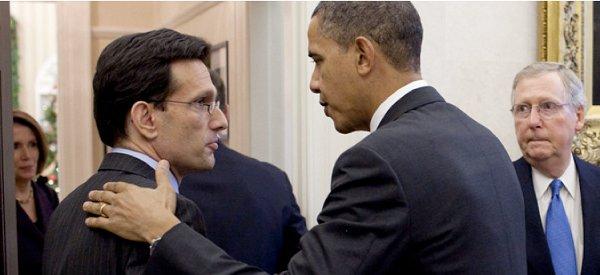
Looking back at Barack Obama’s message from four years ago, one of the more common messages he pushed was a deeply-held desire to govern in a bipartisan way. As a candidate, he spoke extensively about reaching across the aisle, working in good faith, and bringing people with different ideologies together in a spirit of shared values and common purpose.
We now know those efforts fell far short, and I suspect there will be some voters who are disappointed, hoping that Obama would have had more success in at least narrowing the partisan divide. But that’s all the more reason to understand why bipartisanship in the Obama era has proven to be impossible.
Obama made several moves early on that suggested he was sincere. The president put Republicans in high-ranking administration positions; he expressed a willingness to compromise; and he pursued an agenda that was moderate and mainstream, embracing ideas on health care, energy, and immigration that have traditionally enjoyed bipartisan backing.
In November 2008, shortly after the election, the Weekly Standard ran a piece with a list of steps Obama could take to prove that he’s serious about bipartisan governing. The president took most of the steps on the list.
But what about congressional Republicans? Robert Draper has a new book coming out, which shines a light on a private meeting “top Republican lawmakers and strategists” held, literally the same day as Obama’s inauguration.
According to Draper, the guest list that night (which was just over 15 people in total) included Republican Reps. Eric Cantor (Va.), Kevin McCarthy (Calif.), Paul Ryan (Wis.), Pete Sessions (Texas), Jeb Hensarling (Texas), Pete Hoekstra (Mich.) and Dan Lungren (Calif.), along with Republican Sens. Jim DeMint (S.C.), Jon Kyl (Ariz.), Tom Coburn (Okla.), John Ensign (Nev.) and Bob Corker (Tenn.). […] [T]he book says they plotted out ways to not just win back political power, but to also put the brakes on Obama’s legislative platform. “If you act like you’re the minority, you’re going to stay in the minority,” Draper quotes McCarthy as saying. “We’ve gotta challenge them on every single bill and challenge them on every single campaign.” Together, they sketched out a plan over the course of four hours: attack Tim Geithner, show “unyielding opposition” to every economic proposal, launch early attack ads targeting vulnerable Democrats. The GOP leaders left their meeting “almost giddily.” As Jamelle Bouie explained, “In other words, there was nothing President Obama could have done to build common ground with Republicans. From the beginning, the plan was to relentlessly obstruct Obama, regardless of whether that was good for the country The GOP’s high-minded rhetoric of compromise and bipartisanship was bunk.” With this in mind, for all that is good and holy in this world, can we please stop pretending that “both sides” are to blame for the failure of the parties to cooperate in Washington?
The place for in-depth analysis, commentary and informed perspectives. Recommended


