








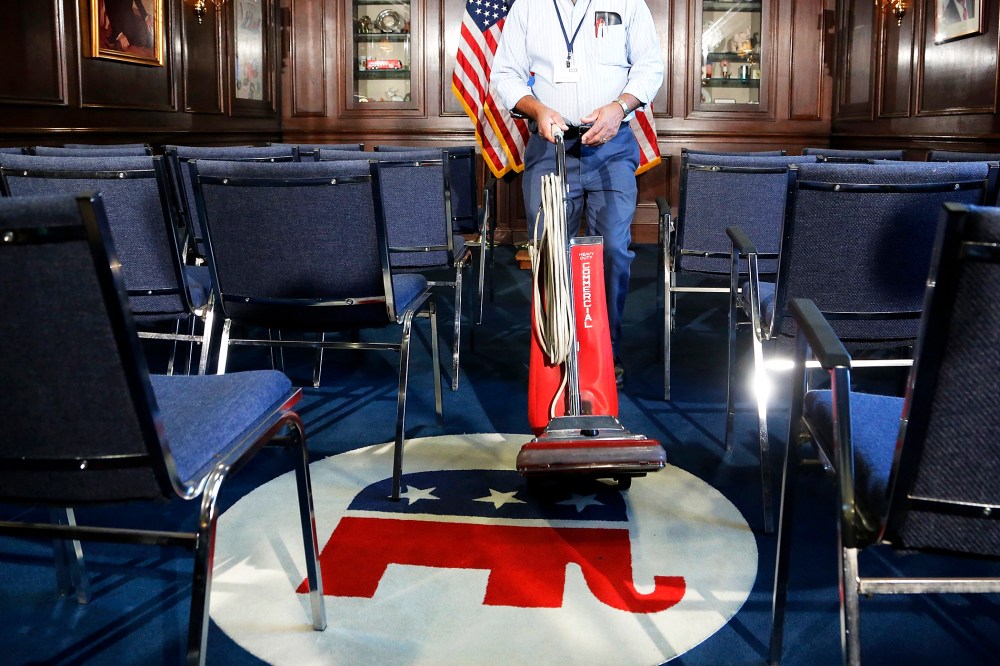
The GOP is going back to school.
Determined to no longer be what American Conservative Union chairman Al Cardenas has characterized as “too old and too white and too male,” the Republican Party called for a makeover to broaden its appeal with an increasingly diverse electorate after the 2012 election. To that end, the National Republican Congressional Committee has been holding sessions designed to teach Republican incumbents how to message against female opponents, Politico reported.
The goal is to avoid another gaffe, à la former Missouri Rep. Todd Akin, who, while attempting to unseat Missouri Democratic Sen. Claire McCaskill in 2012, claimed that victims of “legitimate rape” tend not to become pregnant.
Republican House Speaker John Boehner on Thursday agreed that some his colleagues needed to be “a little more sensitive” toward women and noted that there were “a lot more females in the Democratic caucus.”
But the Republican Party’s problems don’t just lie with women. If the GOP hopes to successfully rebrand itself as a party that welcomes the entire electorate, it could use more than just one course in outreach — it needs a full curruculum. Here are some other “courses” the GOP may need to take before earning its degree in voter outreach.
LGBT Voters 101
Boehner made no friends in the LGBT community this year when he declared an historic employee protection bill passed by the Senate “unnecessary.” A coalition of five Republican colleagues penned a letter this week urging Boehner to allow a vote on the Employment Non-Discrimination Act (ENDA), but the effort to erase the party’s anti-gay image was eclipsed with news of another GOP lawmaker: Virginia Rep. Randy Forbes.
According to Politico, Forbes has been trying to dissuade the National Republican Congressional Committee from backing gay candidates. The Republican lawmaker later released a statement, saying his party’s “goal is to make certain every individual has the right to express his or her belief, while no one is compelled to support financially or otherwise, those who disagree with them.”
The GOP has two openly gay candidates running for Democratic House seats in 2014. And while the Republican Party continues to soften on issues like marriage equality and ENDA, Forbes’ actions won’t do anything to help reel in gay voters–or future candidates, for that matter.
Latino Voters 101:
After Mitt Romney netted just 27% of the Latino vote in 2012–less than John McCain’s 31% in 2008, and George W. Bush’s 44% in 2004–the GOP vowed to repair its relationship with the Latino community. The surest way to do that, many believed, was through passing immigration reform.
The Senate held up its end of the bargain, passing a comprehensive, bipartisan package that included a path to citizenship for the nation’s estimated 11 million undocumented immigrants. But Florida Republican Sen. Marco Rubio, a drafter of the legislation and one of the GOP’s foremost Latino lawmakers, then abandoned his own bill in favor of piecemeal legislation.
“At this point, the most realistic way to make progress on immigration would be through a series of individual bills,” Rubio’s spokesman said in October.
Boehner has also vowed to stay away from the Senate’s 1,300-page bill, calling it a “nonstarter” for his caucus.
Outside of the immigration reform debate, some Republicans have gotten into trouble with the Latino community for inflammatory comments. In April, Texas Rep. Louie Gohmert said that al Qaeda was training “radical Islamists” to “act like Hispanics” and infiltrate the U.S. through its border with Mexico. A few weeks earlier, longtime Alaska Rep. Don Young casually referred to his father’s Latino employees as “wetbacks” while talking about technology’s impact on the job market. He later apologized, saying he “meant no disrespect.”
African-American voters 101
Republicans have not performed well with African-American voters in decades. In fact, the last time a Republican presidential candidate got more than 15% of the black vote was 1960. After suffering another huge loss in 2012, worried GOP leaders launched a minority outreach campaign in early 2013. So what has the party learned? By all appearances, not much.
When Kentucky Republican Sen. Rand Paul took a trip to Howard University to address students at the historically black school, he denied his prior opposition to the Civil Rights Act of 1964. When a student questioning him pointed out that he had been caught on camera criticizing the law, he insisted, ”I’ve never wavered in my support for civil rights, or the Civil Rights Act.” But in 2010 he responded to a question from the Louisville-Courier Journal about the law by saying, “I don’t like the idea of telling private business owners—I abhor racism. I think it’s a bad business decision to exclude anybody from your restaurant—but, at the same time, I do believe in private ownership.” So he supports the law, but not the part that forced the owners of Woolworths to integrate their lunch counters. Republicans would do well to relent on its efforts to make voting more difficult. The impact of GOP-backed voting reforms on African-Americans has alienated black voters. The backlash to suppression efforts helped drive record high African-American turnout in 2012, to the Democrats’ advantage. The party has made more subtle slips, too, as recently as this past weekend, when the Republican National Committee applauded on Rosa Parks for her role in “ending racism.” A better approach might have been to commend Parks for her work for civil rights, rather than declare the end of racism. Also, maybe someone should tell former Gov. Sarah Palin and Sen. Ted Cruz that it doesn’t help the party’s image when they keep going to protests featuring Confederate flags. Low-income voters 101 Republicans lost voters with incomes under $50,000 a year by a 22-point margin. That’s no shock for those who’ve paid attention to the party’s policies and rhetoric about Americans who need help to make ends meet. House Republicans have been obsessed with budget cuts for years, often targeting welfare programs. Most recently House Republicans voted to cut $40 billion from the food stamp program. They also voted to allow states to institute drug testing programs for food stamp recipients, even though recent welfare drug testing programs have been found to waste money. Reps. Michele Bachmann and Steven Fincher justify these cuts to food stamps with bible quotes, often repeating a line from Thessalonians, “If any would not work, neither should he eat.” What these Republicans don’t seem to know is that many Americans on food stamps do work, and many others simply can’t find work. And Republican contenders might want to avoid any echoes of the party’s last nominee, Mitt Romney, who said in early 2012 that he wasn’t “concerned about the very poor.” His reasoning? We have a safety net. Yes, we do. A safety net Republicans want to cut.
Morgan Whitaker
Emma Margolin
Emma Margolin is a reporter at MSNBC.com. Recommended


