








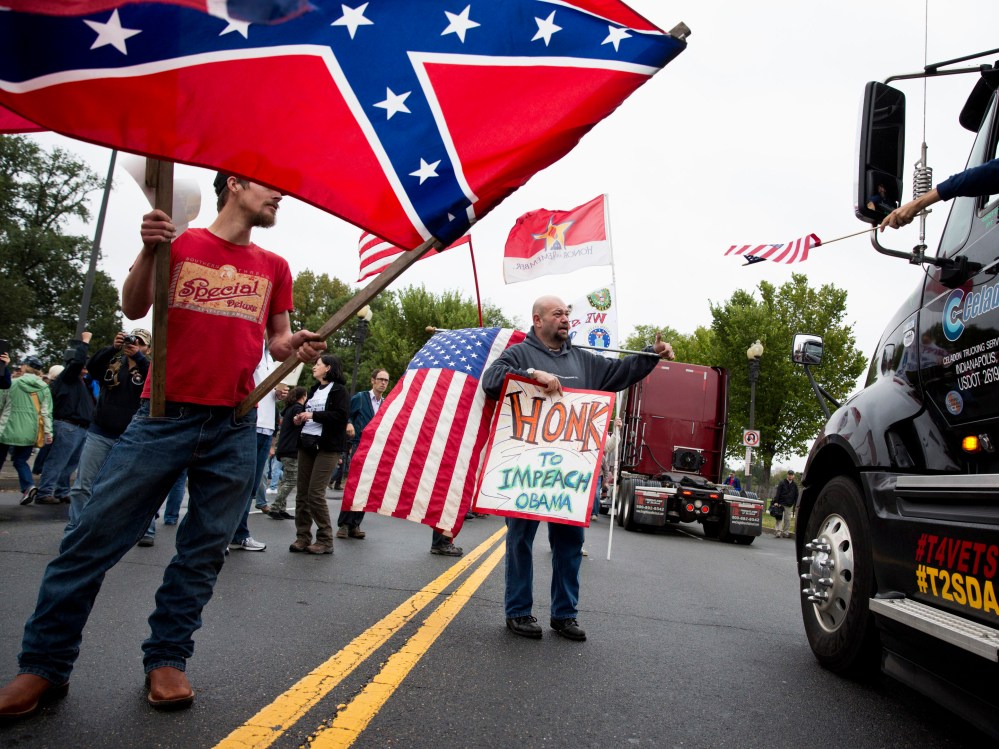
The protest that travelled from the World War II Memorial to the White House this past weekend has drawn a lot of criticism for the Confederate flag that was waved by one protester–but none of the prominent conservative leaders who spoke at the event, from Sarah Palin to Ted Cruz, denounced it.
For a party that needs to win over minority voters, and convince people that its criticism of the president is not racially-motiviated, the images of that flag are not helping. It’s not hard to track how the Republican party went from being early supporters of civil rights to being associated with the stars and bars. The shift began in 1964, when President Lyndon Johnson signed the Civil Rights Act, then famously said of his Democratic Party, “We have lost the South for a generation.”
Republicans turned to exploit that rift with what became known as the southern strategy, working to appeal to white voters who became disenchanted with the Democratic Party for its civil rights support.
Few were so influential in that plan as Lee Atwater, the famous South Carolina Republican strategist. In audio recently unearthed by James Carter IV (who also brought Romney’s “47% tape” to light), Atwater can be heard in a 1981 interview explaining how politicians can shift away from blatantly racist language, to the more subtly coded words.
“You start out in 1954 by saying, ‘N*****, n*****, n*****.’ By 1968 you can’t say ‘n*****’—that hurts you, backfires. So you say stuff like, uh, forced busing, states’ rights, and all that stuff, and you’re getting so abstract. Now, you’re talking about cutting taxes, and all these things you’re talking about are totally economic things and a byproduct of them is, blacks get hurt worse than whites.… ‘We want to cut this,’ is much more abstract than even the busing thing, uh, and a hell of a lot more abstract than ‘N*****, n*****.’”
A few years later, while running George H.W. Bush’s election campaign, Atwater brought America the “Willie Horton” political ad. The infamous TV ad ripped Bush’s opponent Michael Dukakis for supporting a furlough program that allowed convicted felon Willie Horton, an African-American, to leave prison on a weekend work pass, ultimately committing rape and murder.
“By the time we’re finished, they’re going to wonder whether Willie Horton is Dukakis’ running mate,” Atwater said at the time.
Two years later, Sen. Jesse Helms ran a campaign ad in which he slammed his opponent–an African-American named Harvey Gantt–for supporting the “racial quotas” which Helms believed led less qualified minority candidates to win jobs over their white counterparts.
Years later, Republican National Committee Chairman Ken Mehlman conceded this was a mistake.
“By the ’70s and into the ’80s and ’90s, the Democratic Party solidified its gains in the African-American community, and we Republicans did not effectively reach out,” he said. “Some Republicans gave up on winning the African-American vote, looking the other way or trying to benefit politically from racial polarization. I am here today as the Republican chairman to tell you we were wrong.”
More recently, we’ve heard similar talk from current RNC Chairman Reince Preibus, who acknowledges that his party will struggle without course correction, but Democratic strategist Jimmy Williams thinks the party should be willing to denounce displays like the Confederate flag.
“To take that flag, and fly it in front of the White House, that has in it the first African-American president of this country, is patently offensive, is blatantly and overtly racist, and it has zero to do with southern heritage and southern pride,” he said on Tuesday’s PoliticsNation. “In their minds, if you just don’t address it then it doesn’t exist,” he said of the lack of response from the Republican party. This “modern day southern strategy” goes beyond the south today, said Williams. “Racists aren’t confined just to the south–there are plenty of racists all over this country. Don’t forget the busing riots in Boston,” he said. “But yes, it is a modern day sort of extention of that.” “You know when you see racism because people do things like they question your integrity, your morality, your religion, your birth,” he said, referring to the so-called “birthers” and specifically to Larry Klayman, who accused President Obama of worshipping Allah at Sunday’s rally. “He doesn’t have to call Barack Obama the n-word, he doesn’t need to,” he added. “This is as overt as anything I’ve ever seen.”
Morgan Whitaker Recommended


