








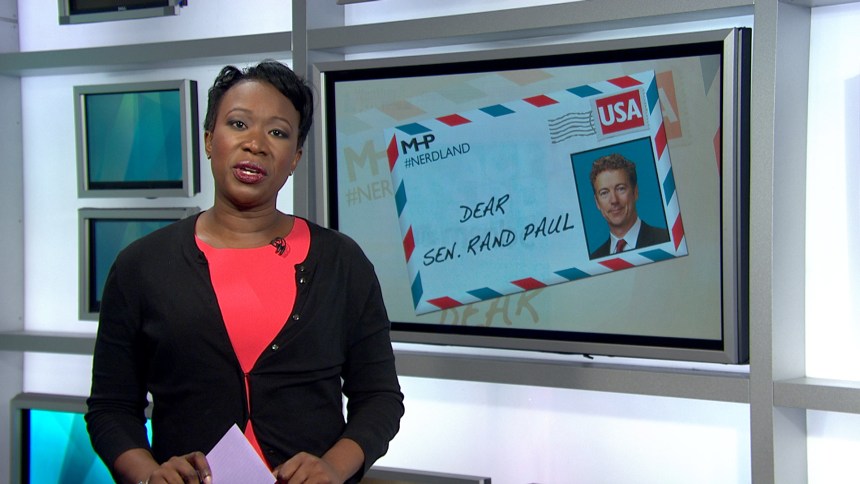
There are some people who, for their own sake, should take a very deep breath before they talk about race. Just to think it through.
Like, before telling a group of Howard University students that they’d be Republicans if only they knew their black history. Or before hiring, co-authoring a book with, and then having to awkwardly part with a neo-confederate who calls himself the “Southern Avenger”—or before admitting that you’re not super on-board with the Civil Rights Act.
This week, the right’s new poster child for awkward race talk had this to say about North Carolina’s new voter restrictions and their likely impact on black voters. According to Louisville radio station WFPL, he said, “I don’t think there is objective evidence that we’re precluding African-Americans from voting any longer.”
And that’s why my letter today is to U.S. Senator Rand Paul of Kentucky.
Dear Senator Paul,
It’s me, Joy. So, here’s the thing.
I get that you’re trying to be the man in the GOP who steps out there on race. And to your point, there are no more “bizarre and absurd literacy tests” from the Jim Crow era. As you said on Wednesday, “That was an abomination, that’s why we needed the Voting Rights Act, but that’s not showing your ID.”
But Senator, if it’s evidence you want that voter-ID laws preclude African Americans from voting? Well then, here we go.
Up to 25% of African-American adults don’t have a photo ID. (Compare that to 9% of white adults who don’t have ID.) Among young African-American adults, the numbers may be even higher. In Wisconsin, for example, one study found that only 22% of young African-American men had a valid driver’s license. Poll workers are more likely to ask young black voters for photo ID—even in states without voter ID laws. And young black adults are four times more likely to say that a lack of ID prevented them from voting in 2012.
And that’s just voter ID. The North Carolina law that you were asked about—the worst in the nation—does a lot more than require certain forms of ID at the polls. It also slashes early voting by a full week.
You might say that doesn’t sound like discrimination, but 70% of African Americans who voted in North Carolina last year voted early. They also disproportionately lack photo ID and register on the same day they vote—another practice North Carolina has banned. Don’t take my word for it, Senator. Just look at the objective evidence from Florida.
In 2011, that state cut six days from early voting, including the Sunday before Election Day, when black churches typically urge their congregations to head to the polls after services.
The result? Unconscionably long lines at the polls last November. Some people waited six hours to vote. And the average wait time in Florida overall was 45 minutes—three times the national average.
Some of the worst lines were on the Saturday before Election Day, which also happened to have the highest minority turnout. And that led Dartmouth researchers to declare that the cuts to early voting disproportionately affected minority voters. Those researchers estimated that more than 200,000 people who wanted to vote didn’t—because of the long lines. And it wasn’t just Florida. African-American voters throughout the country waited, on average, almost twice as long to vote as white voters. Senator, feel free to stop me any time. I just want to make sure I get enough “objective evidence” for you. By the way, African-Americans are also disproportionately precluded from voting by the criminal code. Black adults are four times more likely than white adults to be disenfranchised due to a felony conviction—laws that happen to be a vestige of post-Civil War era, when many states tailored felony disenfranchisement laws to get around the 15th Amendment. In our old friend, Florida, 23% of black adults cannot vote due to a felony conviction. But I don’t need to tell you that, Senator Paul, because you said it yourself, on the same day, in the same speech posted on the Louisville Courier Journal’s website where you said we don’t try to stop African-Americans from voting anymore. “So, a lot of our young people, and particularly a lot of young people of color, get caught up in making mistakes with drug crimes, nonviolent drug crimes, when they’re kids, but it ruins the rest of their lives because the judges can’t have discretion, they get convicted of felonies, it makes it harder to get a job and I think it’s something that isn’t just… “I know people who permanently have lost their Second Amendment rights, lost their voting rights, because of a youthful mistake with drugs.” Spoken like a guy who took a deep breath, and thought before he spoke. Sincerely, Joy
The place for in-depth analysis, commentary and informed perspectives. Recommended


