








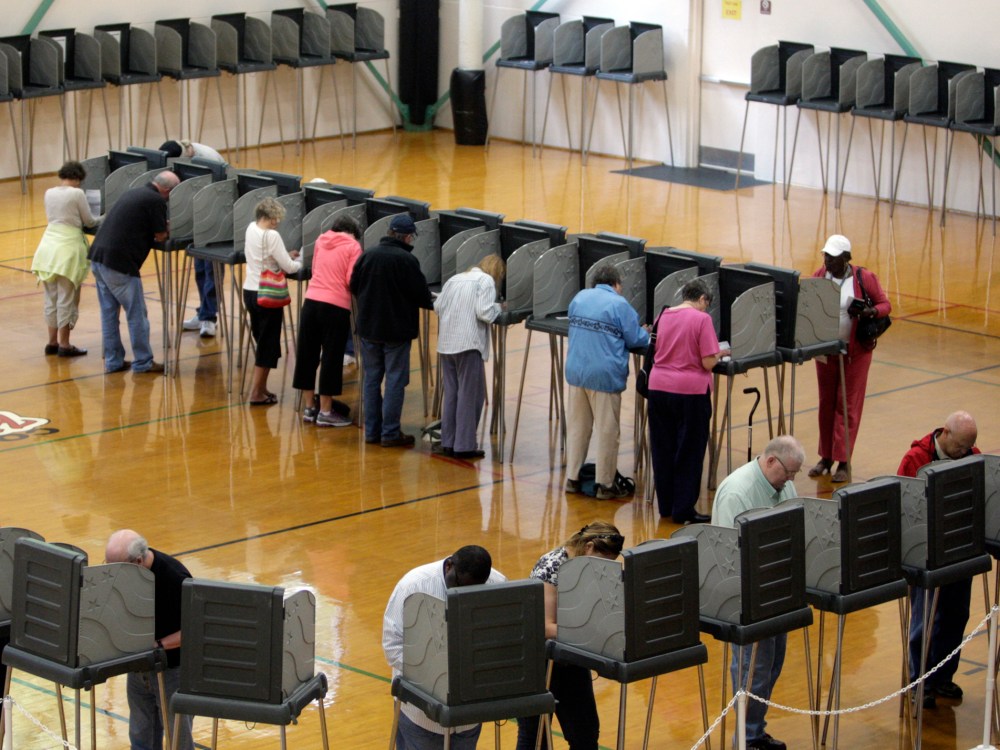
The Associated Press reported Sunday that in 2012, for the first time ever, blacks voted at a higher rate than whites. That’s an eye-catching headline, and it’s reverberated across the Internet. But a closer look suggests a little more skepticism may be warranted.
William Frey, the Brookings Institution demographer who conducted parts of the analysis for the AP, told msnbc.com he wasn’t willing to say definitively that black turnout exceeded white turnout in 2012, because the numbers needed for such a calculation aren’t yet available for 2012. “That’s what they wanted to say, not me,” Frey said, referring to the AP.
Frey made clear he wasn’t claiming the finding was false, but rather was simply being cautious until the Census Bureau releases additional figures next month.
In addition to Frey’s analysis, the AP cited material from other scholars, as well as a Pew Research Center report, and interviews with Census officials, in reaching its conclusions.
The Pew report, released in December, using Census data, found that in 2008, white voters outperformed black voters by a slim margin: 66.1% of eligible white voters turned out that year, compared to 65.2% of eligible blacks. Pew found that white turnout appears to have declined from 2008 to 2012, and that there appears to have been little decline in black turnout. In both 2008 and 2012, blacks made up 12% of eligible voters, but 13% of the actual electorate, Pew found, based on exit poll data.
“Did the turnout rate of blacks exceed that of whites this year for the first time ever?,” Pew’s report asked. “For now, there’s circumstantial evidence but no conclusive proof. And there’ll be no clear verdict until next spring, when the U.S. Census Bureau publishes findings from its biannual post-election survey on voter turnout.”
Using what it described as “rough calculations,” the AP analysis puts the number by which white voter turnout decreased from 2008 to 2012 at between 2 million and 5 million. But beyond that, it offers little to advance Pew’s findings on the question of whether blacks turned out at a higher rate than whites in 2012.
“It was the consensus of experts on voting and demographics based on information they reviewed—including state turnout data, exit polling, and other information—that this was the most likely conclusion,” Jim Drinkard, the AP editor who edited the story, told msnbc.
Frey did calculate that had the racial breakdown of the electorate looked like it did in 2004—when black turnout was significantly lower than last year or 2008—Mitt Romney would have narrowly been elected president. Data-parsing aside, what’s clear is that in the last two presidential elections, blacks and whites turned out at roughly the same rate. Coming less than 50 years after systematic efforts to prevent blacks from voting were banned by the Voting Rights Act, that’s a historic milestone. The Supreme Court is set to rule in June on whether to strike down a key provision of the 1965 law. The news also bolsters the case that the Republican effort to make voting harder for racial minorities—including strict photo ID laws, cutbacks to early voting, and purges of voting rolls—may have backfired, by stoking outrage in the African-American community in particular. “It made the case very clear-cut to people about what was happening,” Marvin Randolph, the NAACP’s vice president for campaigns, told msnbc.com. “We could say to people: This is a poll tax.” “Politics is a lot like physics,” Randolph added. “Every action has an equal and opposite reaction.”
Zachary Roth Recommended


