








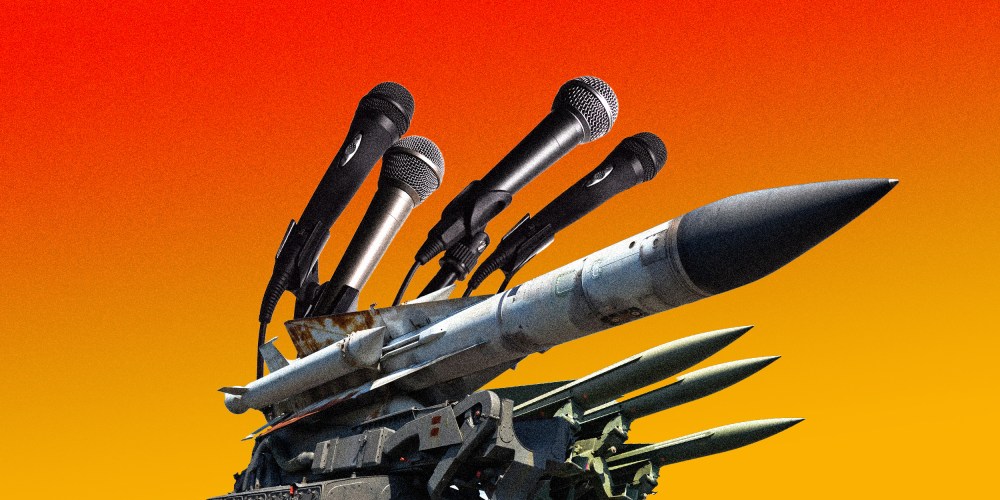
Ever since Russia’s invasion of Ukraine, President Joe Biden has sought to punish Moscow through economic sanctions and military aid to Ukraine. But he has also repeatedly made it clear that the U.S. has no intention of entering the war.
That position on declining to take up arms against Russia appears to be a source of friction with members of the mainstream media. In narrative framing, the way they’ve questioned government officials, or implicit calls for no-fly zones or direct clashes with Russian troops, many journalists and pundits from outlets across the political spectrum have exhibited lurid curiosity about or outright longing for military confrontation with the U.S.’s former Cold War foe.
The media remains stuck in a pro-war orientation, seemingly nostalgic for the interventionist consensus.
And so we find ourselves in a strange and uncomfortable moment in which the media’s hawkishness outpaces the government it observes. During the post-9/11 era, both political parties shared a consensus in favor of military intervention and nation-building, and this orientation was mirrored by much of the mainstream media. But over the past half decade or so, former President Donald Trump scrambled the Republican outlook on perpetual war with his nationalist “America First” turn, as well as open expressions of admiration for the U.S.’s geopolitical adversaries like Russian President Vladimir Putin. And the Biden presidency has led the Democrats in a more realist direction with his unapologetic Afghanistan withdrawal and restraint on Russia. Yet much of the media remains stuck in a pro-war orientation, seemingly nostalgic for the interventionist consensus.
The divergence between the media class and political class is not a trivial one. Should the media find Biden’s Russia policy too dovish for its liking, it could deliver a massive blow to his approval ratings though its framing of his management of the conflict. That dynamic creates incentives for Biden to lean in to a more aggressive policy to defend his already battered approval ratings.
The American media landscape is varied and diverse, and there are certainly pockets of it, particularly in the left-leaning magazine world, that have shown calm in response to Russia’s brutal invasion of Ukraine. But the thrust of hard news coverage and commentary of many mainstream media outlets — from liberal to centrist to right-wing — has tilted us in a more belligerent direction.
Early on, foreign correspondents questioned why the U.S. wouldn’t bomb Russian troops entering Ukraine. Ahistorical framings of Russia’s invasion as Hitlerian, medieval and an unprecedented threat to the world order swept under the rug other countries’ recent misdeeds in violation of international law — like the U.S. invasion of Iraq and Saudi Arabia’s U.S.-backed cold-blooded war on Yemen — and made Russia’s behavior appear more singular than it was. That in turn has implied that a direct war with Russia may be a necessary step to contain it. (Consider that many countries across the Global South have observed that Russia’s heinous domination of Ukraine resembles the behavior of other powerful countries, and have cited that when declining to back the West’s response to Russia.)

Some of the pro-war framing is subtle. An Associated Press headline warned that a poll showed Americans believe Biden isn’t “tough enough” on Russia. After extensively discussing the finding, the report briefly notes that close to as many Americans are “very” or “extremely” concerned about being drawn into war with Russia. And the article doesn’t mention the fact that the poll it cites found that the percentage of Americans who are at least “somewhat” concerned about being drawn into war dwarfs the percentage who want Biden to be tougher. Yet the thrust of the piece effectively casts noninvolvement as the chief political liability for Biden.
The White House Press corps is less subtle. Many reporters have consistently interrogated the Biden administration from a position that frames the administration as inadequately involved in the war in Ukraine, asking why it won’t deliver more intense security aid, why Biden isn’t showing more “strength” and questioning Biden’s opposition to a no-fly zone over Ukraine — a policy that would be tantamount to a declaration of war against Russia. Sometimes reporters will simply casually ask why the Biden administration isn’t willing to start a war with Russia.
Steven Portnoy of CBS News asks Jen Psaki why the US isn’t calling for a world war against Russia at this point pic.twitter.com/NVbnGNavA9
— Aaron Rupar (@atrupar) April 5, 2022
The intensity of coverage has been remarkable as well, not because the coverage is undeserved, but because it far outpaces the amount of coverage devoted to other high-stakes conflicts over the past several decades. For example, The Tyndall Report has found that evening news programs from the three dominant news networks devoted more coverage to Russia’s invasion in March than to any other war — including wars the U.S. has engineered — in any month dating back to the 1991 Gulf War (with the exception of the NATO campaign in Kosovo). The sum effect of the wall-to-wall coverage makes Biden’s Russia policy a high-stakes matter in the eyes of the American public, and his perceived “toughness” emerges as the chief measure for assessing his virtue as a leader.
One does not have to reject the idea of aiding Ukraine to find this all worrisome. Personally, I think some sanctions on Russia and military and humanitarian aid to Ukraine are moral and, for now, strategically sound. But I find it distressing that so many reporters who surely know better seem so eager to pressure the White House into waltzing into a world war with a country that has the largest nuclear warhead stockpile in the world, overseen by a leader whose powers of judgment have become questionable.
The media is displaying an excitement for war it has shown for decades. Mark Hannah, a senior fellow at the Eurasia Group Foundation, wrote an excellent and comprehensive analysis in Foreign Policy Magazine discussing how the mainstream media has rewarded many presidents for efforts to use military force and punished them for turning away from opportunities to do so. During the war on terror, the media was deferential to the bipartisan consensus on calls for war and prolonged occupation of Afghanistan and Iraq. While it grew critical of the war on terror over time, it failed to question the fundamental logic of forever wars and reckless interventionism, which was underpinned by the marriage of neoconservatism and liberal interventionism that prevailed in the two-party system and Washington’s think-tank world. Obama’s intervention in Libya was met with far more media approval than his decision to avoid one in Syria, and CNN’s Fareed Zakaria famously claimed that the pathologically unserious Trump “became president of the United States” after striking Syria with missiles. The media’s pro-war orientation can exact a huge toll on a president’s standing for committing the sin of saying no to intervention. “Biden’s net approval rating suddenly dropped around 10 percent amid overwhelmingly negative responses in the media regarding his decision to end the war in Afghanistan and the coverage of the evacuation,” notes Hannah in his analysis. “In contrast, positive coverage of Trump’s 2017 missile strike on Syria coincided with a substantial net increase in his approval rating.” Biden is still smarting from the media-manufactured blow to his approval over his withdrawal from Afghanistan, an operation marred by its neglect of vulnerable Afghans but a necessary step to ending a brutal war that caused tremendous suffering. Experts on Afghanistan policy have pointed out that fear of being tarred as weak has subsequently played a role in Biden’s asphyxiation of the Afghan economy, which is not just morally abhorrent but also undermines U.S. national security interests by boosting the likelihood of extremist activity. It is also possible that Biden sees recent decisions to give Ukraine heavier-duty weapons than before as not just a foreign policy strategy but also a political one. On Russia, Biden has generally shown restraint and discipline. But still, temptations to act tough abound. It is possible that some of Biden’s occasional forays into reckless rhetoric like when he said Putin “cannot remain in power” have been motivated by a desire to fulfill the spectacle of toughness. It is also possible that Biden sees recent decisions to give Ukraine heavier-duty weapons than before as not just a foreign policy strategy but also a political one. That strategic shift, which has the potential to prolong the conflict, is clearly motivated in part by wanting to add momentum to Ukraine’s astonishing success in fending off Russia and the conflict’s evolution into a full-fledged proxy war to weaken Russian military strength. But there’s also a domestic audience in the pro-war media, and that can serve as an extra incentive for such maneuvers, and be wielded as a shield against questions about being tough enough. In other words, Biden has a media-driven incentive to take more aggressive steps in dealing with Russia. And that pressure will only intensify if Russia escalates the conflict further. It’s a deeply concerning situation. War is always high-stakes, but it’s especially high-stakes when there’s the possibility of nuclear exchange. We desperately need a media culture that’s willing to engage in some serious introspection about its own role in shaping the possibilities of war and peace. Our lives depend on it.
Zeeshan Aleem is a writer for MS NOW. Sign up for his newsletter. 

