








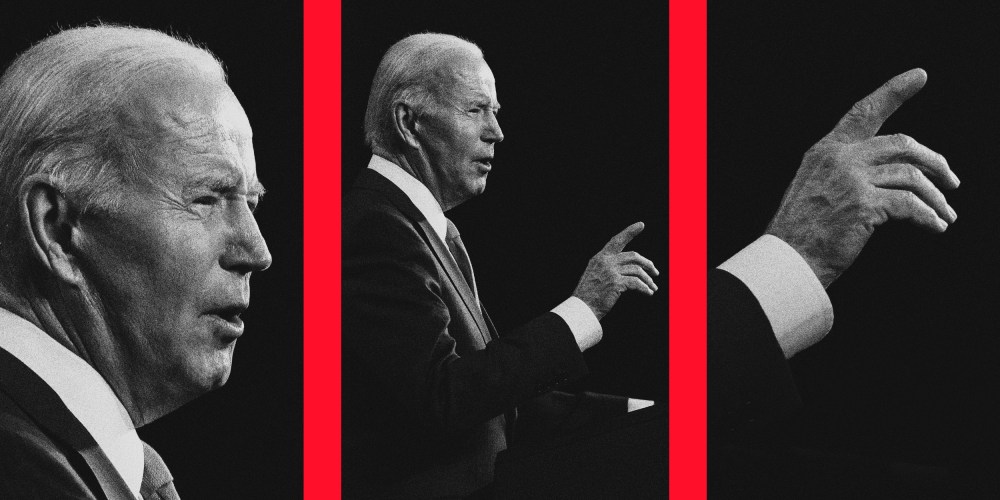
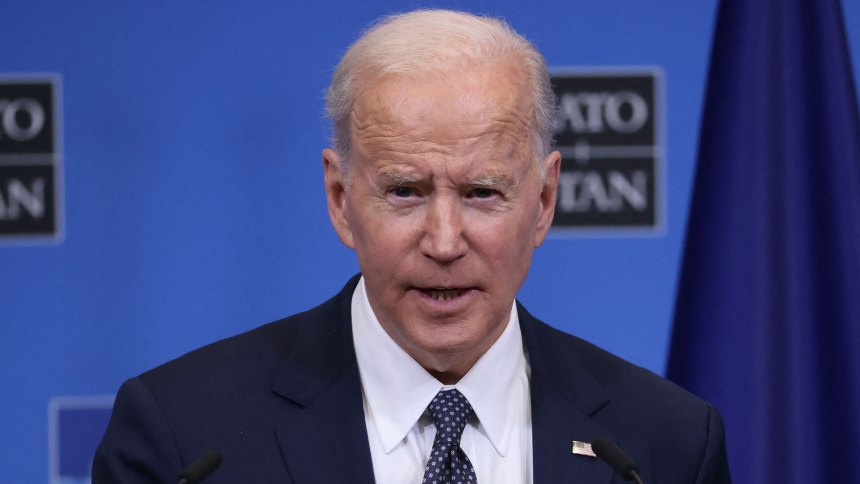
After weeks of clearly stating that the U.S. would avoid any kind of military intervention in Ukraine, President Joe Biden shifted to a more aggressive posture toward Russia on Thursday. Speaking at NATO headquarters in Brussels, he told reporters that if Russian President Vladimir Putin were to use chemical weapons in Ukraine, NATO would respond in some form, without specifying how.
At the news conference, ABC News’ Cecilia Vega asked Biden, “If chemical weapons were used in Ukraine, would that trigger a military response from NATO?”
Biden replied: “It would trigger a response in kind, whether or not, you’re asking whether NATO would cross — we’d make that decision at the time.”
Worryingly, Biden’s statement was more ambiguous even than he meant for it to be.
Biden’s response marked a pivot from his usual position of ruling out the possibility of a direct confrontation between NATO and Russia except in self-defense. Now he’s signaling that if Russia uses chemical weapons against Ukraine, which is not in NATO, it would cross some kind of line that could, theoretically, prompt a military response from NATO.
Asked by @CeciliaVega if the use of chemical weapons in Ukraine would trigger a military response from NATO, Pres. Biden says: “It would trigger a response in kind.”https://t.co/XFaQ3wJP6k pic.twitter.com/QjE2wSD3oO
— ABC News (@ABC) March 24, 2022
The statement illustrated how Biden is moving toward a position of strategic ambiguity that some of the United States’ NATO allies have been clamoring for.
“There is a growing debate in NATO about what to do if Russia uses chemical weapons and a sense we aren’t deterring him from doing so,” Ben Judah, a senior fellow at the Atlantic Council’s Europe Center, told me. “The purpose of the comment is to re-establish ambiguity and, of course, is supposed to encompass nonmilitary [options].”
Worryingly, Biden’s statement was more ambiguous even than he meant for it to be. At first blush, his phrase “a response in kind” would seem to suggest that NATO would use chemical weapons in retaliation against Russia. But that’s against international law, and it isn’t actually what NATO would do. What Biden really meant to signal was that NATO would deal some kind of proportional or equivalent blow to Russia.
In his response Biden also didn’t seem to complete all of his clauses; it’s unclear where exactly he was going after he said “NATO would cross” and then seemingly shifted gears mid-sentence. A remark he made earlier during the press conference in response to a question about whether NATO would respond if Russia used chemical weapons was cleaner and more flexible: “The nature of the response would depend on the nature of the use.”
Biden’s imprecise language is the exact kind of thing international leaders want to avoid in these kinds of situations. But overall, the point of Biden’s remarks was to signal that he’s not ruling out any specific kind of response to a chemical weapons attack in Ukraine from Russia. It leaves open the possibility that he’s talking about a military response or a nonmilitary response like new sanctions or shutting down Russia’s oil exports. The pivot could be a sign that pressure from NATO allies, a hawkish White House press corps and recent polling indicating most Americans want Biden to be tougher with Russia is swaying the administration’s thinking. It could aksi be a sign that the Biden administration is looking for some kind of additional leverage to slow down Putin’s intensifying destruction of Ukraine and reduce the likelihood that he deploys chemical weapons to terrorize Ukrainians or stage a false flag. The move carries some strategic risks. Consider how former President Barack Obama famously garnered criticism for how he responded to Syria’s government after it crossed what he promised would be a “red line” of using chemical attacks. Syria proceeded to use chemical weapons anyway, and his diplomatic response, which involved striking a deal with Russia to remove Syria’s chemical weapons stockpile, didn’t solve the issue of Syria using chemical attacks. In international affairs, if an actor publicly draws a line and it’s crossed, they need take effective action to remain a credible actor. Previously, Biden has preferred to spell out very clearly his disinterest in a direct confrontation with Russia. “Let me be clear, our forces are not engaged and will not engage in conflict with Russian forces in Ukraine,” Biden said during his State of the Union address earlier in March. The logic behind that strategy has been to create space for a more rapid diplomatic solution by suggesting military intervention in Ukraine is off the table. It remains to be seen if Biden will lean more into his new ambiguity about a response to Russia or return to the more clearly restrained approach. Either way, it’s critical that Biden doesn’t behave rashly and unnecessarily enter World War III with the world’s other biggest nuclear power.
Zeeshan Aleem is a writer for MS NOW. Sign up for his newsletter. 

