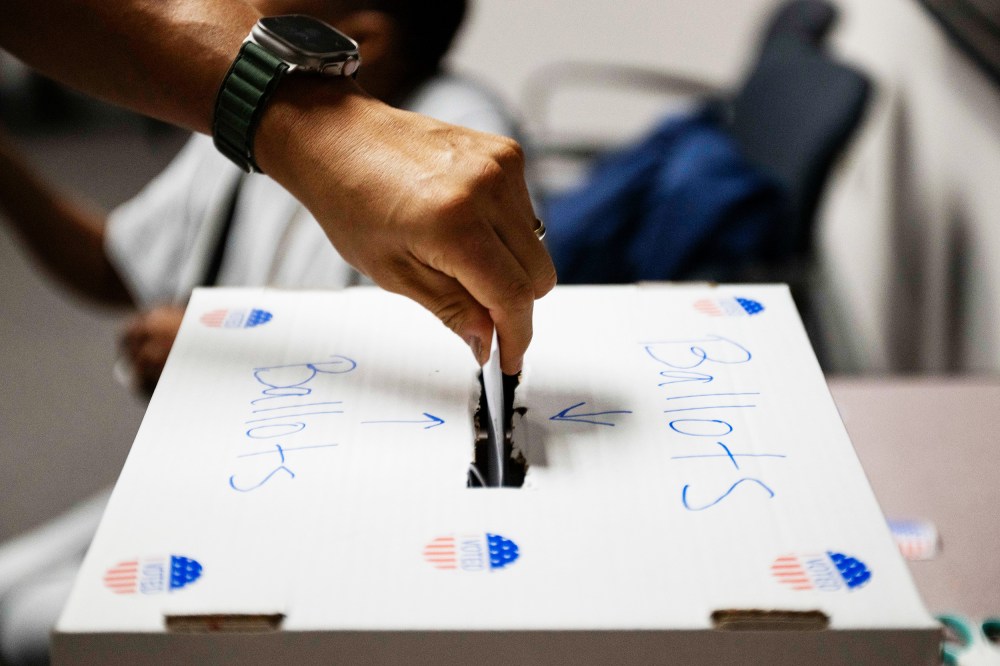
Colorado Democrats were feeling triumphant. After a decade of organizing, the state party was in a strong position. The demographics were trending their way. And so, in 2013, they prepared the coup de grâce for the state’s beleaguered Republican Party: a new voting law.
The law dramatically expanded voting access, mandating that mail ballots be sent to every registered voter for most elections, creating new polling centers where anyone could cast a ballot and allowing voters to register on Election Day, among other things. When everyone votes, Democrats win, as members of the party often say, and now it seemed like nearly everyone in Colorado would be able to vote.
On Election Day the next year, they voted. And Democrats lost.
While the Democratic governor who signed the law won re-election, the boost in turnout from the voting reforms helped Republicans win races for attorney general, secretary of state, state treasurer and, most significantly, U.S. senator, as Cory Gardner defeated Sen. Mark Udall, member of a political dynasty with strong roots in Colorado, in a surprise win.
It was the high-water mark for Republicans in the state, which has since definitively become a blue state. And Democrats had only themselves to blame. They had fallen for the oldest and hoariest political myth in politics, one used by Republicans to justify passing restrictive laws on voting and by Democrats to cope with unexpected losses. But time and again, research has shown that it’s just not true.
The latest evidence came in a study from the Pew Research Center of the 2024 election. Donald Trump won that election by 1.5 percentage points, but any Democrat who muttered that new restrictions on voting in red states skewed the result has to contend with this study, which involved surveying 9,000 voters after the election and then painstakingly verifying which ones actually voted — and which didn’t.
If everyone who was eligible had voted, Trump’s winning margin would have been twice as large.
What they found: If everyone who was eligible had voted, Trump’s winning margin would have been twice as large.
That’s not a fluke. While both Democrats and Republicans believed that the expansion of vote by mail during the pandemic in 2020 helped Joe Biden beat Trump, studies repeatedly undermined the central tenets of that belief:
- A study by the Stanford Institute for Economic Policy Research found that states that made it easier to vote in 2020 didn’t see larger increases in turnout or any partisan advantage.
- A study by the Center for Politics at the University of Virginia found that states that made it easier to vote may have seen higher turnout, but it didn’t help either Trump or Biden.
- A study by the Public Policy Institute of California found that making it easier to vote may have boosted turnout, but it either had no effect or slightly boosted Trump.
I could keep going. I wouldn’t normally get this deep in the weeds on research, but I want to stress how definitive the research is — and this is over an election that saw one of the most dramatic expansions in voting access in recent history.
That’s not to say that voting laws don’t matter. It’s just that our understanding of how they work tends to be static and they are really much more dynamic. Pass a strict voter ID law and campaigns will spend more time helping voters get the right identification. Pass a vote-by-mail law and campaigns will do more outreach to make sure they return their ballots. Expand early voting and campaigns will spend more time locking down those votes. Nothing is fixed. When Coke introduced a zero-sugar cola in 2005, Pepsi didn’t just give up and go out of business. Every now and then, one party will get caught flat-footed and lose a winnable race because it didn’t understand the new rules. (Failing to strategize around ranked choice voting hurt Andrew Cuomo in the New York mayoral election, for example.) The losers learn quickly, though, and the advantage doesn’t last. When Coke introduced a zero-sugar cola in 2005, Pepsi didn’t just give up and go out of business; it launched its own version two years later. Political parties follow the same competitive logic. There’s no question that the recent Republican efforts to restrict voting access are motivated by a belief that it will help their party. While they typically pitch these laws as being about voter integrity and confidence, every now and then someone slips, as when a Republican lawmaker in Wisconsin said that Trump would win the state in 2016 because of a new voter ID law. But that doesn’t mean they are correct, just as Colorado Democrats were wrong in 2013 when they thought making it easier to vote would help them. I understand the impulse to argue against these laws by zeroing in on that premise. But in doing so, Democrats risk giving themselves an out on the hard work of figuring out why so many Americans preferred Trump in 2024 and what they can do about it in the future. On this much, we can agree: Everyone should be allowed to vote. And when everyone votes, we all win.
Ryan Teague Beckwith is a newsletter editor for MS NOW.