








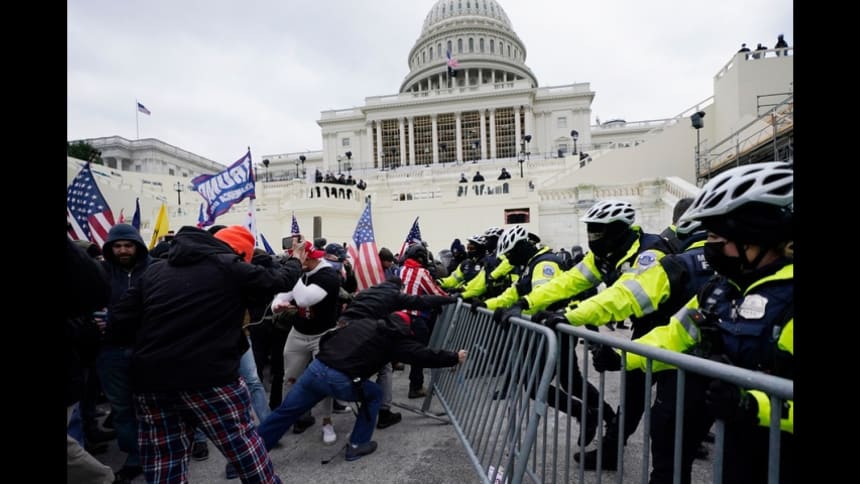
Donald Trump launched his political career a decade ago with a tirade falsely accusing Mexico’s government of sending drug dealers, rapists and other violent offenders across the border to undermine the United States, and the president has returned to racist scapegoating in the name of law and order whenever he’s thought it would serve him politically. Trump has been fearmongering about Black and brown criminals with “tough of crime” rhetoric since at least 1989, when he promoted false claims linking a group of Black and Latino teens to a brutal New York City assault.
But whatever his rhetoric or his fantasies of “one really violent day” to eliminate crime, the president (himself a convicted felon) is the one who has put lawbreakers beyond the reach of justice, specifically by abusing his pardon powers. It’s a point that House Democrats are making this week in a new report focused on “public safety implications” of Trump’s decision a year ago to pardon more than 1,500 insurrectionists charged in connection with the deadly Jan. 6, 2021, attack on the Capitol.
Democrats published the report, “One Year Later: Assessing the Public Safety Implications of President Trump’s Mass Pardons of 1,600 January 6 Rioters and Insurrectionists,” ahead of Tuesday’s fifth anniversary of Jan. 6, as well as a second report that highlights the role and current position of administration higher-ups and allies who played a hand in Trump’s attempt to remain in office despite his 2020 election loss.
“At least 33 pardoned January 6th insurrectionists have now been convicted of, charged with, or arrested for additional crimes since the violent attack on the Capitol,” the report “One Year Later” reads before rattling off a long list of alleged offenses: “child sexual assault, production of child pornography, possession of child pornography, rape, conspiracy to commit murder of Federal Bureau of Investigation (FBI) agents, kidnapping, sexual assault, aggravated robbery, reckless homicide, driving under the influence causing death, illegal possession of firearms, domestic violence by strangulation, burglary, vandalism, grand theft, stalking, violation of protective orders, threatening public officials, and drug trafficking.”
My colleague Steve Benen has covered several of these arrests over on the Maddowblog. The report also identifies at least 159 pardon recipients who had already been convicted of violent offenses before they participated in the insurrection. This is an important figure to keep in mind when Trump’s Department of Homeland Security claims it’s targeting criminals for deportation, even when many of those detained have no criminal record whatsoever. And this pattern, alongside the numerous other eye-popping pardons Trump has distributed over the past year, makes evident his perverse view of law and order: Perceived foes and politically opportune targets face the full weight of the justice system, while perceived allies and those from whom he can benefit can get off scot-free whatever the offense.
Ja’han Jones is an MS NOW opinion blogger. He previously wrote The ReidOut Blog. 

