









When Hugo Chávez ran Venezuela, it was common to hear his supporters chant, “Chávez has them going crazy.” It was a disparaging political slogan meant to describe how the rebel-turned-president bewildered opponents with his maneuvers, leaving his enemies unsure of how to respond.
Many Venezuelans saw the chant as an insult, with a grain of truth.
After all, the actions of Chávez’s socialist government, and later Nicolás Maduro’s after his death, frequently staggered the country and the international community.
Enter Donald Trump.
This month’s dramatic U.S. military operation to remove Maduro from power represents the biggest political opening for the Venezuelan opposition in a generation. On Thursday, that opening reaches a decisive moment as Nobel Peace Prize winner María Corina Machado, the leader of the opposition, meets face-to-face with Trump.
The White House luncheon takes place 12 days after Trump said Machado “doesn’t have the support within or the respect” to lead the country and after he announced instead that Delcy Rodríguez, Maduro’s vice president and loyal enforcer, would assume power despite the opposition’s victory in Venezuela’s 2024 elections.
That decision stunned Venezuelans. As one Venezuelan government official put it, with evident irony, “Now it’s Trump who has them going crazy.”
For decades, Venezuelan opposition groups have struggled with whether to negotiate with an authoritarian government that uses political prisoners as bargaining chips. Some argued negotiation was a moral imperative. Others countered that negotiating risked legitimizing a government built on coercion.
This dilemma mirrors the one now playing out between Washington and Caracas after the Trump administration ousted Maduro: Should the U.S. work with a regime notorious for its abuses, or should it fully back the Venezuelan opposition?
The White House opted for the former “purely on strategic assessments,” said a source close to the deliberations.
The goal, Trump has said, is to use economic pressure and political leverage to push for changes that align with U.S. national security and economic interests and to call for free elections “at the right time.” Whether pro-Maduro factions will comply is uncertain, but the way they are dealing with political prisoners, despite pressure from Washington, may speak louder than any strategy memo.
According to that source and another close to the White House — both of whom spoke on condition of anonymity to discuss the sensitive discussions — one of the first things the U.S. demanded from the Venezuelan regime after Maduro was ousted was the liberation of all political prisoners and the closure of El Helicoide, the headquarters of Venezuela’s national intelligence agency, where a large number of those prisoners are being held. That hasn’t happened, and based on reports from the Venezuelan Penal Forum, an independent human rights organization, more than 700 political prisoners remain behind bars.
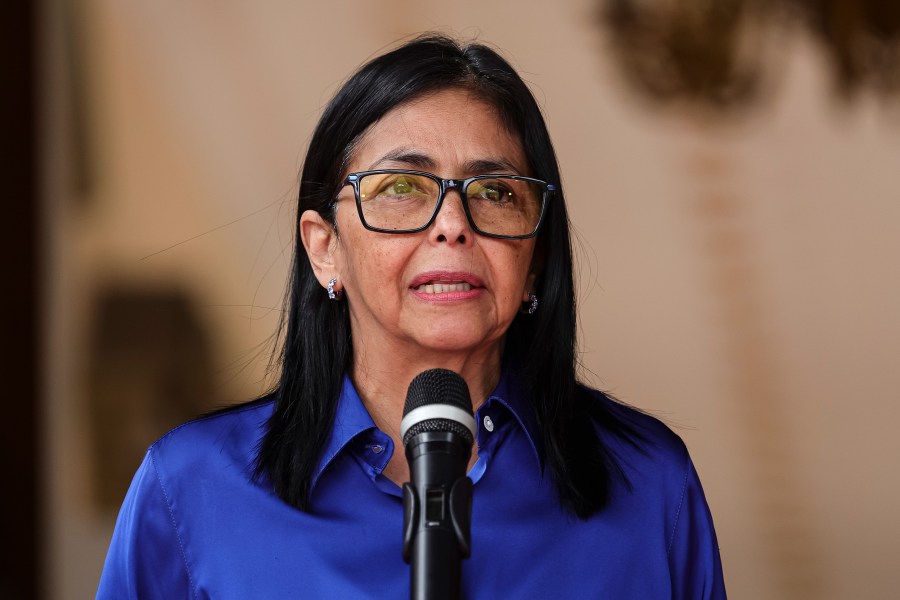
These demands are being discussed with Rodríguez, a central figure of the Venezuelan government for more than two decades who was sworn in as interim president after Maduro’s fall, with the backing of the U.S.
“She’s a terrific person,” Trump said of Rodríguez after having a “long” phone call with her Wednesday. Immediately after the Jan. 3 incursion in Venezuela to seize Maduro and his wife, Trump also said Secretary of State Marco Rubio talks to Rodríguez “all the time” and that in one of those calls she said, “We’ll do whatever you need.”
“There is no way to believe that Delcy, the interim dictator, can act in good faith in this case,” said Luis Almagro, who led the Organization of American States from 2015 until last year, some of the most repressive years of Maduro’s rule. “She is going to act to protect the interests of a dictatorship that refuses to die.”
“If you look at the issue of political prisoners,” Almagro continued, “it’s something that moves forward drip by drip, clearly with reluctance, and obviously it’s not something they agree with. And this is going to be the logic on every issue, on every matter. They will cooperate as much as necessary to keep the regime in place. And that will be the guiding logic behind how they act.”
Rodríguez’s rise to interim president, said two Venezuelan government sources, reflects not only her political acumen but also her deep entrenchment in the Venezuelan system. “She is both a defender and executor of the Maduro regime’s strategies, skilled in diplomacy, negotiation and internal power consolidation,” said one of the sources.
Machado, however, has called Rodríguez “one of the main architects” of Maduro’s repression and said she is “perhaps even more ruthless” than the former president.
Last week, the president of Venezuela’s National Assembly, Jorge Rodríguez, Delcy’s brother, announced the release from prison of an “important number of Venezuelan and foreign individuals.” He said the decision was a “gesture by the Bolivarian government” to seek peace.
Trump celebrated the announcement, saying on social media that “Venezuela has started the process, in a BIG WAY, of releasing their political prisoners.”
As of Thursday, fewer than 100 had been released, according to the Penal Forum. The Venezuelan government claims that more than 400 have been freed since December.
Soon after the announcement, families rushed to prisons all over the country, desperately waiting for news. Parents and spouses camped outside, prayed and even begged for information. But after a week, the majority of them are yet to see their loved ones come out. “They have no intention of releasing my brother,” a young woman waiting outside El Helicoide said to MS NOW. “Who is in charge of releasing these prisoners? Who is it?”
The answer, according to several Venezuelan government sources who spoke on condition of anonymity because they’re not permitted to speak publicly, is simple: Delcy Rodríguez and Diosdado Cabello, the minister of interior who oversees the police apparatus and, reportedly, the armed pro-government gangs known as colectivos. Cabello is widely regarded as the regime’s No. 2.
A former military officer and longtime Chávez loyalist, Cabello is considered a master of internal control. He has been accused of drug trafficking and narco-terrorism alongside Maduro, and the U.S. has offered a $25 million reward for his capture. Since Maduro was ousted, Cabello has been patrolling Caracas with armed troops, intimidating civilians, while families await the release of political prisoners. “Cabello knows that without political prisoners, there’s no leverage,” said one of the sources in Venezuela close to the regime. “His plan … is to gain time by releasing them one by one and by releasing other prisoners and calling them ‘political prisoners,’ and hoping that works.” That’s an important distinction. “Our work at this moment is to discern which releases are, in fact, of people who were arbitrarily detained for political reasons,” the Penal Forum emphasized. Since the 2024 election, eight political prisoners have died in state custody, according to Comando ConVzla, a grassroots political movement under Machado. “How many more people are going to die while in custody?” asked David Smolansky, deputy director of the group’s international office. Smolansky told MS NOW there can be no transition to democracy as long as there are political prisoners. “This has to end in only one way: with the restoration of fundamental guarantees to the Venezuelan people, with the restoration of sovereignty to the Venezuelan people,” Almagro said. Many Republicans in Washington agree. Sen. Rick Scott, R-Fla., drafted a resolution praising the U.S. military operation that captured Maduro but also underscoring Machado’s work to achieve democracy. Florida Rep. Carlos Giménez also said the U.S. must stabilize Venezuela “to have a smooth transition into a government that will certainly be led by my dear friend, Nobel Laureate María Corina Machado.” Machado now has an opportunity to make the case herself. Back in Caracas, Rodríguez is trying to block that effort. As complaints mounted that political prisoners were not being released as the U.S. demanded, she appeared Wednesday alongside Cabello and her brother, Jorge, insisting the process is still underway. “The message is that Venezuela is opening up to a new political moment that allows for understanding based on divergence and political and ideological diversity,” Rodríguez said. But while she’s talking about ideological diversity, a government source in Caracas told MS NOW she’s pressing for her own meeting with Trump and for her team “to be received at the White House the same week” as Machado. “It’s one of life’s ironies, isn’t it?” said Almago. “Delcy Rodríguez labeled half the continent, and even me, for a long time, as a puppet of the empire, a bootlicker of the empire. Look who turns out to be the puppet, the bootlicker.” Kate Farrell, Ali Vitali and Mychael Schnell contributed to this report.
Kay Guerrero
Kay Guerrero is a senior producer of newsgathering for MS NOW. Recommended


