








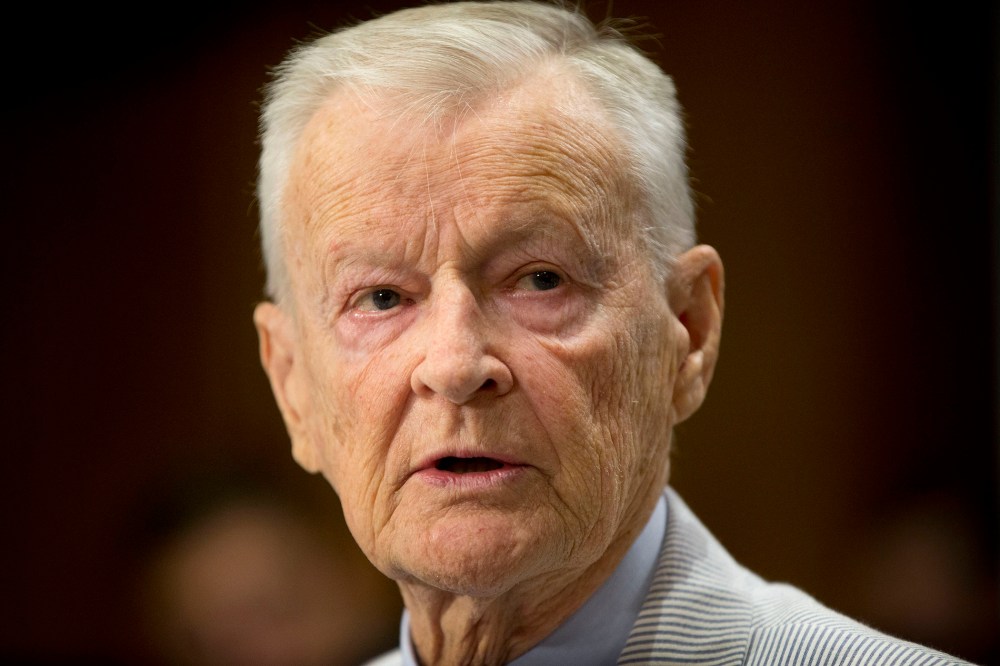
Zbigniew Brzezinski served as counselor to Lyndon B. Johnson from 1966 to 1968 and national security adviser to President Jimmy Carter from 1977 to 1981. In 1981, he received the Presidential Medal of Freedom for his role in the normalization of U.S.-China relations.
On Monday, he attended a private dinner at the White House with President Obama, Vice President Biden and other top policy experts to discuss critical U.S. national security and foreign policy challenges; before that meeting, he spoke with msnbc in a conversation on those same issues.
MSNBC: Let me ask you about ISIS. The president is expected to propose on Wednesday a new offensive against ISIS that could last as many as two or three years, and would likely involve taking the fight to Syria. I have two questions. First, how can we combat ISIS without strengthening other enemies, such as the Assad regime or Iran? And second, do you believe this crisis could have been mitigated by bringing aid to the moderate Syrian opposition earlier, as Sen. John McCain has suggested and former Secretary of State Hillary Clinton has recently argued?
Brzezinski: The problem is that the so-called Syrian forces that are moderate and friendly to the U.S. were the weakest forces contending for the domination of Syria. I think it was a mistake, in fact, to give such a free hand to the Saudis and others in organizing some sort of an internal self-promoted conflict within Syria. Being as it may, however, I think we have to be aware of the fact that right now, the whole region is very flammable. And we have to be very careful how we become engaged.
%22It%E2%80%99s%20going%20to%20be%20a%20long%20process%20%E2%80%93%20you%20mentioned%20two%20or%20three%20years%20%E2%80%93%20I%20think%20it%E2%80%99s%20likely%20to%20be%20much%20longer%20than%20that.%22′
Obviously we have to be involved. But my view is, we have to limit that involvement, primarily to air and maybe some other associated very limited strikes. But the basic heavy lifting has to be done by those Islamic states in the region that have a stake in stability.
It’s going to be a long process — you mentioned two or three years — I think it’s likely to be much longer than that, and maybe even wider in scope than it currently is.
MSNBC: You have some personal experience in this area. As President Carter’s national security adviser in the late 1970s, you were involved in a covert operation to degrade the Soviet Union by funding and arming the Afghan Mujahedeen — a group that later evolved into al-Qaida. President Obama has been interested from day one in extricating the U.S. from the Middle East, something that has become progressively more difficult for him to do. How is it possible, and how does your experience in Afghanistan inform your understanding of how the U.S. can stabilize and withdraw from the region without creating blowback in the future?
Brzezinski: We can’t leave the Middle East entirely because if we leave it entirely, it’s quite possible that the worst elements will prevail. One of the things which our aid to the Mujahedeen, in resisting the Russians, accomplished was that there were many, many more Muslims friendly to the United States as a consequence. And we saw that, for example, in the opposition to the invasion of Kuwait by Iraq, and more generally in the region as a whole.
We must avoid a situation in which it becomes polarized, between us on the one side and the Muslims on the other. That is what we have to avoid. And therefore helping moderate Muslims defend their freedom is perfectly sensible. But simply withdrawing from the region also raises the possibility of the region falling into really dangerous hands. In fact, al-Qaida came into being years after the conflict in Afghanistan — that’s something that people tend to forget.
MSNBC: You’ve been a part of the foreign policy establishment for well over half a century. President Obama recently said that “if you watch the nightly news, it feels like the world is falling apart.” But, he said, “the world’s always been messy … we’re just noticing now in part because of social media.” Setting aside the optics of that statement, do you think there’s some truth to that? That today’s challenges are “not something that is comparable to the challenges we faced during the Cold War”? In other words, is the world a safer place today, despite the horrible foreign policy setbacks the U.S. has experience this summer?
%22We%20are%20facing%20a%20kind%20of%20dynamically%20spreading%20chaos%20in%20parts%20of%20the%20world.%22′
Brzezinski: Let me answer the question this way. During the Cold War, we were always faced with the risk of a nuclear war. A nuclear war would produce momentous casualties almost instantly. For example, if there were a collision between America and the Soviet Union, within 24 hours more than 80 million people worldwide, and particularly in our respective societies, would be dead.
This is not what we’re facing. But we are facing a kind of dynamically spreading chaos in parts of the world. Now in the Middle East, but that could spread to other portions of West Asia, to Central Asia, even into Russia, perhaps even into China. It could spread and is spreading somewhat into Africa, and so forth. And then we have this residual, late-Cold War — or Cold War revived — conflict with Russia, not directly by military force, but clearly overly the stability and security and freedom of Ukraine.
MSNBC: Are those different events the result in some way of the U.S. not exerting its leadership? Is there some way we can solve those problems or are they outside our sphere of influence?
Brzezinski: Well maybe alternatively, we exerted too much leadership. I was against the war in which the United States attacked Iraq in 2003. I thought it was fraudulent and it has produced a mess in Iraq, which continues to perplex and engage us. When we first went into Afghanistan after the al-Qaida attacks of 9/11, I told the secretary of defense myself that I fully supported the decision to go in and overthrow the Taliban and see if we can destroy al-Qaida. I did not feel we should stay there in order to promote democracy because I thought this would engage us in a prolonged and eventually self-destructive conflict.
I think we made some errors. We were on top of the world by the beginning of this century. I think our position has dramatically declined. We’re still the strongest, but we’re not necessarily the most respected or the most legitimate leader as the United States historically was prior to the beginning of this century.
%22We%20were%20on%20top%20of%20the%20world%20by%20the%20beginning%20of%20this%20century.%20I%20think%20our%20position%20has%20dramatically%20declined.%20We%E2%80%99re%20still%20the%20strongest%2C%20but%20we%E2%80%99re%20not%20necessarily%20the%20most%20respected%20or%20legitimate.%22′ MSNBC: How can the U.S. regain that stature and position? Is that possible? Brzezinski: Well to some extent it’s impossible because power is more decentralized now — China is certainly a more serious player, for example. But I think it can be regained to some extent by being steadfast, by being true to our principles, and by being cool-headed in what we do. In other words, don’t lapse into total self-isolationism — in effect, defeatism — but don’t become over-engaged militarily. Be very selective about how you do it, with whom you do it, and arrange for the heavy lifting to be done by the parties most directly concerned and most directly affected by the conflict. MSNBC: It seems like there’s a contradiction there between the U.S. exerting leadership — standing up for our values and moral vision for the world in a steadfast way — and the realist vision you also espoused, most particularly for Syria, where hundreds of thousands of people have died and the president has stood back. Do you think we made the right choice there in not getting involved earlier? Should we continue to be as uninvolved as possible? Brzezinski: I supported the president’s decision not to be involved because I didn’t feel that the parties that were trying to overthrow Assad were dedicated to the establishment of a democratic regime — they were even, in some respects, more fanatical on some issues than Assad. I think Assad was a dictator, without a doubt, capable of very brutal activity, without a doubt, and he demonstrated that. But in some ways he was more tolerant of non-Muslims than some of the Muslim countries now engaging themselves in some sort of special operation to unseat him. MSNBC: Ukraine is not part of NATO, and it doesn’t look like the West will come to their aid militarily. The Obama administration appears to be drawing a line west of Kiev with NATO member states like Estonia, which the president visited recently. What does that mean for the post-Cold War system of American geopolitical deterrence? For instance, what is to stop China from looking at Putin’s advances and then claiming their own contested territories or expanding their own sphere of influence? Brzezinski: First of all, I think we have to understand clearly what kind of obligations we have. Estonia is a member of NATO, and NATO is based on the principle “one for all and all for one.” We’re obligated to defend Estonia. Ukraine is not a member of NATO, but we are sympathetic to its desire to be part of Europe — not necessarily NATO though — and we are certainly determined to help it retain its independence. %22I%20would%20not%20exclude%20the%20possibility%20of%20some%20defensive%20weaponry%20being%20given%20to%20the%20Ukrainians.%22′ For the moment, the NATO alliance — as well as Europe and America jointly — have not been giving military aid to Ukraine. But I would not exclude the possibility of some defensive weaponry being given to the Ukrainians before too long, simply if the Russians, and particularly Putin, continue to try to intimidate Ukraine. That’s not the same thing as defending them; it’s helping them defend themselves. MSNBC: Is that the middle path you think the United States is going to take — something more than economic sanctions, but less than proxy war? Brzezinski: I think so. It seems to me that if we really are serious about Ukraine having the right to be an independent state with a friendly relationship with Europe, but not necessarily a member of NATO, and if Ukraine is not only threatened but actually victimized by Russia using force, then some defensive arms — publicly given — but only defensive weaponry, handed over to the Ukrainians makes eminent sense. It contributes to greater stability and it’s more likely to deter Mr. Putin than if he’s in effect given the green light to use as much force as he feels like.
Benjamin Landy Recommended


