








Wisconsin voters will weigh in on the Republican presidential race in Tuesday’s primary after a brutal week for Donald Trump. Divining meaning from the results, however, could be more difficult than it looks.
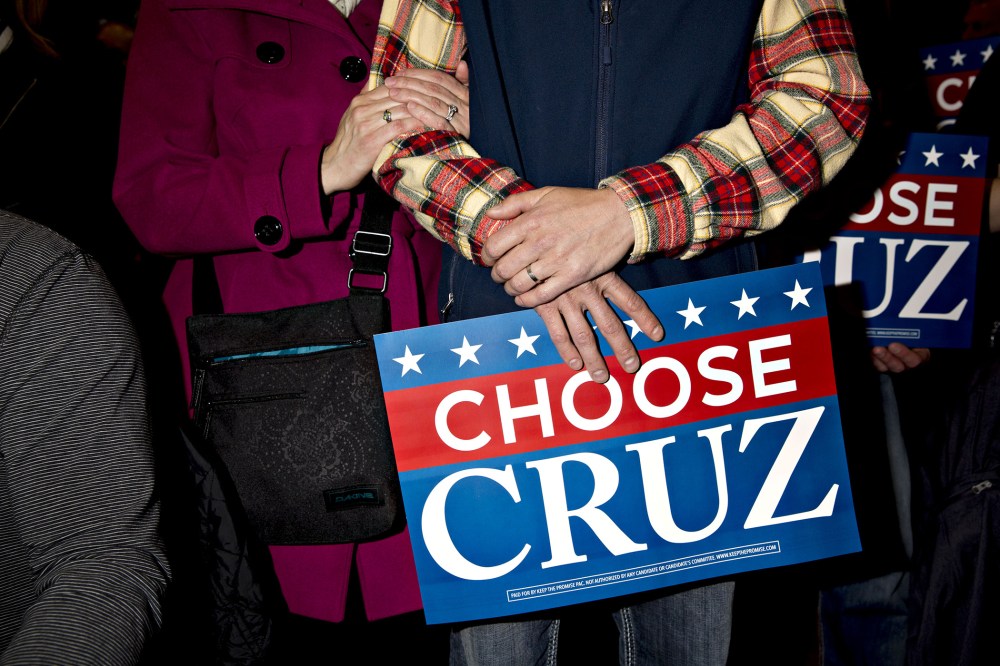
Several recent polls show Texas Sen. Ted Cruz with a solid lead over Trump and Ohio Gov. John Kasich holding a significant minority.

Trump suffered through a week of stories about his campaign manager’s battery charges, his flip-flops on abortion and his cratering position in general election polling, especially with women. Cruz argued on Monday that a Wisconsin victory for his campaign would finally expose Trump as vulnerable after months of seeming impervious to bad press.
“This race has national implications,” Cruz told reporters while campaigning in Madison on Monday. “The entire country is looking to Wisconsin.”
Cruz’s position might not be clear after Tuesday’s results, though. Wisconsin has more in common with states that have already held primaries and less with upcoming states in the Northeast, Eastern Seaboard and Pacific Northwest, all voting before the primaries close in June with a crucial race in delegate-rich California. The next primary is Trump’s home state of New York on April 19, and polls so far show him leading the race there by a wide margin.
Some election analysts, like The Upshot’s Nate Cohn, have argued that Wisconsin’s demographics were already weighted against Trump before his recent string of bad news. The state awards most of its delegates by congressional district, and Trump has so far polled poorly in the Milwaukee area, which composes much of the state’s electorate. He is favored in the less populated and more rural northern and western parts of the state.
RELATED: ‘Desperate times for democracy’ in Wisconsin
Trump predicted a “very, very big victory” at a rally in La Crosse on Monday and added that if he wins the state, “It’s over.”
That doesn’t mean Tuesday’s results don’t matter, though. The race is turning into a game of inches in the delegate count, and if Cruz dominates – he could potentially win all of Wisconsin’s delegates with even a modest victory — the odds of a contested convention would go up.
It’s becoming clear that Trump needs to win the nomination outright with a 1,237-delegate majority or face an open Republican National Convention, where he’d be an underdog to win. Trump has so far shown little strength at winning the battle to select loyal delegates at state and local conventions, which will become critical if he falls short of a majority and “bound” delegates, required to vote for him on the first ballot, become free to vote for whomever they choose.
That scenario isn’t all good news for Cruz, though, who batted away speculation on Monday that delegates might try to draft someone from outside the race if they can’t settle on either him or Trump.
RELATED: Paul Ryan is absent as Wisconsin votes “If over 80 percent of the delegates are Cruz delegates and Trump delegates, under what universe do 1,000 Trump delegates or 1,000 Cruz delegates go vote for some uber-Washington lobbyist who hasn’t been on the ballot?” Cruz said Monday. Wisconsin serves as another test for Kasich, who both Cruz and Trump have suggested should drop out of the race given that he has no path to winning an outright majority of delegates on the first ballot. Cruz said Monday that he would support maintaining convention rules set in 2012 to keep insurgent candidates off the ballot in order to block Kasich in July. Kasich has tried to present himself as an upbeat candidate above the day-to-day squabbles of his rivals, but in recent days both he and a super PAC supporting him, New Day America, have taken a more negative tone. “They want to dirty me up like they’ve dirtied themselves up,” Kasich told voters in Long Island, New York, on Monday. “Now we have one guy with no experience and the other guy whose experience amounts to shutting down the government and calling the majority leader a liar. That is not the way in which you get things done in this country.”
Benjy Sarlin Recommended


