








By the time Arizona Republican Gov. Jan Brewer announced that she was vetoing SB 1062, a bill that would have made it easier for business owners to turn away gay and lesbian customers, the religious right had already lost.
“Religious liberty is a core American and Arizona value, so is non-discrimination,” Brewer said in a statement Wednesday. “The bill could could divide Arizona in ways we cannot even imagine and no one would ever want.”
Major corporations like Apple, Delta, and American Airlines voiced opposition to the bill. The National Football League was preparing to move the Super Bowl. And by the time Brewer put pen to paper Wednesday evening, it wasn’t just both Republican U.S. Senators from Arizona urging her to veto it. State lawmakers who had supported the bill were begging Brewer to save Arizona from themselves.
“I hope other fringe legislators will take a lesson from what’s happening in Arizona,” said Evan Wolfson, head of the LGBT rights group Freedom to Marry. “This is not about religious freedom, it was about creating a license to discriminate. It was wrong in the 60s with regard to race discrimination, wrong in the 70s in regard to women’s equality, and it’s wrong for America today.”
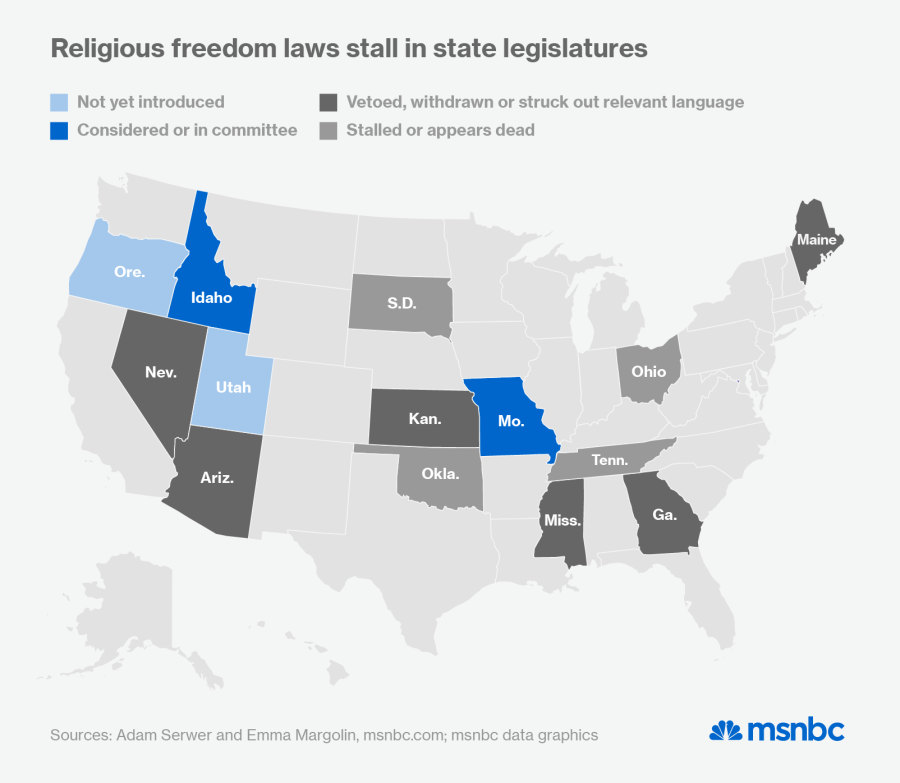
Brewer’s veto was only the latest defeat in the movement. In the past month, bills aimed at protecting business owners’ prerogative to refuse service to individuals based on their religious beliefs faltered in Kansas, Ohio, Mississippi, South Dakota, Idaho, Georgia, and Tennessee. Spurred on by cases in New Mexico and Colorado, where a photographer and a baker were told they couldn’t refuse customers on their religious objections to same-sex marriage, state legislators responded to a growing fear on the religious right that they are the ones suddenly becoming an unpopular minority whose fundamental rights are in danger.

“I think you’ve had a rise in hostility towards religion, and towards religious people in the public square,” says Brian Walsh, executive director of the American Religious Freedom Program, which helped write religious freedom legislation in Kansas and elsewhere. “It’s become increasingly acceptable to be negative towards religious people. It’s okay now to speak in a very negative way, especially if you can label them as haters.”
For LGBT rights activists, this feels like a tipping point. The Supreme Court’s decision striking down part of the Defense of Marriage Act has led to a flood of federal court rulings striking down bans on same-sex marriage. The swiftness and breadth of the backlash against the religious freedom laws in Kansas, Arizona and elsewhere, has bolstered a sense that the wind is at their back.
“You see these moments at real turning points for social change, the fact that this is happening is a testament that we are at a moment with how our society treats LGBT people and our readiness to take a big step forward,” says Louise Melling of the American Civil Liberties Union.
Conservatives felt blindsided by that same response, and betrayed by what they felt was misleading coverage of what their proposals actually did.
“I think there were a lot of well intentioned people who were acting on misinformation,” says Walsh. “When the torches and pitchforks come out in a seeemingly endless procession it makes it difficult for people to find out what the truth is.”
The truth is, though, that as far as sexual orientation is concerned, the attempt to carve out a broad religious exception to non-discrimination laws (in many cases, a preemptive one) was probably doomed from the start. Though conservatives insisted that the religious freedom bills were maligned as the reincarnation of Jim Crow, they were written so broadly that they could easily have been construed as a license to discriminate. Persuading Americans that you should be allowed to discriminate against gays and lesbians is a harder sell than telling them same-sex couples shouldn’t be able to get married.
A majority of Americans now favor same-sex marriage, in every region of the country except for the South. But non-discrimination is not just a majority position. It’s practically a foregone conclusion. According to a recent survey by the Public Religion Research Institute, 75% of Americans already think it is illegal under federal law to discriminate on the basis of sexual orientation in employment. They’re wrong — there is no federal law barring discrimination on the basis of sexual orientation. Most states don’t ban it, including Arizona. People simply take for granted that it’s the case because an overwhelming majority — 72% — think it should be.
Had conservatives focused narrowly on the issue of services for same-sex weddings, they might have had an easier time. But only in Oregon was the language of their proposal that narrow. In every other state, they pursued a religious exception that would be broad enough to cover the caterer who does not want to provide food for a same-sex wedding and the shop owner who objects to paying for insurance that covers his women employees’ birth control. The result was a set of proposals so broad as to justify everything from a cop refusing to respond to a domestic violence call from a same-sex couple to a restauranteur telling a same-sex couple that their kind aren’t served here.
Conservatives used to be able to count on the influence of culture, if not the state, to enforce their views on homosexuality. That’s no longer true.
What changed first is a chicken-and-the-egg kind of question. But Walsh points to the Supreme Court’s ruling in a 1990 religious freedom case, rather than the more recent battle for same-sex marriage, as the catalyst for the current battle. In that case, Justice Antonin Scalia — not known as a champion of gay rights — wrote that religion could not serve to exempt people from “laws of general applicability.” Any other approach, Scalia wrote, would “make the professed doctrines of religious belief superior to the law of the land, and in effect to permit every citizen to become a law unto himself.”
“The Supreme Court essentially kicked religious freedom out of the pantheon of First Amendment rights,” says Walsh. “It told religious people they could no longer rely on the constitution, on the First Amendment, and would have to work through state legislatures.” This isn’t just about same-sex marriage for people like Walsh–but about a longstanding American tradition of respect for religion that he feels is slipping away.
“There have been decades of assurances that if same-sex marriage becomes law, it would not restrict religious freedom, a lot of people took those assurances at face value,” says Walsh. “I would say that those assurances are being called into question.” The bipartisan backlash to that ruling is a faded, dog-eared photograph from another time. Democrats and Republicans banded together, passing the Religious Freedom Restoration Act, which narrowed the ability of the state from placing a “substantial burden” on people’s religious beliefs. It was signed by President Bill Clinton, at a time when liberalism was in a fighting retreat and the Democratic Party was terrified of appearing hostile to people of faith. Religious conservatives also pushed for state versions of Religious Freedom Restoration Acts, passed in the years following the ruling. The Affordable Care Act’s contraception mandate and conflicts over businesses serving same-sex couples renewed a sense among religious conservatives that their freedoms were under threat, and conservative activists began pushing their allies in the state legislatures to expand the state level religious freedom laws to keep religious business owners from having to serve same-sex couples. So far, they’ve failed. “The really powerful story on this front is that so many of the legislatures have stepped back from the brink, and refused to go along with this extremist agenda,” said Wolfson. The backlash from corporate America should be seen as a barometer for just how drastically things have changed. It’s not enough to argue that the bills failed because legislators feared a loss of campaign contributions. The fact that corporate America fears driving away young talent, and is afraid that laws seen as targeting gays and lesbians are bad for business, is symbolic of how hard it will be for the religious right to roll back the LGBT rights movement’s progress. Republican state legislators, heading into 2014 primaries and general elections, also have nothing to lose from supporting bills that excite their base but have little chance of passing. The religious freedom laws are a fragile bulwark against a cultural change that most likely cannot be reversed. They carve out an exception to the principle of non-discrimination by sexual orientation that does not apply to race or sex. Even if few business owners take advantage of them, they could prevent future generations from remembering those who turned away gay and lesbian customers as part of the same class of people who put up “whites only” signs in their shop windows. Conservatives bristle at the suggestion that allowing business owners to discriminate against employees, deny them benefits, or refuse customers based on sexual orientation is equivalent to racial discrimination in the Jim Crow South. The analogy is inexact: Jim Crow laws demanded complete separation of the races in order to preserve the myth of white supremacy. Whites and blacks could not play a game of pool together, let alone eat a meal, or even use the same toilet. Segregation cleaved America into two nations, separate and unequal. Religious freedom laws would allow homophobic business owners to choose be islands unto themselves, an tiny archipelago floating in the shadow of a coming tsunami. Yet, left up to the religious right, same-sex couples could be denied some of the most basic rights. They would not be able to marry, much less adopt children. They could be fired at will for their sexuality, and if not fired, denied benefits available to heterosexual employees. Those in the military would not be able to serve openly, if at all, and their families would not be properly compensated if they gave their lives. Society would view gays and lesbians the same way they view incest and bestiality, or as a psychological disorder to be cured. That may not be Jim Crow. But the fact that the religious right has failed to drive gays and lesbians to the margins of society as a despised minority is not a testament to their tolerance, it is a testament to their present weakness. That weakness has some generally supportive of gay rights causes arguing that there’s nothing wrong with laws allowing religious exemptions, even if it means a homophobic restaurateur might refuse to serve a same-sex couple. If nothing else, that sort of hostility toward gays and lesbians is already ushering itself into extinction. “I would advise my fellow people that agree with marriage equality, don’t go suing businesses that disagree with you,” Ilya Shapiro, a legal scholar with the libertarian Cato Institute, told msnbc’s Chris Hayes Wednesday. “Take your business elsewhere, and advise your friends to do the same.” There’s no chance that LGBT rights activists will give up that fight. While religious conservatives see the issue of allowing people to act according to their conscience, gay rights supporters see them as essentially demanding state sanction of gays and lesbians as a semi-pariah class against whom discrimination is less objectionable than it is against people on the basis of race, religion, or sex. When racists raised religious objections to integrating their schools and stores, they were told they had to follow the same rules as everyone else–and LGBT rights activists don’t think this should be any different. “We don’t say that you can turn away or refuse to hire someone because of gender or race because you have an objection to integration of the sexes or integration of the races, and there’s no reason we should have a different standard here,” said Melling. “Sure you can go somewhere else, but what kind of signal are we sending to society if we have in essence a sign up in the inn or the bake shop that says ‘heterosexuals only,’ or ‘weddings for heterosexuals only?’ It’s ferociously undermining of people’s dignity.”
Adam Serwer Recommended


