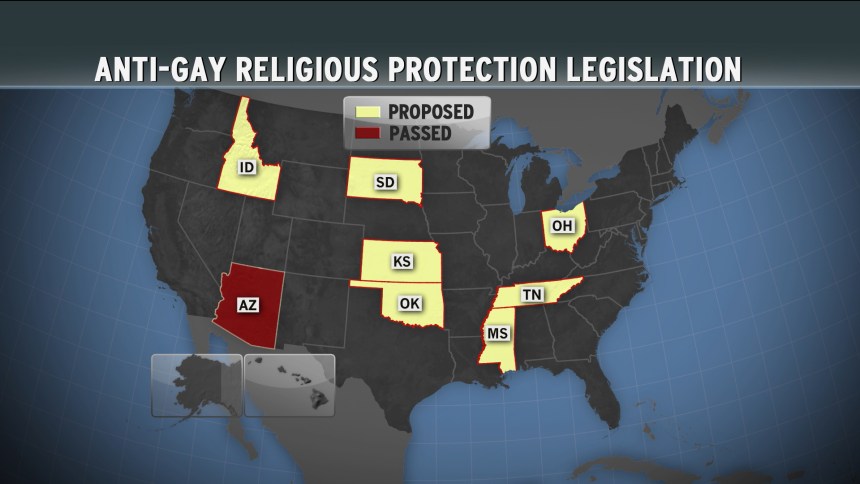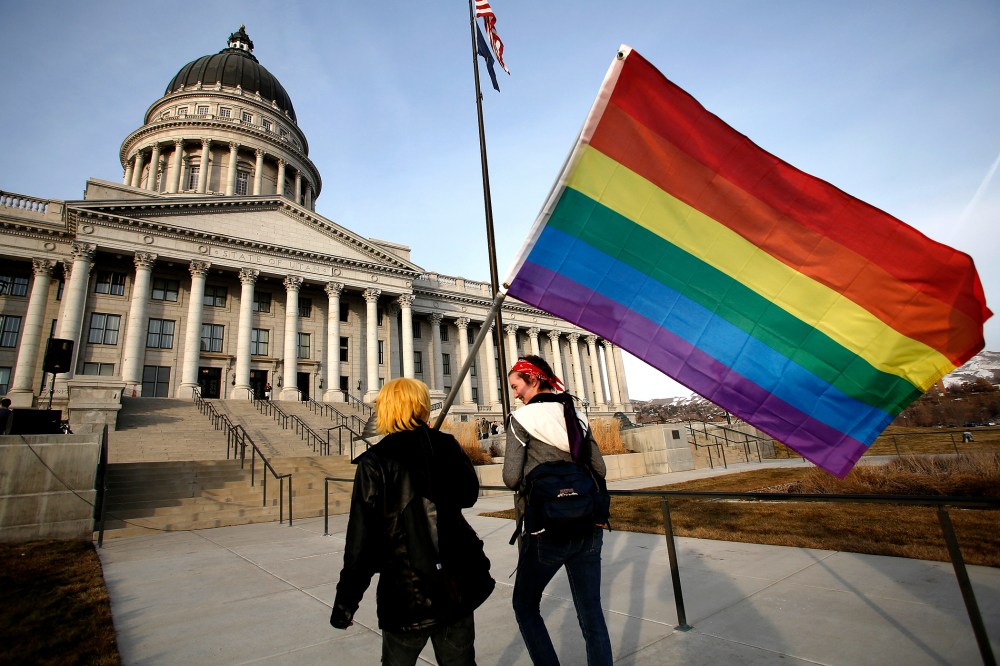
Conservatives insist the so-called religious freedom bills that would allow a right to refuse to serve same-sex couples don’t do what liberals and gay and lesbian rights activists say they would do. Yet the bills supposedly crafted to protect religious business-owners’ right to discriminate against same-sex couples solely within the context of marriage ceremonies or celebrations could be much broader than their stated purpose.
“I just don’t know anybody influential in the religious freedom arena who thinks that you should be giving people some type of pocket veto not to provide services to people based on their sexual orientation in general public accommodations,” Brian Walsh, the head of the American Religious Freedom Program, which helped draft the Kansas bill, told msnbc last week.
Walsh seemed shocked that opponents of such laws believe that the Kansas bill and others like it would allow a broader right of refusal than simply allowing religious business owners to refuse to provide services to same-sex wedding ceremonies or celebrations.
“I don’t know any influential party who thinks that you should be protecting the hotel chains, or the diners, or the gas stations, or anything like that,” Walsh said. “If the legislature decides to further clarify things like that, I think that’s great.”
Other conservatives backing these laws have stuck to that narrow defense. Ryan T. Anderson, a fellow at the conservative Heritage Foundation, wrote that the Kansas bill “would not allow businesses, individuals, or government employees from refusing to serve someone (or a couple) simply because of his or her sexual orientation.”
With the exception of a carefully worded potential ballot initiative in Oregon, conservative religious freedom proposals being considered by several states contain language that can be read as going much further than protecting the right of refusal associated with the solemnization or commemoration of a commitment between same-sex partners. Indeed, most of the proposed laws include language that could grant state approval to myriad forms of discrimination against people in same-sex relationships.
Eugene Volokh, a law professor at UCLA, said the Kansas bill would not grant a right to refuse services to gays and lesbians generally. Under the Kansas proposal, Volokh argued, a hotel would not be able to refuse a room to a same-sex couple unless they had a policy of only serving married couples, because that wouldn’t count as “treating as valid” a same-sex marriage, since hotels rent to unmarried couples all the time.
“If a hotel generally lets anyone in, but refuses a room to a couple because they are a same-sex couple, that’s not ‘related to…any marriage,’” Volokh says.
Under that interpretation, a day care center couldn’t refuse to care for the child of a same-sex couple, a restaurant couldn’t refuse to serve same-sex spouses, and a doctor couldn’t refuse to treat a patient in a same-sex marriage, because those services are unrelated to the marriage as such.
But that’s not the only plausible interpretation of the law.
“The language of the statute says that religious objectors need not provide any services, accommodations etc “related to” any marriage,” says Caroline Mala Corbin, a law professor at the University of Miami. “There is no clear limiting principle to the interpretation of that phrase.”
Samuel Bagenstos, a law professor at the University of Michigan and a former deputy assistant attorney general for civil rights, says neither interpetation is definitive because of the way the bills are written.
“It’s not inevitable that the treat-as-valid language would be read that broadly,” Bagenstos says. “But the language of the bill is broad enough that it’s not the only plausible interpretation.”
Conservatives in other states could have hewed to language that resembles the potential ballot initiative in Oregon if their goals were as narrow as they claim. That proposal is crafted simply to allow people to refuse to offer services for a “same-sex marriage ceremony or its arrangements.”
Yet even if the more narrow interpretation prevails, the Kansas bill–and similar counterparts in other states–would still sanction discrimination against same-sex couples beyond refusal of services associated with weddings. The Kansas bill allows employers to deny “employment or employment benefits” if “it would be contrary to the sincerely held religious beliefs of the individual or religious entity regarding sex or gender.”
More than just saying no to baking a cake with two grooms standing at the top, the Kansas bill unambiguously grants employers with religious objections a right to use their views regarding sexual orientation to impair the livelihoods of potential or current employees because they are in a same-sex relationship. It also contains language related to “adoption” and “foster care,” as well as provision of “social services.” “I frankly think they’re being deliberately misleading,” Eunice Rho of the ACLU told msnbc referring to the Kansas bill last week. “The proponents are trying to say this legislation is just about wedding services, when the clear drafting says otherwise.” Arizona is the only state to pass one of these laws so far, and its Gov. Jan Brewer has yet to say if she will sign it, but both of Arizona’s Republican U.S. senators, John McCain and Jeff Flake, have urged her to veto the bill. Brewer is also under pressure from big business. Marriott hotels, American Airlines and Apple are all urging the Republican to veto the bill, arguing the measures would be bad for business. The Arizona Super Bowl Host Committee warned the bill would “deal a significant blow to the state’s economic growth potential” when it holds the big game next year, and that the legislation runs contrary to the National Football League’s “core values which embrace tolerance, diversity, inclusiveness and prohibit discrimination.” The language of Arizona’s law allows exemptions from requirements that “substantially burden” an individual’s exercise of religion–something that could allow almost any kind of discrimination as long as it is based on sincere religious beliefs. “There is absolutely nothing in the act that would preclude a bed store from arguing that selling beds to same sex couples violates its religious beliefs because it facilitates sinful conduct,” Corbin said. Theoretically, anti-discrimination laws could be enforced over such conservative objections if the state is pursuing a “compelling interest,” (a nebulous legal concept that refers to when a government is justified in regulating certain conduct) but there’s no guarantee the courts would see it that way. And Arizona doesn’t have state laws barring discrimination on the basis of sexual orientation anyway. “Banning discrimination in places of public accommodation is a compelling interest. But given the split decisions on the contraception mandate, there is no guarantee that such claims would lose,” Corbin says, referring to the slew of cases that involve employers challenging the Affordable Care Act’s mandate that health insurance companies offer birth control coverage, on the grounds that paying for such health insurance would violate their religious beliefs. Like the Kansas bill, the Arizona bill seems potentially much broader than the narrow purpose conservatives claim to be pursuing. Rather than creating small exceptions that would allow discrimination only in specific, narrow circumstances, their proposals are written in such a way that, at least in theory, could allow other forms of discrimination against gays and lesbians — and in some cases anyone — as long as an individual feels that they are following the tenets of their religion. The mismatch between their stated goals and the laws actually crafted to serve their purpose raises the question of what conservatives are truly seeking with their religious freedom bills. LGBT rights activists would oppose even limited exemptions that allow businesses to discriminate against same-sex couples, on the principle that discrimination on the basis of sexual orientation is wrong under any circumstances. But few of the proposals conservatives have put forth could be truthfully described as narrow, even if they intend them to be.
Adam Serwer Recommended