








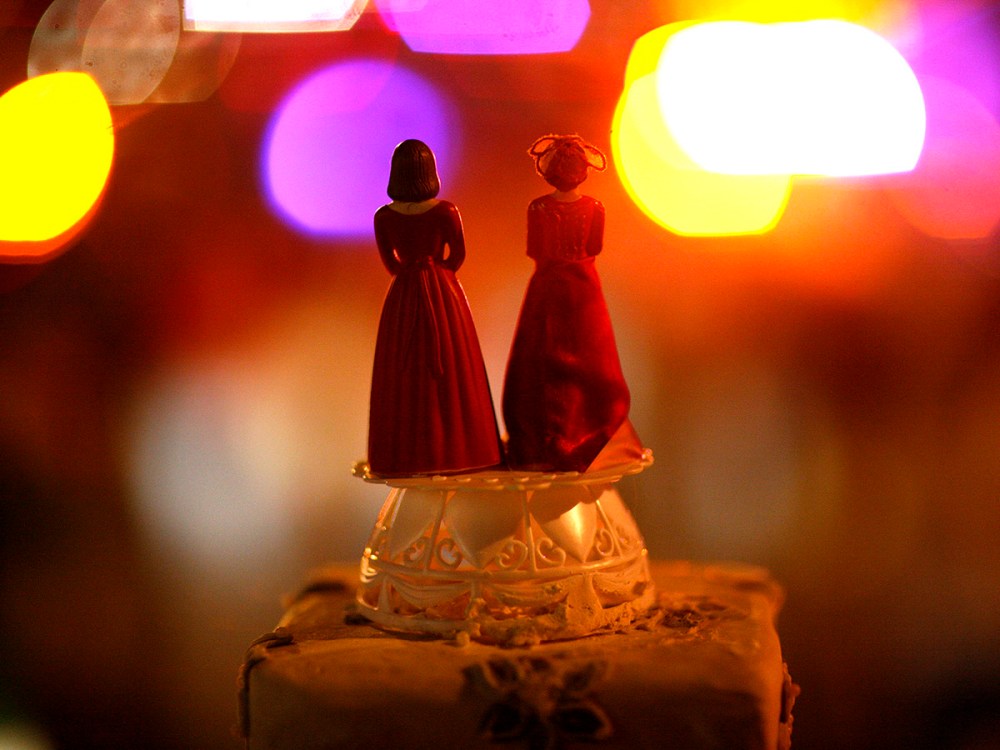
Vanessa Willock sent a brief email to Elane Photography wondering if they’d take pictures of her 2006 commitment ceremony to her longtime partner, Misti Collinsworth.
Elaine Huguenin, the photographer and co-owner of Elane photography with her husband Jonathan, said no. “As a company, we photograph traditional weddings,” read her response. “Are you saying that your company does not offer your photography services to same-sex couples?” Willock asked. “Yes, you are correct in saying we do not photograph same-sex weddings, but again, thanks for checking out our site!”
Willock told the state Human Rights Commission she was “shocked, angered and saddened” by Elane’s response, and suddenly worried she and Collinsworth would be unable to find a photographer. Though they eventually did, Willock also filed a complaint with the New Mexico Human Rights Commission, saying that Elane Photography had violated a New Mexico state law banning discrimination on the basis of sexual orientation.
In August, the New Mexico Supreme court agreed, ruling unanimously that Elane Photography had violated state law by refusing to photograph the ceremony. Now the Huguenins are seeking to have their case heard by the U.S. Supreme Court, saying that forcing them to take pictures of same-sex ceremonies violates their First Amendment rights by compelling them to engage in speech they don’t believe in. If the Supreme Court accepts the case, it will provide the first key test of a conservative political and legal strategy of reframing a losing battle against gay rights into a conflict over religious freedom, one that could rewrite the bounds of anti-discrimination laws in the United States. The case has “widespread ramifications for the conflict between religious rights and anti-discrimination rights,” said Caroline Mala Corbin, a professor at the University of Miami School of Law.
“The anti-gay, anti-freedom to marry crowd, having largely lost the argument on gay people and on marriage, are resorting to a distraction argument that is aimed at tearing a hole in the longstanding protections we have in this country against public accommodation discrimination,” said Evan Wolfson, head of the pro-LGBT rights group Freedom to Marry. “Their quarrel is not really just with marriage, it’s with the whole idea of non-discrimination law that we’ve fought hard for over decades through many difficult chapters of American history.”
Conservative activists naturally see it differently. The Elane Photography case they argue, is about the state forcing someone to engage in creative expression they don’t agree with. Just as the First Amendment protects your right to say whatever you want, it also protects you from having to say what the government wants you to say. Having to photograph a same-sex commitment ceremony tramples the Huguenins’ free speech rights by forcing them to violate their beliefs by approving of same-sex marriage. (Ironically, New Mexico is currently in the midst of a county-level revolt over same-sex marriage rights, but the state itself has not passed a same-sex marriage law).
“We have to guard the right to not be compelled to speak for everyone, especially those who have disfavored points of view, or else the government can compel people to advance messages they don’t agree with,” said Jordan Lorence, an attorney with the Alliance Defending Freedom, the conservative law firm representing Elane Photography. “They also couldn’t force a gay photographer to photograph a wedding at Westboro Baptist.” Could they also refuse to photograph an interracial marriage for religious reasons? “I think that they could,” he added, “because the government cannot force people to communicate messages they don’t agree with.”
Conservatives say they aren’t trying to relitigate the civil rights era. Instead, they say that photography, like writing or singing, involves creative expression that can’t be regulated the way that you could prevent a restaurant from serving a black customer. “This is distinctly different from a segregated lunch counter or segregated hotel,” Lorence says.
LGBT-rights supporters say it isn’t and that we already had this argument 50 years ago. Private expression is one thing, but entering the commercial marketplace means having to abide by its rules against discrimination. “It’s impossible to draw a line here between an expressive commercial service and a non-expressive commercial service. Almost any commercial interaction we have today involves the expression of words or pictures or talking,” said Josh Block, an attorney with the American Civil Liberties Union. “People once argued that they had a religious or associational right to refuse to serve black people in an integrated manner, and those claims were rejected.”
As a business, non-discrimination rules apply
The key question is whether Elane Photography’s refusal to offer their services to a gay couple is actually speech, or whether it’s commercial conduct that can be regulated. The New Mexico Supreme Court decided it was the latter. Chick-fil-A was free to donate all its money to anti-gay causes if it wanted to, Block says, but they never argued in states with anti-discrimination laws that they didn’t have to serve chicken sandwiches to gays and lesbians. Similarly, Block says, nothing prevents the Huguenins from expressing their disapproval of same-sex marriage–or even alerting their customers to their personal beliefs–they just can’t refuse customers on the basis of sexual orientation.
In 1984, international corporate law firm King and Spalding argued that the First Amendment’s guarantee of freedom of expression and association allowed them to deny any and all women and minorities partnerships if they so chose. They lost the case 9-0, even though then-Chief Justice Warren Burger acknowledged that attorneys make a “distinctive contribution” to “the ideas and beliefs of our society.” That much is true, and the Elane Photography is part of a larger effort to shape those ideas and beliefs. With legal cases, polling numbers, and even state referenda trending in the direction of gay rights, the religious freedom approach is less weighed down by the conjecture and pseudoscience used to argue against same-sex marriage. Where the same-sex marriage cases put conservatives in the uncomfortable position of arguing that government should be small enough to drown in a bathtub but big enough to tell you who you can marry, the religious freedom argument takes place on terrain conservatives are more comfortable fighting on. Rather than justifying government intrusion in the most intimate corners of Americans’ lives, they’re arguing that the government can’t tell you what to say. “Photographers, writers, other people who create protected speech get to choose what to create,” said Eugene Volokh, a law professor at UCLA School of Law. “We can condemn them, we can say they’re intolerant, but they have a right to be intolerant.” Serving chicken sandwiches isn’t protected by the First Amendment, but creative expression is. The Elane Photography case is demonstrative of a larger argument about when, and to what degree, a person’s individual beliefs exempt them from the rules everyone is required to follow. Though not legally related, the challenges to the Obama administration’s mandate that insurance plans provide contraception to the insured are part of the same dispute. Cases like these aren’t just about legal precedents, they’re about shaping how society decides which freedom it wants to protect with the force of the law—the right not to be discriminated against, or the right of individual entities to decide whom they want to serve and how. “They are united at a higher level,” said Lorence of the contraception cases and the Elane Photography case, “in that they’re right-of-conscience cases that people are having a sincere objection because of their beliefs to doing something the law requires.” Elane Photography’s petition to the Supreme Court to hear the case is due in November, but the high court takes only a small number of cases each year. Even if it refuses this case, the larger argument conservatives are making about conscience will eventually get its day in the high court. When it comes to race and gender, civil rights activists have won great legal victories that have drastically altered American society and culture to the point where we take for granted egalitarian values that were once seen as radical, values that have paved the way for black men to be presidents and women to be secretaries of state. When it comes to sexual orientation, no one knows which side will ultimately take the field.
Adam Serwer Recommended


