








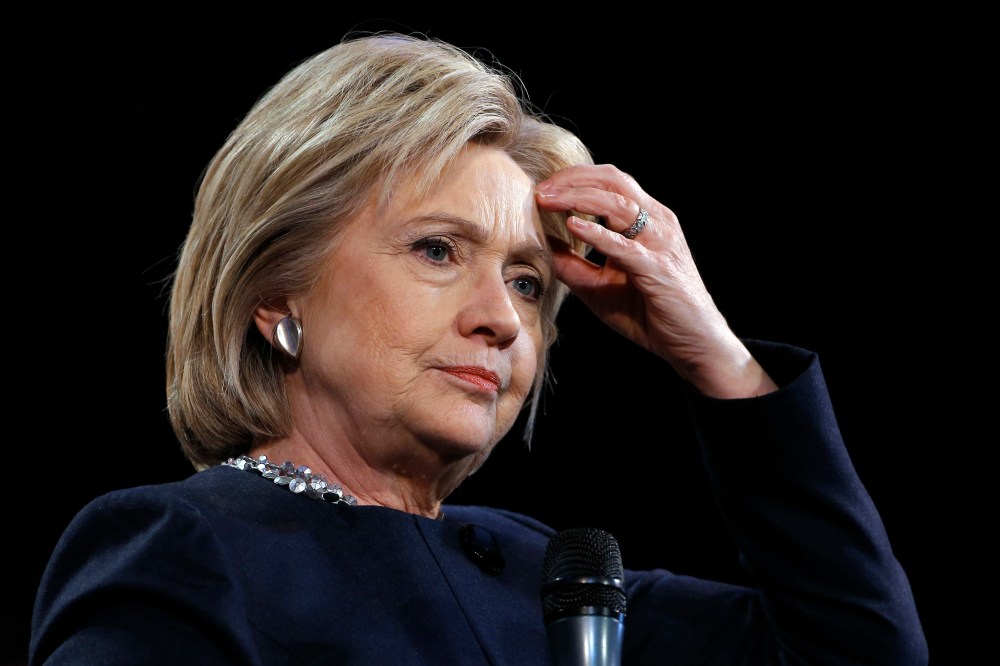
Hillary Clinton’s path to the presidency had a clear trajectory from the beginning: Secure the Latino vote early and where it counts.
Clinton quickly hit battleground states where Latinos pack a hard punch. She stacked her team with a diverse group of leaders, which, in a deeply symbolic gesture, included a once-undocumented DREAMer. Her platform on immigration was the most progressive approach the nation had seen yet.
Still, just as with the air of inevitability that once defined Clinton’s chances of securing the nomination, her stronghold on the Latino vote may be slipping.
“I think she really personifies that candidate whose talking points are dictated by polls and not by taking a firm position on your values,” Marisa Franco, an immigrant-rights activist with the group #Not1More, said of Clinton.
“How can Latinos bank on such a variable?” she added.
Clinton’s early efforts certainly helped create a firewall for Democrats to claim the Latino vote, but Donald Trump did most of the legwork for her. What she wasn’t prepared for were challenges from the left.
The most jarring example for the Clinton campaign came in Nevada, where leaders of the most powerful union in the state decided they would not endorse any candidate ahead of the Feb. 20 caucuses. The Culinary Union Local 226, a collective of bartenders, housemaids and cooks, is a massive political machine with more than half its membership of Hispanic origin.
Their silence this election cycle is a subtle snub to Clinton. The union formally endorsed Obama in 2008, but Clinton ultimately came back to win the central precincts in their area by a 10-point margin. This time she’s going to have to try again to win over the membership without the overarching union’s support.
Bethany Khan, communications director for Local 226, says members are free to caucus individually on their own. But the vast machine of the union’s political power will be standing on the sideline for the caucuses next month.
“I think moving forward when the union does have a candidate that we will endorse, it will be a strong ground game,” Khan said. “Right now, we’re focused on organizing.”
Days after the union’s decision to stay out of the Democratic primaries came another blow: Lucy Flores, a prominent Latina in Nevada state politics, announced that she was supporting Sanders.
“I believe that Bernie Sanders will lead the charge, with many millions of Americans behind him, against the unfettered Wall Street greed that has threatened the very existence of the middle class and shackled so many more to permanent poverty,” Flores posted on Facebook.
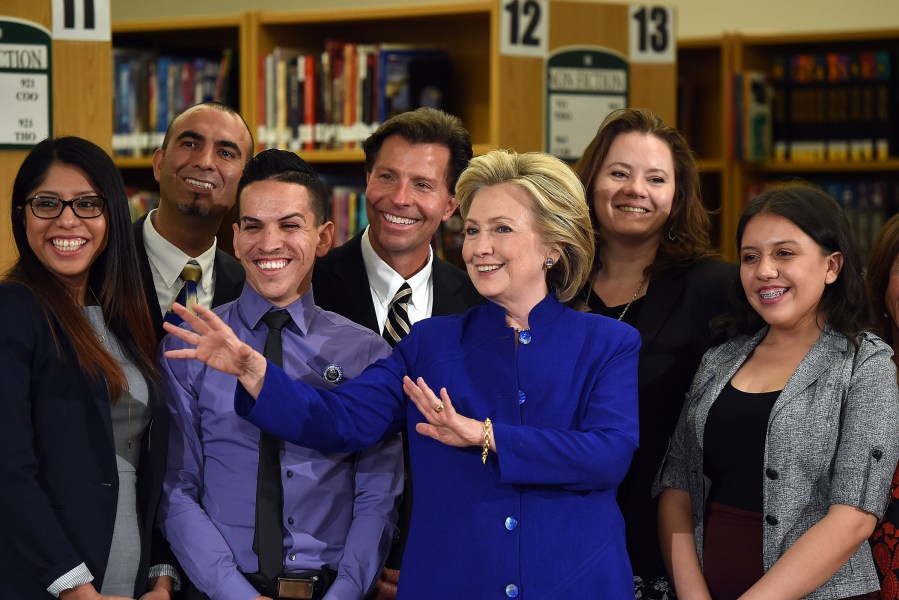
The setbacks come even after the Clinton campaign went early and hard in Nevada. Months before other candidates had formally entered the race, Clinton was in Las Vegas, sitting at a table surrounded by DREAMers and laying out her vision. It was one of the first big reveals of the direction in which Clinton would steer her campaign, and she did so by rolling out an uncharacteristically bold agenda.
“Right from the beginning, she brought her campaign to Nevada. She was very strategic about it. She has done more outreach and people are familiar with her,” said Rafael Lopez, one of the DREAMers she met with during her Las Vegas trip in May. “We’re a battleground state so this could definitely influence the outcome of our presidential nominee.”
Nevada is the first early state for Democrats where Latinos could play a deciding role in who wins the nomination. They helped Obama flip the state blue in both 2008 and 2012 and helped Senate Minority Leader Harry Reid cling onto his seat. Latinos make up 17 percent of eligible voters, among the highest shares in the country in a race that will also likely play a crucial role in the general election.
By contrast, the first two states for Democrats to pick their nominee, Iowa and New Hampshire, have a negligible share of Latino voters — 3 and 2 percent respectively. But in areas where campaigns aren’t giving precious time to court Latinos, they seem to be gravitating toward Clinton’s opponents. “There is a division specifically between Bernie and O’Malley,” said Monica Reyes, co-founder of the group DREAM Iowa, who this week formally backed the former Maryland governor. What’s ironic is that there’s little daylight separating the candidates. All three Democrats want to expand Obama’s executive actions shielding millions from deportation. They all press for comprehensive immigration reform and a pathway to citizenship. All have plans to scale back detention practices. Where they differ is on the degree of health care offered undocumented immigrants. Clinton has said she’s open to allowing immigrants to buy into Obamacare, but has hesitated in offering them federal subsidies. O’Malley supports full Obamacare, while Sanders has proposed coverage under his single-payer plan. Crucially, very few of these proposals are realistic. Obama’s executive actions have already been frozen by the courts; expanding them would likely result in much of the same. Congress is necessary to pass comprehensive immigration reform, but legislation didn’t pass even when Congress had bipartisan support three years ago. Since then, the Republican Party has lurched so far to the right that its presidential front-runner is now proposing to deport 11 million people. Health care for undocumented immigrants? Good luck. This only begins to explain the complications that arise when you have millions of people hanging in the balance of a contentious political battle. Latinos were wooed by Obama’s message of hope and change after he promised to pass comprehensive immigration reform during his first term in office. Instead, he deported more undocumented immigrants than any other president, exceeding the 2 million milestone. He delivered on deferred action for DREAMers, but, as advocates note, only after facing enormous public pressure and timed just months ahead of his re-election. Any other executive actions have since been on hold. “He’s known as the ‘Deporter-in-Chief’ and I feel like he has used immigration as a strategic tool instead of looking at immigration as a humanitarian issue,” Reyes said. “Honestly, I feel like Clinton would be just like President Obama.” DREAMers say they’ve heard empty promises before. And when the stakes involve whether their loved ones could be torn from their families, it’s a grudge they won’t soon forget. That’s why disillusionment, particularly among young Latinos, matters in the context of this presidential election. A new Pew study out last week finds that millennials make up almost half of Latino voters eligible to participate in the 2016 election. Lynn Tramonte, deputy director of America’s Voice, a Washington-based advocacy organization fighting for comprehensive immigration reform, points out that immigration used to be a third-rail issue for Democrats. Now the default position is the most progressive approach seen yet. “The DREAMers at the forefront changed the way of how you do politics in Washington,” Tramonte said. “We have learned so much over the past years over how to hold a candidate accountable. I think our movement really grew up a lot.”
Amanda Sakuma Recommended


