








Boiled down to the most basic terms, President Obama’s executive actions on immigration provide three universal human needs: security, livelihood and family. Nearly 5 million undocumented immigrants found out on Tuesday that they have a legitimate shot at getting all three here in the United States.
But at the exact same time, dozens of other families have found out just the opposite. At any moment, they could be caught up in immigration raids currently sweeping the nation and be deported back to the countries from which they fled.
Throughout Obama’s presidency, the line dividing which undocumented immigrants are allowed to stay in the U.S. and which should be shut out has been blurry at best and a complete mess at its worse. Without comprehensive immigration reform, any semblance of consistency or justice gets lost somewhere in the middle.
RELATED: Supreme Court takes up major immigration case
And so in deciding this week to hear the legal challenge to Obama’s executive actions, the Supreme Court may finally offer some clarity to how far a president can act on his or her own in promising that broad swaths of 11 million undocumented immigrants can remain, lawfully, in this country.
There’s weariness on both sides of the policy. Can immigrants trust a president once crowned as the “deporter-in-chief,” who is currently carrying out deportation raids against women and children? But also can opponents trust the administration to enforce the law, particularly as fear builds over whether immigration policies have compromised our nation’s security?
The latter question will likely be a major source of contention when the nine justices on the court hear oral arguments in April debating whether Obama’s immigration actions should move forward as planned. In agreeing to take on the case Tuesday, the Supreme Court asked that special consideration be given to what’s known as the “take care” clause of the Constitution — in its simplest terms, is the president faithfully carrying out the law?
The administration argues that he is. The federal government has finite resources to carry out immigration laws. Contrary to what many Republican candidates have said along the campaign trail, it’s simply not feasible to round up all 11 million undocumented immigrants and deport them.
To solve the problem, the administration divided up a list of categories for enforcement. The top priority: deport undocumented immigrants with felony convictions and recent border-crossers.
The guidelines seemed simple enough. Leave families alone for now while the feds go after the bad guys. And the U.S. government seemed to have stuck with the directives. The Department of Homeland Security reported at the end of last year that 86% of deportations were people who fell into that Priority One category.
The problem is that reality is almost never so black and white.
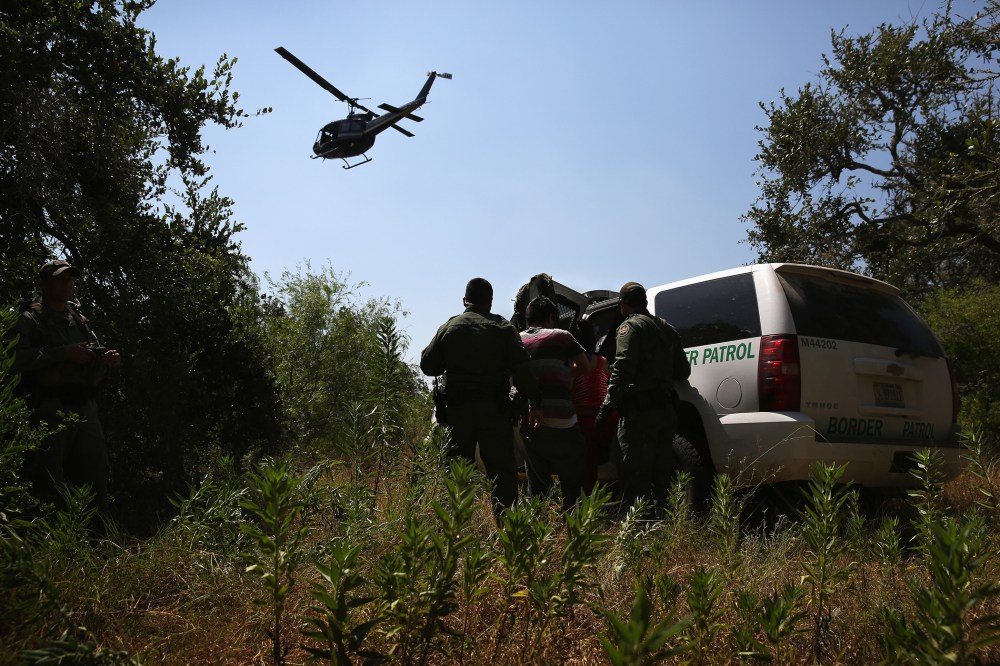
The U.S. government has carried out a series of raids in recent weeks targeting mostly women and children from Central America who were caught up in the border crisis that made headlines during the summer of 2014. Many had turned themselves in at the border and pleaded for asylum. But immigration courts have since come back saying their legal options are over, they must return home.
And though technically these families are considered top deportation priorities as “recent border-crossers,” it hardly seemed in the same spirit as going after criminals. If the president had the discretion to decide who should stay and who should be removed from the U.S., then why target primarily women and children? And those from some of the most dangerous regions in the world, no less? RELATED: Obama administration may have fumbled deportation raids in a big way The 121 people caught up in the raids represent a tiny fraction of the 100,000 Central Americans apprehended along the border since 2014. But there has been a recent spike in apprehensions, signaling the potential of another border crisis. And after the U.S. last year saw the lowest number of deportations in six years, the administration needed to show it is in fact faithfully carrying out the law. It needed to send a clear message that illegal immigration would not be tolerated. Immigrant communities that have watched deportation directives swing back and forth in recent years are increasingly distrustful that they will be safe in the time that it takes for the Supreme Court to hand down a decision in June. Michelle Brané, executive director of the Women’s Refugee Commission, has spent the last week visiting communities hit by the raids. Advocates like her have found that immigrant families are so afraid of the raids that they’re pulling their kids out of school and refusing to follow up with doctor’s appointments. They’re heading underground. “I think what the administration didn’t realize is that the population that is now extremely concerned and living in fear because of the raids are the very populations they intend to protect,” Brané said. It’s a delicate balance of a human approach toward immigration with enforcement priorities in mind that has left the administration struggling to hit the right tone. That push and a pull of deportation policies is what has pro-immigrant allies pulling out their hair one week and singing the administration’s praises the next. President Obama’s executive actions are no longer just about him securing a lasting legacy on immigration. They’re merely a stop gap until Congress comes up with immigration reform. But at least until then, they give some clarity to the chaos.
Amanda Sakuma Recommended


