









First, there were the “Big Four” — the original outlaw motorcycle gangs who became notorious in the 1960s: the Hells Angels, Outlaws, Bandidos and Pagans.
Over the next few decades, as bikers’ numbers and notoriety expanded, many smaller gangs formed, some of them becoming powerful themselves and others forming alliances with the larger ones.
That inevitably sparked turf battles, as the gangs tried to run each other off by force.
These violent clashes often led to deaths, but rarely anything like what happened in Waco, Texas, over the weekend, when a brawl involving members of five gangs ended with nine bikers killed, 18 injured and at least 170 arrested.
RELATED: Nine killed in biker war at Waco, Texas restaurant
The most comparable event is the so-called River Run Riot, a violent confrontation on April 27, 2002, between the Hells Angels and the Mongols at Harrah’s Casino in Laughlin, Nevada. There were more bikers involved in that infamous brawl than the one in Waco, but only three died.
Authorities have not said what they believe sparked the Waco brawl, or the names of the five gangs represented there. But biker gang experts told NBC News that the violence appeared to stem from a beef between the formidable Bandidos and the Cossacks, a regional gang with purported allegiance to the Hells Angels. The nine bikers who died came from either of those two gangs.
The fight was allegedly over the smaller group’s plans to include a reference to Texas on the lower section of its official jacket patch — called the “bottom rocker.”
“The Cossacks didn’t have a Texas bottom rocker and they were tired of taking the Bandidos’ s—t,” said Edward Winterhalder, a former Bandidos member who has written 10 books and produced several television programs on the subject. “But other clubs had Texas rockers and they felt big and bad enough to do it.”
“That’s what led to all this.”
Billy Queen, a former investigator with the the U.S. Bureau of Alcohol, Tobacco, Firearms and Explosives, said the spat is fairly typical among biker gangs.
“You and I would call it petty. To them it’s their whole life,” said Queen, who infiltrated the Mongols gang in California and wrote a book, “Under and Alone,” about the experience. “What makes it unusual is the amount of death involved in this one.”
Authorities are now bracing for retaliatory attacks that could leave more casualties.
The Bandidos, formed in 1966, is one of the country’s biggest outlaw motorcycle gangs, with around 900 members and 93 chapters across the United States. The U.S. Justice Department says they’re one of the nation’s most dangerous, selling drugs and weapons and enforcing their dominance through violence. The Bandidos in particular focus on distributing cocaine and marijuana, and are involved in the production, transportation and sale of methamphetamine, the department says.
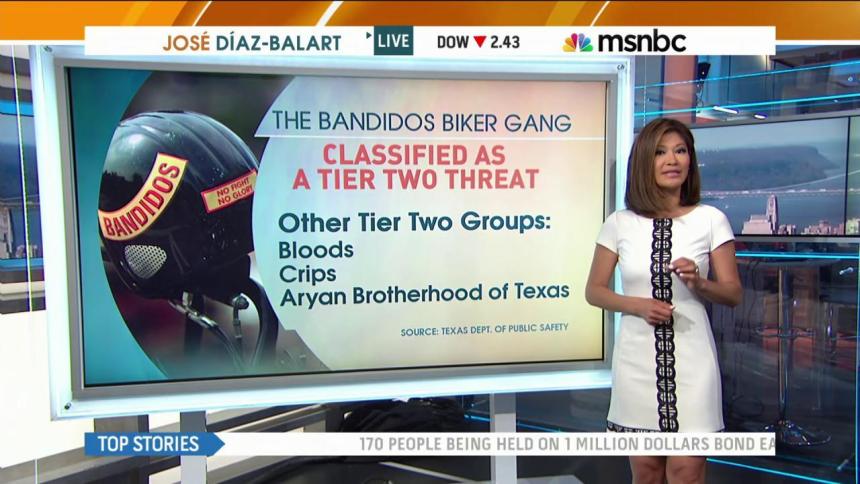
In Texas, the Bandidos are particularly powerful, with chapters scattered throughout the state. They are one of the most dangerous gangs there, on par with the Bloods, Crips and the Aryan Brotherhood, “responsible for a disproportionate amount of crime across urban, suburban, and rural areas,” according to an intelligence report published by the Texas Department of Public Safety a year ago. The Bandidos typically try to keep their criminal activity covert, sometimes masking their intentions with “charity runs,” the report said.
In September 2011, the Justice Department charged nearly 40 members or associates of the Bandidos for various firearms and drug-related offenses in Texas and Colorado.
Less is known about the Cossacks, a Texas gang formed in 1969 with the motto, “We take care of our own,” according to the book “The One Percenter Encyclopedia.” The Cossacks are affiliated with the Hells Angels in Texas, said Jay Dobyns, an author and former ATF agent who infiltrated the Hells Angels. Those two national gangs have been engaged in a “tit for tat” in recent years, “testing” each other by conducting national runs in each other’s territories, according to an assessment published by the Rocky Mountain Information Network in 2010. That rivalry moved overseas in the late 1990s, when the Hells Angels and Bandidos fought over territory in Denmark and Finland. Eleven people were killed and more than 70 injured in what’s become known as “The Great Nordic Biker War.” Back in America, battles between the gangs have included proxy confrontations involving affiliated “puppet” clubs. “You’ve got a lot of sister clubs that are support clubs for bigger clubs. It all depends on what area you’re in and who wants to take that area for themselves,” said George Rowe, author of “Gods of Mischief,” about his going undercover in the Vagos biker gang for the ATF. Competition from Mexican drug cartels over the methamphetamine trade has put economic pressure on the gangs’ criminal enterprises, adding an economic factor to the more traditional turf battles, particularly in areas close to the border, law enforcement authorities say. Dobyns said the Waco brawl will bring new, unwanted, attention and law enforcement resources to the two gangs, and to outlaw biker gangs more broadly. When gangs are keeping a lower profile, law enforcement officials and the public tend to cast them as “rebels and outcasts, who like to ride motorcycles and get into scrapes,” Dobyns told NBC News. But Waco could be a watershed event, Rowe predicted. “Its going to be a war against these gangs,” he said. “It’s going to have that impact.” Al Henkel, Polly DeFrank, Helen Kwong and Donna Mendell contributed reporting. This article originally appeared on NBCNews.com.
Andrew Blankstein
Jon Schuppe Recommended


