









This is the Jan. 5, 2026, edition of “The Tea, Spilled by Morning Joe” newsletter. Subscribe here to get it delivered straight to your inbox Monday through Friday.
Twenty-two years after George W. Bush stood beneath a “Mission Accomplished” banner, thousands of American troops remain stationed in Iraq, still searching for stability in a country scarred by war. The initial 2003 invasion may have toppled Saddam Hussein, but it also unleashed chaos that defined two decades of bloodshed.
More than 200,000 Iraqis were killed, and over 4,500 U.S. service members lost their lives in a conflict that promised liberation but delivered tragedy.
The story in Afghanistan was no different.
What began as a targeted mission after 9/11 devolved into a 20-year stalemate. Donald Trump vowed to end America’s involvement there. He even flirted with the idea of a Camp David meeting with the Taliban on the anniversary of 9/11, a proposal that was widely condemned. But Trump did set a withdrawal plan that President Joe Biden would later carry out, with disastrous results.
Two decades of American wars taught leaders an unmistakable lesson: Military adventurism plus regime change equals tragedy.
That’s why Trump’s new neocon pose is so jarring.
For years, he ridiculed Bush 43’s foreign policy and promised to rebuild America from within by focusing on secure borders, a strong middle class, and no more trillion-dollar wars.
All that changed this weekend, as Trump’s tone hardened and his advisers suddenly sounded like born-again neocons.
By Saturday, “America First” melded into “Mission Accomplished.”
Venezuela and the world are better off with Nicolás Maduro gone. He stole elections, plundered the country, and destabilized the region. But the same was rightly said of Saddam Hussein.
Is the massive risk worth the reward? To Donald Trump it is. Because unlike George W. Bush’s misadventure in Iraq, Trump plans to run Venezuela and keep its oil.
Count on it.
“In the battle of Iraq, the United States and our allies have prevailed.”
– President George W. Bush during his May 1, 2003, “Mission Accomplished” speech.
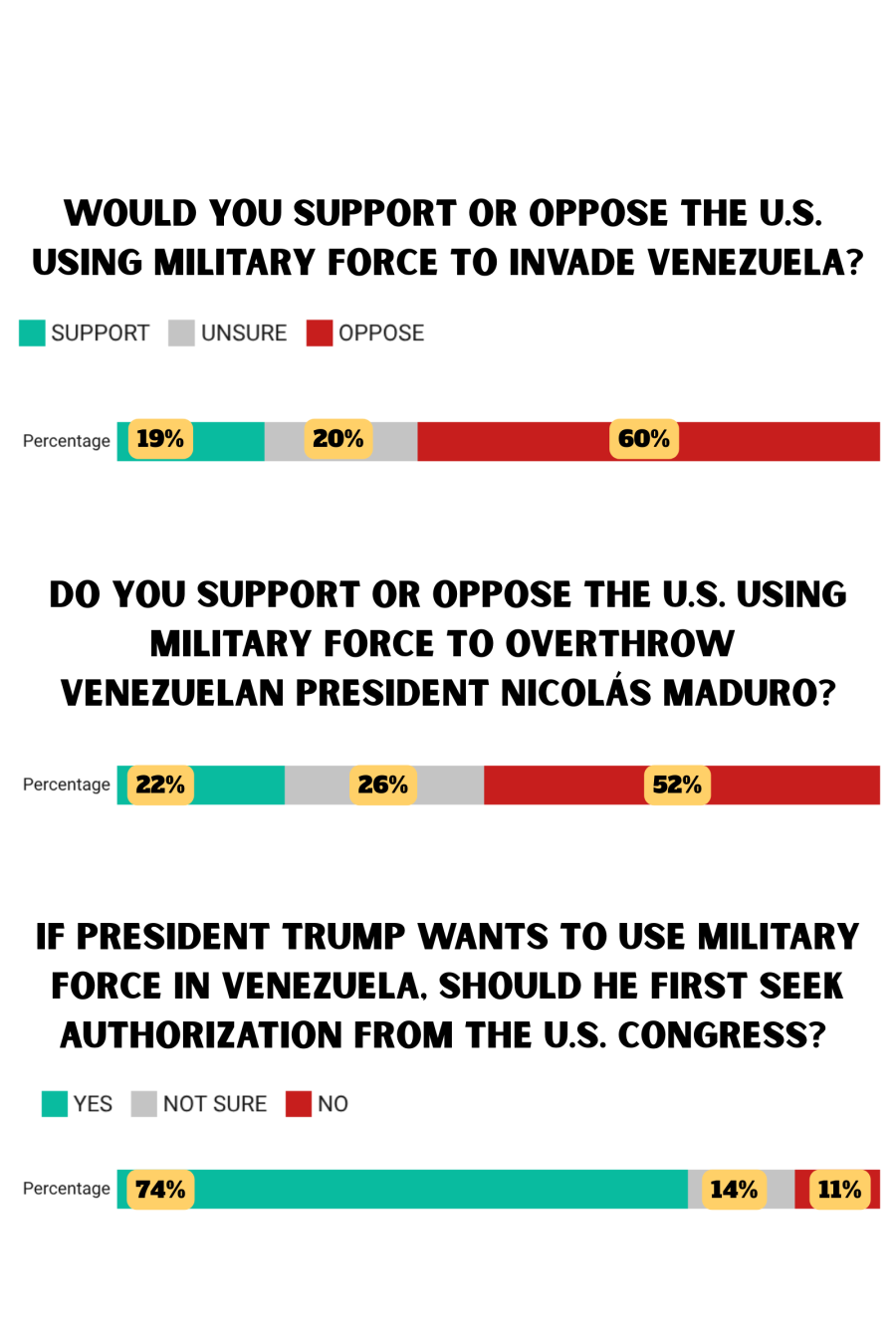
Source: The Economist/YouGov Poll Dec. 20-22, 2025; 1,592 U.S. adult citizens
A CONVERSATION
with
James Story, former U.S. Ambassador to Venezuela
The strongman who ruled Venezuela for more than a decade is now a defendant in a federal courthouse in New York. Donald Trump says the United States will “run” Venezuela “until such time as we can do a safe, proper and judicious transition.”
Few understand the geopolitical angles of this U.S. operation better than James Story, the last U.S. ambassador to Venezuela, who continued to lead the U.S. mission from exile in Colombia after Caracas expelled American diplomats. We asked him what Maduro leaves behind — and what it would really mean to “run” Venezuela.
Mika Brzezinski: Ambassador Story, help us make sense of what’s happening inside Venezuela right now.
Amb. James Story: First, understand that the Venezuelan people are glad to see Nicolás Maduro gone. Unfortunately, there are some pretty bad actors who have been left behind — Dia [acting President Delcy Rodríguez] being the chief among them.
Brzezinski: What comes next?
Story: The White House should be pressing Delcy Rodríguez to release the 900-plus political prisoners in the country, as well as wrongfully detained Americans. Also remember there was an election, and that election was won by Edmundo González.
Brzezinski: How does the current government’s illegitimacy play into the situation?
Story: If America really plans to “run Venezuela,” then María Corina Machado can reenergize the country’s democratic opposition, which is obviously shocked by the decision to allow Delcy Rodríguez to lead Venezuela.
Brzezinski: What are some of the biggest problems facing Venezuela right now?
Story: It’s a country riddled with illegal armed groups. You’ve got the FARC and ELN from Colombia, and Hezbollah elements reportedly from Iran. It’s clear the Cubans were protecting Maduro and providing intelligence. Thirty-two of them, according to a Cuban government agency, died during this attack.
Delcy’s got her own internal struggles: between Vladimir Putin and [Vladimir Padrino] López, who runs Venezuela’s military, and Dia herself — who runs the security services and is in bed with the FARC and ELN. She has enormous domestic concerns, and now she will have the United States telling her what to do.
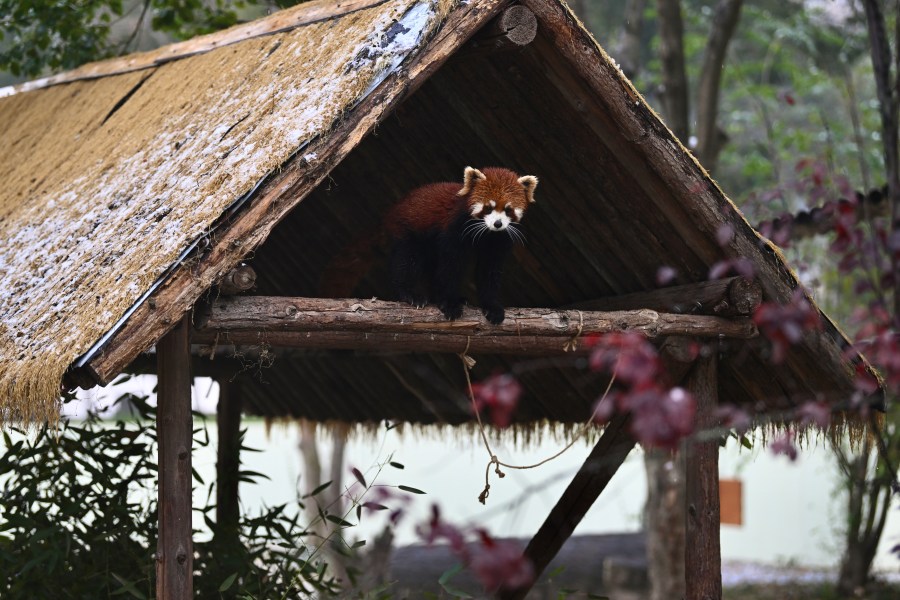
Mike Barnicle: Ambassador, what armed resistance could arise on the ground inside Venezuela? Story: It’s a great question. I’ve said for many years now that Venezuela is a failed state. I called Maduro the mayor of Fuerte Tiuna, the massive military base where he lived. You’ve got illegal armed groups across the territory. I don’t know the extent to which there’s going to be an internal struggle. But if the idea is that somehow the oil industry will boom and that will rebound positively for Venezuela, for the region, for the United States, then there are some fundamental questions that have to be answered — about stability and security, and also the rule of law and the independence of the Venezuelan judiciary. Barnicle: And if people don’t trust the courts and the system? Story: If it’s the same regime with a different leader, then what boardroom of a publicly traded oil company will invest in Venezuela? I’m skeptical. Joe Scarborough: Do you see any parallels with Iraq, or is this operation different? Story: I discount the idea that this can become another Iraq, Libya, Afghanistan, or Syria for a few fundamental reasons. There aren’t the ethnic or sectarian differences you had in Iraq. In fact, Cilia Flores and members of the democratic opposition went to school together. A lot of them are first cousins. You find some very strange bedfellows when you’re looking at the political elite on both sides of the spectrum in Venezuela. Scarborough: Will drug gangs try to fill the void left by this attack? Nicolás Maduro was given new American digs this weekend, courtesy of Donald Trump. The former Venezuelan dictator is now locked down at the notorious Metropolitan Detention Center in Brooklyn — the grim federal fortress that has, over the years, hosted a constellation of celebrities, politicians, and assorted miscreants. Famous inmates currently stuck inside the complex that advocates and judges have branded “hell on earth” include music mogul Sean “Diddy” Combs and disgraced R&B singer R. Kelly. Rappers Fetty Wap, Tekashi 6ix9ine, and Ja Rule have also done time in the Brooklyn iron-bar motel. Juan Orlando Hernández — the coke kingpin and former president of Honduras — was locked up at MDC on a 45-year sentence before Trump’s bizarre pardon of the drug trafficker. Luigi Mangione, the accused killer of UnitedHealthcare’s CEO, is also imprisoned there while awaiting trial. Convicted child sex trafficker Ghislaine Maxwell did hard time at the Brooklyn hellhole before being transferred to a Florida prison. Trump’s Justice Department then relocated Jeffrey Epstein’s partner-in-crime to a Club Fed-style minimum-security facility, complete with language and business classes, sports, television, religious services, and other privileges not afforded to inmates like Maduro and Combs. Maxwell’s move came after the sex trafficker was interviewed by Trump DOJ officials and claimed the sitting president had done no wrong while partying in Epstein’s smarmy orbit. A red panda forages on a snowy January day in Hefei, Anhui province, China. This has been The Tea, Spilled by Morning Joe. See you next time! Have more to say? Just write here.
Former Rep. Joe Scarborough, R-Fla., is co-host of MS NOW's "Morning Joe" alongside Mika Brzezinski — a show that Time magazine calls "revolutionary." In addition to his career in television, Joe is a two-time New York Times best-selling author. His most recent book is "The Right Path: From Ike to Reagan, How Republicans Once Mastered Politics — and Can Again." Recommended


Story: We can’t go through a de-Baathification process like we did in Iraq. You need a strong military and security service inside of Venezuela to handle that particular problem set. Of course, the country is riddled with violent gangs. I think the closest example is Panama, where, even after Operation Just Cause, you had several months of score settling among rival groups.EXTRA HOT TEA
ONE LAST SHOT
CATCH UP ON MORNING JOE


