









Word on the street is that Tuesday night’s State of the Union address is going to be heavily weighted toward the economy. That’s a good thing because the big speech comes at a bit of an economic turning point, one in which President Obama is well-versed.
The economy, writ large, is likely to do better this year than last. But the essential question at a time like this in an economy like ours, with such high levels of income and wealth inequality, is “whose economy are we talking about?”
The figure below helps orient the conversation and provides what I believe will prove a useful context for listening to the speech. It shows the trends in a few key variables over the course of the recovery (all are adjusted for inflation): GDP is up 10%, but corporate profits and the value of stocks are up much more, while median household income is down a few percent.
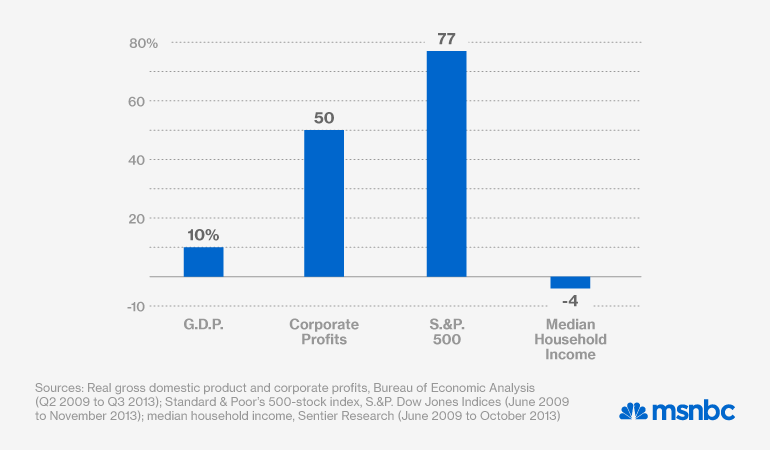
Clearly, this picture feeds directly in to the president’s inequality theme. It’s simply not enough to talk about macroeconomic growth; from the perspective of most working families. Such growth is necessary for their improved living standards but it is not sufficient. And that fact leads to the jobs agenda.
Both the quantity (labor demand) and the quality of jobs are very important right now for two reasons. First, there are those who will look at the first few bars in the figure above and conclude that we’re clearly on the mend so the president’s message should essentially be, “over to you, private sector…nothing more government can do to help.” I think that’s wrong, and incalculably more importantly, so does the president, I believe.
Second, in an economy where unions represent only about 7% of the private sector workforce, a tight labor market is just about the only way most workers can generate any bargaining power. As long as labor supply outpaces labor demand—as long as workers are chasing jobs versus jobs chasing workers—employers won’t face much pressure to boost compensation to get and keep the workers they need to remain profitable. One of the best ways to push back on rising inequality is to improve workers’ bargaining power through tighter labor markets.
The problem is what to do about it. With a cooperative Congress, there would be obvious policies to pursue. Infrastructure, like the FAST! program (Fix America’s Schools Today, a program to make the nation’s stock of public schools more energy efficient), a version of which has been part of the White House jobs agenda, would be a natural. Extending unemployment benefits would both address the still high levels of long-term unemployment and add a needed fiscal boost. A higher minimum wage would address the quality deficits in the low-wage sector of the job market, where much job creation has occurred.
But that’s not the hand the president has been dealt. He will surely discuss these policies, but the fact is he did so in last year’s State of the Union and they haven’t gone anywhere since. So he’s left with the a) bully pulpit and b) the “pen and the phone,” as he puts it (executive orders and cajoling of employers).
The latter tends not to be very effective. Employers are not philanthropists – they will try to restrain costs, including labor costs, in the interest of profitability. When not hiring means being unable to meet consumer demand and thus leaving money on the table, they’ll hire. Perhaps the president can nudge them to hire one type of worker over another (like the long-term unemployed). But the phone doesn’t do much for job quality or quantity.
The pen, on the other hand, is different. Here, there are two changes the president could announce tonight that could help significant numbers of workers.
The first is a high-road executive order (EO) regarding federal contracting. The feds buy half-a-trillion of goods and services each year, and there’s no reason they can’t have a say in the quality of jobs they’re helping to support with these contracts. When it comes to the low-wage labor market, shouldn’t the federal government be part of the solution rather than part of the problem? As it turns out, we’ve learned this morning that this is precisely one of the policies the president will announce tonight: an Executive Order to increase the minimum wage paid to workers on federal project to $10.10, which would then be indexed to inflation. It’s not a national increase in the minimum—that would take legislation. But it’s a smart plan to apply the federal proposal to workers on federal contracts, something the president can accomplish with an EO. My guess is that this move alone would lift the pay of hundreds of thousands of low-wage workers, like maintenance and food service workers in national parks, museums, and army bases. The second significant change the president could make with the pen is to increase the salary threshold under which workers get overtime pay, i.e., time-and-a-half after 40 hours. As described here by EPI’s Ross Eisenbrey, it’s a change with the potential to boost the pay of millions of workers currently ineligible for overtime pay, despite the fact that the spirit of the original law—the Fair Labor Standards Act—clearly intended that they should be covered. Of course, employers will protest the increase in labor costs, and one wants to be careful about implementing changes the increase the cost of labor, whether it’s overtime or minimum wages. But “careful” doesn’t mean ossified. It’s a solid and worthy cultural norm that if lower paid, non-supervisory workers work more than 40 hours in a week, they should get premium pay. The fact that the aforementioned salary threshold is not adjusted for inflation vitiates that norm. And by the way, there’s a simple way for employers to avoid paying more overtime: hire more workers, which helps to solve another problem. I fully expect the president to get up in Congress’s grill regarding the jobs and infrastructure bills they’ve blocked, at great cost to working families. But we can’t count on that moving them to act. That leaves changes the president can implement without them, and these two look to me like strong steps in the right direction.
Jared Bernstein was chair of President Joe Biden's Council of Economic Advisers. Recommended


