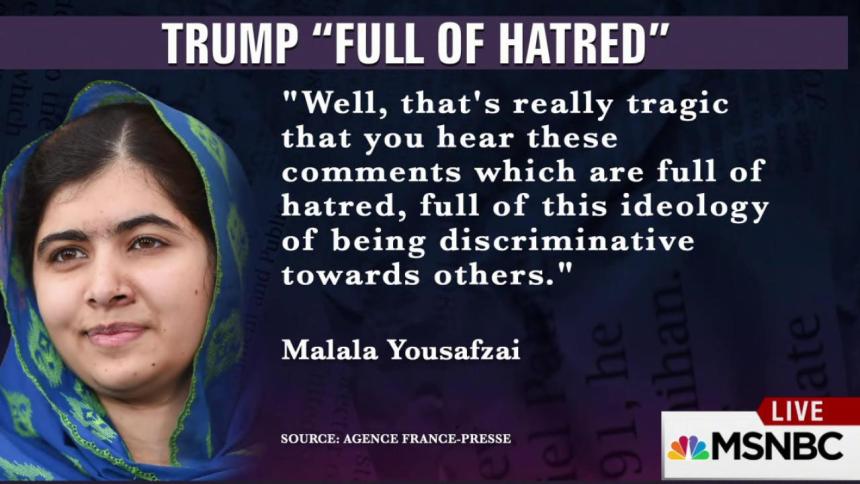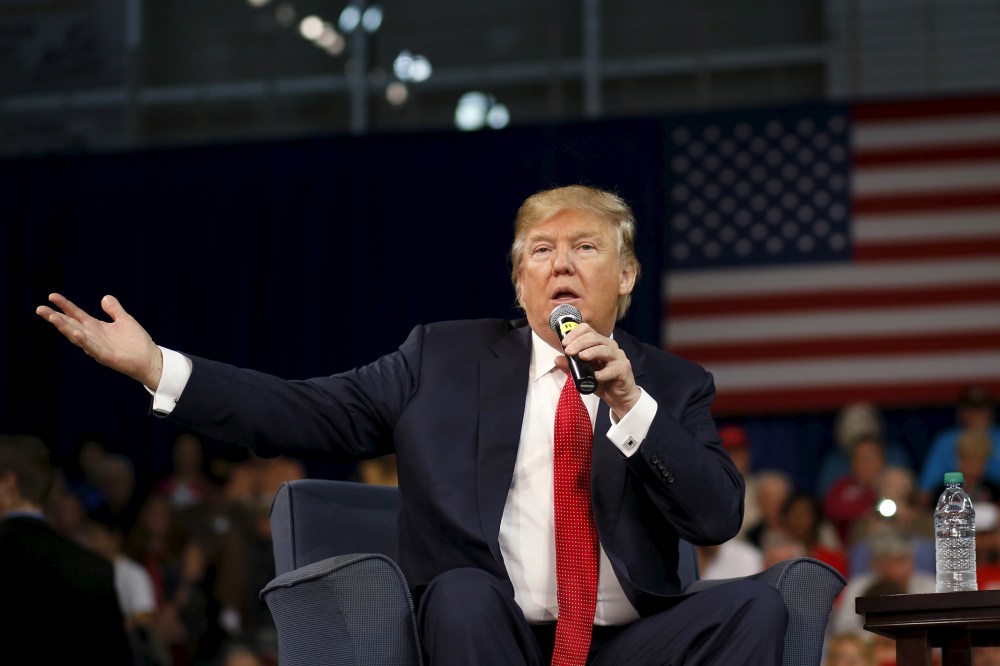
Donald Trump’s call to ban Muslims from entering the United States has been widely derided as discriminatory, hateful and unworkable – never mind illegal. Many legal experts have said it’s almost certainly unconstitutional.
According to several scholars surveyed by MSNBC, while foreign citizens do enjoy fewer rights than Americans, it is still illegal for the government to use a religious test on foreigners. The Constitution’s “bar against declaring an official religion” would apply to discrimination against non-citizens, argues Harvard law professor Laurence Tribe.
RELATED: Democratic candidates blast Trump’s Muslim ban at debate
The question has not been recently tested, however, because the federal government has not proposed open religious discrimination in a long time. In other words, there aren’t recent court precedents that undermine Trump’s proposal because no one with the power to try it has proposed that kind of federal discrimination in the modern era. And while many scholars say the Supreme Court would shoot Trump down, some have emerged claiming the plan could be legal.
Eric Posner, a professor at the respected University of Chicago Law School and specialist in executive power, says there is precedent to support a Trump-style ban on Muslim immigrants. He estimates the odds are about “50/50” that the Supreme Court would uphold Trump’s plan, were it ever enacted. Trump’s proposal is “just a terrible idea” that “violates important values” and does not “enhance security,” Posner says, but as a legal matter, it may be constitutional.
Posner discussed the legal issues in depth with MSNBC Chief Legal Correspondent Ari Melber:
Ari Melber: On what basis could this type of proposal be legal and constitutional?
Eric Posner: First, the immigration law delegates to the president extensive powers to exclude people who he thinks might threaten security, or any way might be detrimental to the interests of the United States.
Second, as a matter of Supreme Court precedent, the general rule — called the Plenary Power Doctrine — is that the normal, substantive, constitutional protections that we’re accustomed to do not, generally speaking, apply to the immigration context. For example, a domestic law that applied only to Muslims in some way – the [constitutional] rule against such a domestic law wouldn’t apply to an immigration law.
AM: Would that be the same then for race? Do you think the Supreme Court would uphold a proposal to only let in, say, white people into the United States?
AM: Do you think that this proposal would be upheld?
EP: Well I think it’s about 50/50. So in other words, if the Supreme Court just followed its precedents, it would uphold this proposal.
With gay marriage, [we saw] the Supreme Court change its view. I could imagine the court doing that. Part of what’s going on here is that most of these cases are pretty old, not all of them, but the most significant precedents go back to the first half of the last century, and earlier. So sometimes the Supreme Court changes its views.
AM: What about the view that regardless of executive immigration powers, a rule to pick one religion over another would flatly violate the Establishment Clause of the First Amendment?
EP: The problem is that people have made these arguments before about other clauses in the Bill of Rights, and even in the First Amendment, like the free speech clause. In the past, people have been excluded from the U.S. simply on the basis of their viewpoints. For example, people who are Marxists or Communists were excluded. Now, the government is not allowed to discriminate against people on the basis of their viewpoints if they are citizens — so the meaning of these rulings is that the Bill of Rights, the First Amendment, don’t apply to non-citizens, at least when they want to enter the country.
Now, it is true that Supreme Court has never approved a statute — held one way or another – that explicitly excluded people on the basis of religion. So it’s conceivable that they could say, “Well in decisions about whether non-citizens can enter the country, you can discriminate on the basis of speech or viewpoint, but not on the basis of religion.” I mean, they could say that, but I don’t see why they would.
RELATED: In debate, Trump’s controversial Muslim idea is virtually forgotten
AM: The court might be concerned that such a religious ban – excluding one major religion – is a potential endorsement to another religion or religions. To take it one step further, if the U.S. said they would only admit followers of one religion, then as a rule, you’re talking about an immigration power. But as a First Amendment issue, might that be seen as an endorsement of religion?
EP: It would be, but in these old cases by the Supreme Court, the court is saying the First Amendment doesn’t apply to immigration decisions, at all. Basically that is what they say. So if you interpret the cases as saying that, which is the most plausible interpretation, then those cases apply as much as the Establishment Clause [of the First Amendment] as to the other causes. AM: For the lay audience, what would your explanation be of the importance of the recency or antiquity of a precedent? Certainty going back before the Civil Rights era, old case law on Civil Rights isn’t very useful now. This particular issue has been less tested, because federal law on immigration, in the modern era, has not experimented with this kind of discriminatory or exclusionary clause. What would you explain to a lay person the issues of how recent a holding is and its power? EP: Well I think the Supreme Court does reflect the values of the public at any given time. So as public values change, so do the Supreme Court’s views. As a legal matter, the court is supposed to adhere to precedents in old cases, but from time to time it does depart from those precedents; it changes the law, because of changing values. That’s why its hard to make a prediction about what the court would do if Trump’s proposal actually became law and came before the court. I think it’s perfectly possible that people just take religious values much more seriously today than they did in the past. I would add also that in the past, although the Establishment Clause has been part of our law since the beginning, in the past there were all kinds of religious discrimination that was widely acceptable. There was discrimination against Mormons, and against Catholics, and against Jews. This discrimination was often embodied in the law, and it was just considered a part of political culture of the country. Today that’s changed. Religious values are much more powerfully entrenched in our political culture, and in the law, and so that’s why you could imagine the Court coming up the other way if this came up. EP: That’s a harder question. [Federal immigration law] does give the authority to the president to act on his own. He’s given just a tremendous amount of discretion to decide that certain classes of aliens are inadmissible. So he could do that. Now the question is whether the constitutional limits that we were talking about before might apply if the president acts alone. There’s a case that I quote called Kleindienst, which suggests that if the President is going to identify a class of people, it has to be bona fide and in good faith. So it is possible that a court could hold that excluding Muslims would not be bona fide and good faith. It’s possible that a court would say, “No, he can’t do this on his own.” I think that if he did do it on his own, he would have a colorable legal argument, but it’s less likely that he would succeed in Congress. AM: Lastly, you’re providing a legal analysis of the constitutionality and how courts might read this kind of proposal. Do you want to state any view on the wisdom or propriety of the proposal? EP: I think it is a terrible proposal, just terrible, for all the reasons people have been saying. I don’t think it would enhance security; I think it violates important values — political values and moral values — and I think it harms our relations with Muslim countries. It’s just a terrible idea.
Ari Melber
Ari Melber, an Emmy Award-winning journalist, writer and attorney, is the host of “The Beat with Ari Melber” airing nightly at 6 p.m. ET on MSNBC. He also serves as MSNBC’s chief legal correspondent and an NBC News legal analyst. Before joining MSNBC, Melber practiced First Amendment law and served as a legislative aide in the U.S. Senate. He received a J.D. from Cornell Law School and is a member of the New York Bar. Recommended