Billionaire venture capitalist Tom Perkins raised the Internet’s collective eyebrows last week when he said Americans who don’t pay taxes — he likely meant income taxes — shouldn’t get to vote. (It didn’t help that Perkins had recently compared efforts to fight inequality to Kristallnacht).
“The Tom Perkins System is: You don’t get to vote unless you pay a dollar of taxes,” Perkins said during a speech in San Francisco. “What I really think is, it should be like a corporation. You pay a million dollars in taxes, you get a million votes. How’s that?”
The audience laughed, and Perkins later implied he was being deliberately provocative.
But the “Tom Perkins System” has its roots in some long-standing conservative thinking about the purpose of voting. And versions of that thinking continue to play a role in today’s heated debates over voter ID and other restrictive laws.
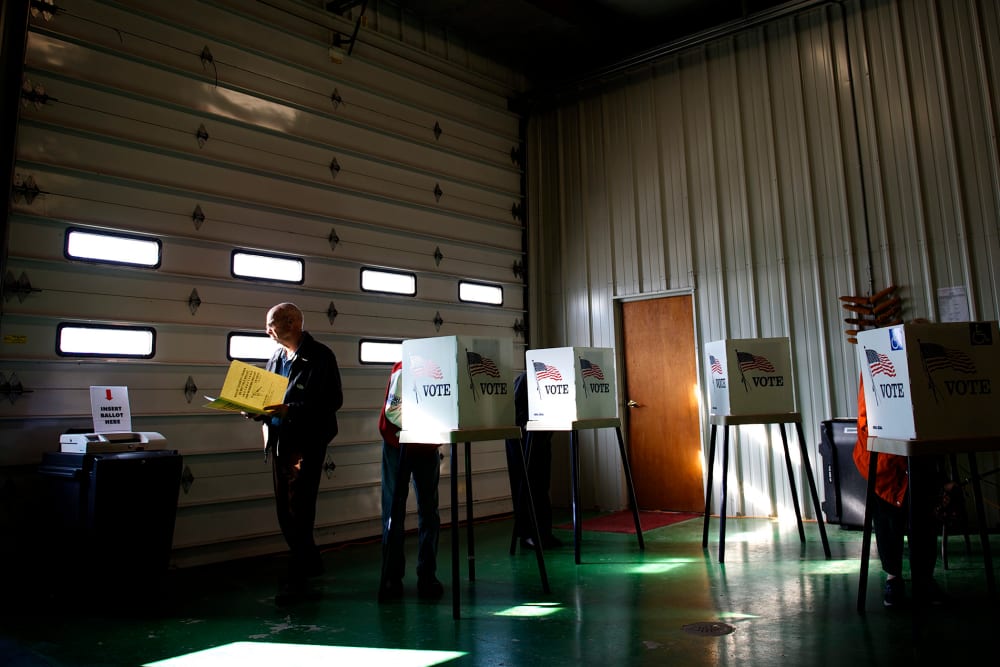
Progressives think of voting as a right. It’s the way a society of equals makes decisions. That’s why progressives generally see bringing new voters into the process as a good thing in itself. The more people involved, the more democratic the process, and the more legitimate the outcome.
But as the election law scholar Rick Hasen has written, many conservatives have tended to think about voting differently. For them, it’s a means to an end. And that end, an entirely reasonable one, is making an informed collective choice that will produce effective government and promote the common good.
That view of voting has deep roots in American history, scholars of U.S. democracy say. It’s how the citizens of the early Republic who gathered on village greens to vote in public, with the broad interests of the community uppermost in their minds, conceived of what they were doing. It’s no coincidence that of the 13 original colonies, the three most prominent — Massachusetts , Pennsylvania, and Virginia — to this day call themselves not states but commonwealths, political communities that were founded for the common good.
But from the start, that notion of voting for the common good paradoxically provided a rationale for excluding less-privileged groups from casting a ballot. In the years after U.S. independence from Britain, those who lacked property were barred from voting. The thinking went that non-property owners couldn’t be counted on to keep the common good in mind, and might sell their votes to the landowners on whom they depended.
By the 1830s, property-less white males were mostly enfranchised. But tax-paying requirements of the kind Perkins suggested followed in their wake for a while. And groups including blacks–not just slaves, but many who were nominally free–women, and later immigrants from eastern and southern Europe, would continue to be shut out in large numbers, with similar justifications used.
The historian Francis Parkman wrote in 1878 that a “New England village of olden time” could be “safely and well governed by the votes of every man.” But, he argued, this was no longer true now that those villages had grown into cities with “tenement-houses” and “restless workmen, foreigners for the most part.” For these people, Parkman wrote, “the public good is nothing and their own most trivial interests everything.” Under these conditions, “universal suffrage becomes a questionable blessing.” The passage is included in Alex Keyssar’s 2000 book The Right to Vote: The Contested History of Democracy in the United States, probably the most comprehensive historical look at the subject.
A related justification was offered for the literacy tests that were used against both immigrants in the north during the late 19th and early 20th centuries and blacks in the Jim Crow south: that only the literate can be informed enough to be entrusted with the vote.
One obvious weakness of this view is that it ignores the reality that different groups have different interests–the rich may benefit from the policies of one candidate, the poor from those of another. So there’s no “common good” that serves everyone equally. But this aversion to the idea of interests, too, has deep roots, historians say.

Americans have generally believed that this society–unlike the multiple nations of Europe–enjoys a basic consensus on values. For instance, people believe in the legitimacy of private property. A system that prioritized the idea of interests, the thinking goes, would be more likely to cater to extremists who might not share those same values. That’s one major reason for our two-party system: to marginalize the extremes.
These conflicts over interests versus the common good, and over a broad electorate versus an informed one, aren’t as neatly resolved today as they might appear, said Steven Mintz, a professor of history at the University of Texas at Austin who has written in depth about access to the vote through history.
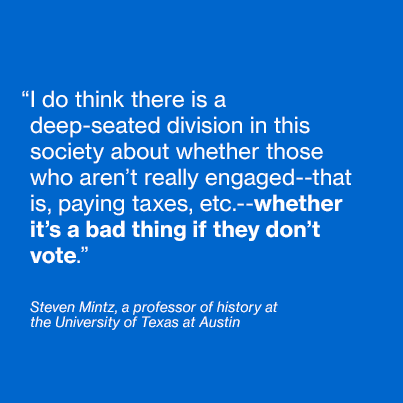
“I do think there is a deep-seated division in this society about whether those who aren’t really engaged–that is, paying taxes, etc.–whether it’s a bad thing if they don’t vote,” Mintz said. Some people think it isn’t so bad, he added, because those who are disengaged “would either vote out of ignorance or they would vote for extremist parties.”
It’s not hard to find examples of what Mintz is talking about.
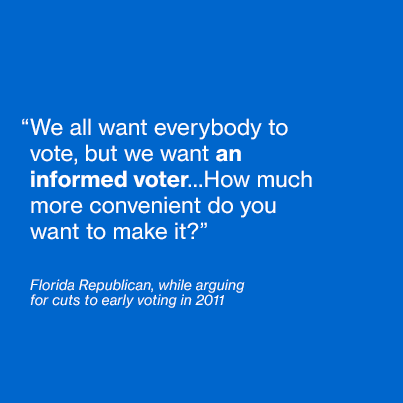
“We all want everybody to vote, but we want an informed voter,” one Florida Republican said while arguing for cuts to early voting in 2011. “How much more convenient do you want to make it?”
That’s not really a fringe position on the right.
“If you are having an intelligent conversation with somebody, is it enriched if a mob of uninformed louts, never mind ex-cons and rapists, barges in?” Jonah Goldberg, the prominent conservative opinion writer, asked in a 2005 Los Angeles Times column. “People who want to make voting easier are in effect saying that those who previously didn’t care or know enough about the country to vote are exactly the kind of voters this country needs now.” Goldberg has suggested giving new voters the same citizenship test—featuring questions about U.S. history and government—that new citizens must take. “We might get fewer voters, but the voters would be far more likely to appreciate the solemnity of their ballots,” he wrote. The conservative journalist Matthew Vadum has called government efforts to help the poor register to vote “like handing out burglary tools to criminals.” “Are we trying to destroy our society?,” Vadum asked in an interview with msnbc. “It’s a recipe for disaster to be trying to perpetuate government programs and growth in government spending, and to encourage greater government dependency.” Others who are skeptical of efforts to expand the franchise don’t go that far. But they clearly prioritize a well-informed electorate over a broad one. When a bipartisan presidential panel last month recommended expanded early voting as a way to make the voting process smoother, several conservatives–including Washington Post columnist George Will–offered a quick thumbs-down. Letting people vote before Election Day, they argued, deprives voters of the full information they need to make an informed choice. The off-setting value of making voting more convenient, thereby allowing more people to participate, went unconsidered. “Early voting means stubborn voters will make uninformed decisions prematurely,” wrote Christian Adams, a former Bush Justice Department lawyer and a supporter of restrictive voting laws. “Voting even one week early produces less-informed voters and dumbs down the electorate.” Of course, it’s one thing to want a better-informed electorate, and another to support a tax-paying requirement like the one Perkins floated, or the literacy tests favored by southern segregationists. But Mintz said he thinks those ideas are at least somewhat related. “That an informed, engaged electorate is a prerequisite for an effective democracy— I think that’s what connects them,” Mintz said. “Now, literacy tests are not permissible under the Constitution, so you can’t do it that way … But that principle of an informed electorate with a broad consensus of values–there are people who believe that, as opposed to just: ‘Everybody should be able to vote’.” Of course, it’s virtually impossible to disentangle philosophical principle from crass political or partisan advantage. Some see ideas about the common good and the value of informed voters–both in history and today–as not much more than sophisticated-sounding covers for efforts to reduce the power of people likely to vote in a different way from those in control. “If you want to bend over backwards, it’s correct to say that conservatives of different eras generally had reasonable-sounding rationales, which many of them actually believed,” said Keyssar, a history professor at Harvard University. But those rationales, he added, were “always serving other purposes at the same time.” “It’s always served to try to keep out of political activity the people whose interests were perceived to be in conflict, and/or people you didn’t trust, or people who you thought might be voting for the, quote, wrong people,” Keyssar said. “No one has ever disenfranchised upper-middle-class white males.”
Zachary Roth Recommended